Crude Oil, Maritime & Shipping, Wet Freight
February 28, 2026
FACTBOX: Oil markets braced as Iran confirms death of Supreme Leader Khamenei

By Staff
HIGHLIGHTS
Iran exported 1.3 mil b/d in Jan, mainly to China
Strait of Hormuz handles 20% of global oil supply
Updated March 1
Iranian state TV confirmed March 1 that Supreme Leader Ali Khamenei was killed in US and Israeli airstrikes. Iran has declared 40 days of mourning and seven days of public holiday following his death.
The oil markets will be weighing the impact of US and Israeli missile strikes on Iran on Feb. 28, which has provoked the Islamic Republic to retaliate against neighboring oil-rich Arab states in the Gulf. Flights have been canceled across the Middle East, including at the region's busiest airport in Dubai, after a day of airstrikes rocked the Middle East and caused damage to Kuwait International Airport and Dubai International Airport.
Oil shipping through the Strait of Hormuz declined after Iran claimed it had closed the major oil artery.
"Even if production and terminals remain intact, higher risk premiums, shipowner caution and delayed shipping fixtures can reduce delivered barrels, supporting higher risk premiums on the March 2 opening until maritime threats de-escalate," S&P Global CERA analysts said Feb. 28.
"Hormuz risk is not only about closure but also fleet productivity. If Iran escalates by seizing tankers or using drones to threaten commercial traffic, voyage times and possibly costs for Middle East oil exports would further increase," the analysts said.
Below are key facts being watched by the Platts news team, part of S&P Global Energy:
Prices
- Crude prices have climbed to seven-month highs over recent weeks and are up by over $12/b in the year to date, reflecting higher geopolitical uncertainty. Brent crude futures closed at $72.87/b on Feb. 27, after hitting an intraday high of $73.54/b earlier in the session, the highest since July 30, 2025.
- Platts, part of S&P Global Energy, assessed Dated Brent at $72.87/b on Feb. 27, up 2.9% on the day.
- A potential 1 million b/d supply disruption -- which corresponds to half of Iran's crude exports -- for 12 months would boost the fair value of oil by $8/b, according to Goldman Sachs analysts.
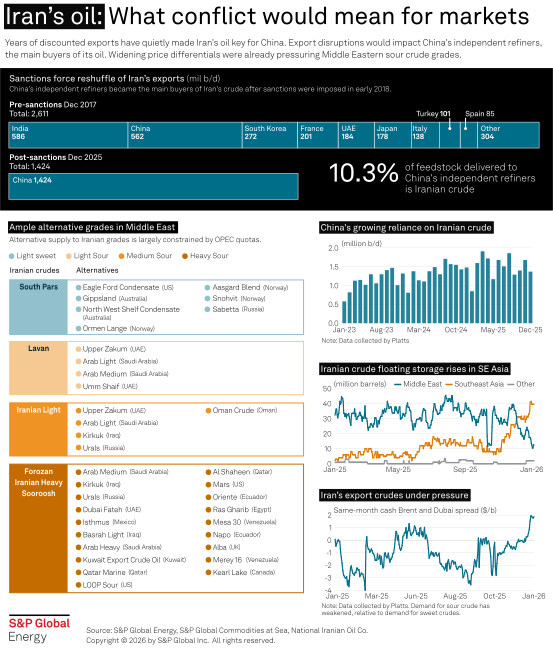
- The spread between same-month cash Brent and cash Dubai remains in positive territory, showing weaker demand for sour crude relative to weak crude. Platts assessed the spread at $1.13/b on Feb. 24.
- The UAE has set the May Dubai crude OSP at a 5 cents/b premium to the average May Oman futures settlement, up from a 30 cents/b discount for April.
- The April Brent-Dubai exchange of futures for swaps was pegged at $2.01/b on Feb. 24, up 17 cents/b over the same period.
- OPEC+ is scheduled to meet on March 1.

Trade flows
- Iran's state media said Feb. 28 that the Islamic Republic has shut the Strait of Hormuz, through which roughly one-fifth of the world's daily oil trade passes.
- The Strait of Hormuz area "showed an approximately 40% to 50% drop compared with earlier in the day, with vessels funneling toward the exit, suggesting that ships are racing to exit the area," S&P Global Commodities at Sea analysts said in a report on Feb. 28.
- UK maritime authorities on Feb. 28 warned shippers of "significant military activity in the following areas: Arabian Gulf, Gulf of Oman, North Arabian Sea and the Strait of Hormuz."
- The US Maritime Administration issued an advisory Feb. 9, warning US-flagged commercial ships transiting the Strait and Gulf of Oman to remain as far as possible from Iran's territorial sea "without compromising navigational safety."
- Iran produced 3.19 million b/d of crude in January, according to the latest OPEC+ survey from Platts. That month, Iran exported 1.3 million b/d, predominantly to China, according to S&P Global Commodities at Sea data.
- Chinese independent refineries cut their Iranian crude imports to 1.17 million b/d in January, down 14.4% from December.
- But over 2025, China's independent refineries raised their Iranian crude imports by 10.3% year over year to 1.5 million b/d, accounting for 35.6% of their feedstock share.
- Iranian crude volumes held in temporary floating storage in Southeast Asia had spiked above 89 million barrels at the end of 2025, a record level, according to CAS data. They have since dropped to 18 million barrels as of Feb. 23, within the long-term average.
- Similar grades to Iranian crudes include Saudi Arabia's Arab Heavy, Arab Light and Arab Medium; Iraq's Basrah Light, Basrah Medium and Basrah Heavy; Russia's Urals; the UAE's Upper Zakum; Oman Crude Blend; Kuwait Export Crude; Venezuela's Mesa 30 and Merey 16; and Mexico's Maya.
Infrastructure
- The authorities in Bahrain, Qatar and the UAE issued statements following Iranian counterstrikes on Feb. 28.
- Iran's oil export terminals at Kharg Island handle most of the country's crude exports, and damage to infrastructure there could significantly impact Iran's ability to generate revenue.
- Iran's Jask oil terminal bypasses the Strait of Hormuz and is connected to a 1,000-km, 42-inch pipeline able to transport heavy and medium crude oil from Goureh in the Bushehr province.
Israeli strikes in June 2025 damaged infrastructure at Iran's biggest gas field, South Pars. The field produced 725 million cubic meters/day late last year, which provided 75% of the country's total national supply.

Editor: