Crude Oil
February 25, 2026
Norway's Panoro to nearly double oil output with Equatorial Guinea deal

HIGHLIGHTS
Buys 40% stake in Block G from Kosmos
Deal hikes crude output by over 8,000 b/d
Country trying to revive flagging oil sector
Norway's Panoro Energy has agreed to buy a roughly 40% stake in Equatorial Guinea's Block G from fellow West Africa-focused player Kosmos Energy, in a "transformational acquisition" that will almost double its oil production.
In a statement on Feb. 24, Panoro said it was acquiring the Kosmos subsidiary that holds a 40.375% non-operated interest in the offshore license, which contains the producing Ceiba field and Okume Complex.
Oslo-listed Panoro already holds a 14.25% participating interest in Block G, which will rise to 54.625% upon completion of the deal, which is subject to regulatory approvals. London-listed Trident Energy is the operator of the block.
The transaction will add 46 million barrels of 2P reserves to Panoro's portfolio, and net working interest production of 8,271 b/d of crude, the company said, putting it "on path to achieve group net production of 20,000 b/d in 2027."
In an interview Feb. 25, Panoro's executive chairman, Julien Balkany, said the partners were eyeing a new drilling campaign on Block G in 2028, with technical work expected on the fields before then.
The agreed price of the transaction is $180 million, plus up to $39.5 million in payments contingent on production and price thresholds, according to the statement.
The acquisition "represents a rare and highly strategic opportunity to significantly transform the scale of and strengthen our portfolio, creating a materially larger, more resilient business," Balkany said in the company statement.
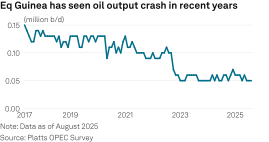
Equatorial Guinea has taken steps to revive its oil and gas sector in the past year after seeing crude production slide from 289,000 b/d in 2010 to 40,000 b/d in January, Platts, part of S&P Global Energy, reported Feb. 9. It is planning to hold a new oil and gas licensing round in April, Antonio Oburu Ondo, the country's hydrocarbons minister, said in September.
Balkany told Platts that the company was "very pleased" with the business climate in Equatorial Guinea, whose government is "very pro-business" and currently "encouraging foreign investment".
"Over the last decade oil and gas production has been coming down," said Balkany, adding that there is an awareness from the government of the need "to do something to turn it around".
Ceiba crude is medium sweet -- like the country's flagship Zafiro export grade -- and finds buyers in China, Spain and Nigeria, according to data from S&P Global Commodities at Sea.
Balkany added that Panoro is "totally open" to the possibility of partnering on the lifeblood Zafiro field, which ExxonMobil quit in 2024 and has since been handed to state-run GEPetrol.
Dallas-based Kosmos, which has assets across West Africa, from Senegal to Ghana and Gabon, as well as the Gulf of Mexico, will retain stakes in two exploration blocks offshore Equatorial Guinea, including EG-24, which it operates. Kosmos said the Block G deal was expected to close in mid-2026.
Production guidance
The deal came as Panoro announced its fourth quarter and 2025 results, with total oil production reaching 10,263 b/d in the year, a record high and up from 9,950 b/d in 2024.
The company is planning to start development drilling on its flagship Dussafu block in Gabon in mid-2026 and is "maturing" its Bourdon discovery in the country towards a final investment decision, it said.
In addition, it has "high-graded the existing Estrella discovery on Block EG-23 as a potential fast-track appraisal and development project that could be tied back to existing infrastructure."
Taking into account the acquisition, Panoro is guiding production of 15,000-17,000 b/d in 2026.
Revenues fell year over year to $217 million in 2025, the company said, from $285 million in 2024 amid sluggish crude prices over the year.
Balkany said the company's strong financial footing -- and support from investors proven by an oversubscribed bond issue launched on Feb. 24 -- meant it was in a good position for further M&A, but noted that Panoro will only pursue "accretive" deals with swift payback.
"We're open for business and to transact as long as it is at the right price," he said, noting the company's focus on prudence and capital discipline.
Unlike some of its peers, the company is "not highly leveraged", he said, therefore able to withstand a lower oil price environment.
When asked about potential future deals, Balkany said Panoro is open to opportunities in its current host countries Equatorial Guinea and Gabon, as well as regional players like the Republic of Congo and Angola.

Editor: