NGLs, Crude Oil
February 05, 2026
Shell promises spending cuts, oil and gas growth to tackle price weakness

HIGHLIGHTS
Upstream unit's output rises 60,000 boe/d from Q3
Forecasts Q1 2026 output in 1.7 mil-1.9 mil boe/d range
Company looking at Kuwaiti, Venezuelan opportunities
Shell's CEO Wael Sawan pledged to "focus on what we can control" after falling oil prices sent the company's revenues to four-year lows in the fourth quarter of 2025, promising to fix the company's chemicals business, cut spending and accelerate upstream production.
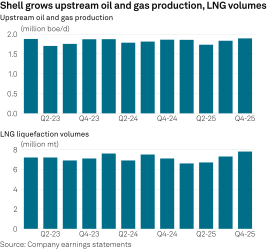
The international energy company's upstream oil and gas business produced 1.89 million boe/d in Q4 2025, 60,000 boe/d higher than Q3, it said Feb. 5, which CFO Sinead Gorman called a "strong quarter in the current price environment."
The fourth-quarter increase for the upstream unit was driven entirely by gas, where output grew 15% quarter over quarter. In Q1 2026, Shell expects the division to contribute roughly stable or lower production, within a range of 1.7 million-1.9 million boe/d.
Its separate integrated gas business, which includes LNG, grew production to 948,000 boe/d. LNG liquefaction volumes rose to 7.8 million metric tons, supported by record cargo deliveries in 2025.
Gains were driven by higher contributions from Brazil and the US, while final investment decisions for the company's Kaikias waterflood project in the Gulf of Mexico and 120,000 boe/d Orca project in Brazil, formerly Gato do Mato, should support future output.
Growth ambition
By 2030, Shell aims to add 1 million boe/d to its output by commissioning new projects, a quarter of which are already online, it said.
In Brazil, the company achieved first oil from its 180,000 boe/d Mero-4 asset this year, while Brazil's Atapu-2, due onstream in 2029, is projected to add some 225,000 boe/d of output.
In 2025, it pledged to invest an additional $20 billion in Nigerian deep-water oil production, acquired acreage in Angola and South Africa, and created the UK North Sea's largest independent producer through its Adura joint venture, in a bid to boost output.
Additionally, the company is also "looking with interest" at new opportunities in Kuwait after the country unveiled plans for a new bid round Feb. 3, and is "well positioned" in Venezuelan gas, Sawan said.
Yet with oil prices in decline and integrated gas results back at "pre-Covid levels," new spending will demand strict capital discipline and "tough choices" on loss-making assets, Sawan warned. "This is not an open bucket, 'let's go back to the swashbuckling days of exploration everywhere,'" he told investors.
After abandoning high-profile assets including a Rotterdam biofuels project and its Bukom refinery in Singapore, the company is prioritizing "fixing and repositioning" its chemicals business in 2026, Sawan said, promising to leave "no stone unturned" and scrutinize costs down to a unit-by-unit level. Chemicals plant utilization dropped to 76% in Q4, and is expected to stay below 87% in Q1.
In contrast, refining margins continued to perform strongly. Shell's indicative refining margin was $13.8/b in Q4, up from $11.6/b in the third quarter and more than double the previous year's level. Its refinery utilization averaged 95%, and is expected to be in the 90%-98% range in Q1 2026.
Earnings decline
Weaker oil prices and "a difficult macro" took a toll on profits, leaving adjusted 2025 earnings 22% below the previous year at $18.5 billion, the company reported.
Adjusted earnings fell to $3.3 billion in the fourth quarter, from $5.4 billion in the third quarter, mostly due to losses in marketing, chemicals and products, and an $800 million spend on carbon emissions certificates and biofuel programs.
The results fell short of an analyst poll compiled by Shell that had projected its Q4 profit at $3.5 billion, and pushed full-year revenue to its lowest level since 2021.
Since 2022, the company has reduced costs by $5 billion, and has identified "a few hundred million" worth of further reductions, promising "more to come" on spending cuts.
Planned capital expenditure for 2026 is $20 billion-$22 billion, consistent with 2024-25 levels. It remains focused on preparing for "countercyclical opportunities," meanwhile, should falling prices trigger new asset sales.
In 2025, Brent oil prices dropped to $69/b from $81/b, while Shell's realized liquids price was $59/b in the fourth quarter. It assumes a $70/b average price through 2035.
The company's oil outlook broadly aligns with the long-term view of analysts at S&P Global Energy CERA, who see Brent oil prices averaging $59/b in 2026 and $73/b between 2025 and 2035. Platts, part of S&P Global Energy, assessed the Dated Brent benchmark at $69.82/b on Feb. 4.

Editor: