Crude Oil, NGLs
January 29, 2026
Venezuela's oil industry could recover by 2030 with US supervision, reforms
By Eamonn Brennan and Mery Mogollon
HIGHLIGHTS
Current investment climate worst in world: S&P Global Energy CERA
US oversight, stability to provide short-cycle business
Long-term recovery hinges on political, legal system overhaul
Venezuela's oil and gas landscape is currently the world's least attractive, but its industry could make some recovery by 2030 if US supervision leads to improved infrastructure and legal reforms, an S&P Global Energy CERA analysis found.
The report, "Venezuela: Outlook for rebuilding a failed petro-state," ranked Venezuela last out of 112 rated jurisdictions for the attractiveness of its oil and gas investment climate. The country is "characterized by a capacity-depleted national oil company (NOC), dilapidated infrastructure, a lack of contractual sanctity, widespread corruption and violence against oil sector personnel and facilities," the analysts wrote.
Those characteristics -- the same ones American Petroleum Institute CEO Mike Sommers has described as barriers to widespread investment by upstream US oil and gas companies, and that ExxonMobil CEO Darren Woods called "uninvestable" at a Jan. 9 White House meeting -- will complicate US President Donald Trump's goal to recover Venezuelan production after the arrest of President Nicolás Maduro.
But sustained US intervention could enable "short-cycle business opportunities," laying the groundwork for broader reforms and enabling medium-term production growth, the report projected.
"By 2030, Venezuela is forecast to rank in the top 60% of rated jurisdictions in our index," the analysts wrote. "Improving above-ground conditions are anticipated to enable an increase in liquids production from 800,000 barrels/day in 2025 to approximately 1.5 million b/d by 2030," requiring an annual average of about $3.2 billion in investment.
Petro-state priorities
Veterans of Venezuela's oil sector have told Platts, part of S&P Global Energy, that short-term improvements to the investment environment -- including elements of a new hydrocarbons law advanced by Interim President Delcy Rodriguez -- are the fastest way to improve economic conditions and spur broader support for US supervision.
"For now, what is important is that Venezuela be able to provide legal certainty and the necessary conditions to attract as much investment as possible and increase production as quickly as possible," Jose Toro Hardy, former director of PDVSA, said. "New investments would have an immense multiplier effect on the entire Venezuelan economy."
Experts and the Trump administration have said they expect the most immediate investment to come from Venezuela's already producing fields by companies like Chevron that have maintained a presence amid longstanding US sanctions.
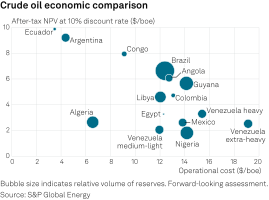
Among the reforms that could yield greater short-term interest, even in producing fields, are reductions in operational costs and government take rates. Those costs have made the net present value of Venezuela's current assets less competitive than other African and Latin American fields with at least 100 million barrels of remaining reserves, the report found.
On Jan. 28, at a hearing before the US Senate Committee on Foreign Relations, Secretary of State Marco Rubio praised Rodriguez's government for its new hydrocarbons law, which Rubio said "basically eradicates many of the Chavez-era restrictions on private investment in the oil industry."
"It probably doesn't go far enough to attract sufficient investment, but it's a big step from where they were three weeks ago," Rubio said.
Stability, then change
Rubio, echoing recent comments made by US Energy Secretary Chris Wright, told the Senate committee the Trump administration's number one priority after Maduro's capture was "stability." The US has leveraged its naval blockade over Venezuelan shipping to control and market exports, placing revenues from sales in US-controlled accounts and distributing them back after approving monthly budget requests from the government in Caracas, which has thus far cooperated with US oversight.
Roughly 17.6 million barrels of Venezuelan crude have been exported so far in January, with 8.9 million barrels headed to the US, according to S&P Global Commodities at Sea data.
In the long term, the US wants Venezuela to transition to a more open, market-oriented economy, with a democratically elected government, Rubio said.
While the US has not pledged to provide security guarantees to US companies, the potential stability provided by the current strategy -- with a functioning central government, no civil war, and the ability to restrain criminal violence against the oil sector -- gives the South American country a chance to recover more similarly to Iraq than Libya, the CERA analysts wrote.
In 2003, before former president Hugo Chavez nationalized its oil industry, Venezuela produced around 3 million b/d. That same year, when the US invaded Iraq and overthrew Saddam Hussein, Iraq and Libya both produced around 1.4 million b/d. Iraq is currently producing around 4 million b/d, while ongoing political chaos in Libya has reduced its output to about 1 million b/d.
Any sustainable, long-term recovery will hinge on significant changes to the Venezuelan political and legal system. Juan Fernandez, a Florida-based oil analyst and advisor to Venezuelan opposition leader Maria Corina Machado, told Platts a new hydrocarbons law "could be a step in the right direction," but won't be enough on its own.
The law is being debated in Venezuela's parliament on Jan. 29.
"The growth of Venezuelan oil production in the medium and long term depends on major legislative changes and recognition of the need for a change of government, without which the objectives sought by (Trump) will not have the desired result," he said.
The CERA analysis also forecasts long-term political change as crucial to Venezuela's hopes of eventually exploiting its 300 billion-barrel reserves. Key "watchpoints" for investors will include the removal of military leaders from involvement in key economic sectors, the replacement of oil workers' union leadership, the appointment of non-political technocrats in petroleum institutions, the creation of a new electoral institute staffed by independent observers, and whether a free, fair election is held by the time Trump leaves office in 2029.
"To unlock large long-term upstream projects, investors require more certainty, which can only result from the current regime transitioning toward a relatively autonomous government that embraces a rules-based pro-market economic model and is committed to fostering productive relations with foreign investors," the analysts said. "Achieving this outcome will take longer than the remaining three years of the Trump presidency, but the Trump administration is expected to accomplish important milestones toward this end before leaving office."

Editor: