29 Jan 2020 | 22:45 UTC New York
Factbox: Commodity markets assess coronavirus impact on demand as airlines curtail flights

Commodity markets continued to assess the impacts of the coronavirus outbreak Wednesday on global demand, especially for jet fuel as airlines were curtailing flights into and out of China.
Key international airlines including British Airways, Lufthansa, American Airlines, United Airlines, Swiss International Air Lines and Austrian Airlines, suspended or reduced flights due to the outbreak.
The virus has now sickened more than 6,100 people globally, with cases emerging in the US and Europe, while the death toll across China has climbed to 132, according to CNBC.
As a result of the spreading virus, S&P Global Platts Analytics updated its scenarios for the global impact on oil demand.
"In worst case, due to travel curtailments, demand drops by a massive and almost catastrophic 2.6 million b/d in February and 2 million b/d in March," said Claudio Galimberti, the head of demand, refining and agriculture analytics for Platts Analytics. "In best-case, it drops by 900,000 b/d in February and 650,000 b/d in March."
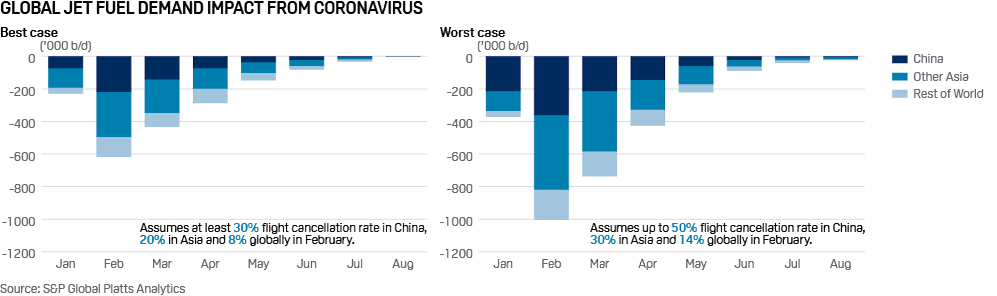
The Platts Analytics best-case scenario shows global jet fuel demand declining by 618,000 b/d in February, while its worst-case scenario shows a decline of 1 million b/d.
"Crucially, both scenarios are assumed to be short-lived, as this is a common trait with the overwhelming majority of the epidemic outbreaks. Therefore, we assume the impact will fizzle out by June-July," Galimberti said.
Click here for full-size image

Prices
Oil
**Dated Brent crude prices edged 16 cents higher to $59.43/b Wednesday, according to S&P Global Platts assessments. Still, that was down $4.99 since January 20.
**US spot jet fuel prices weakened on news of the flight curtailments. The Gulf Coast benchmark surpassed six-week lows, assessed by Platts at NYMEX March ULSD futures minus 10.35 cents/gal, down 1.10 cents on the day.
**Los Angeles jet fuel prices fell 1.50 cents to be assessed at March ULSD futures plus 3.25 cents/gal. New York jet fuel for Buckeye Pipeline was down 0.50 cent, assessed at February futures minus 0.65 cent/gal.
**The Singapore jet crack spread against Brent ended Wednesday at $10.20/b, up from $8.88/b Tuesday, but down from $11.34/b January 20, Platts data shows.
**The Rotterdam jet fuel crack against Brent ended Wednesday at $12.58/b, down from $14.17/b January 20, while the US Atlantic Coast crack ended at $12.06/b, down from $14.18/b January 17.
Metals
**The London Metal Exchange three-month copper price ended $23 lower Wednesday at $5,722.50/mt. That was down $548, or 9%, from January 20. Copper is often seen as a barometer for global economic health.
**Although a rebound in equity markets stemmed copper's losses to some extent, China's current struggle with the coronavirus is shaking confidence in copper demand prospects.
Agriculture
**The S&P Global Platts SOYBEX FOB New Orleans price assessment for nearby delivery has fallen $8.46/mt since January 21 to $350.35/mt Wednesday.
Trade Flows
Oil
**Key international airlines including British Airways, Lufthansa, American Airlines, United Airlines, Swiss International Air Lines and Austrian Airlines, suspended or reduced flights due to the outbreak.
**Platts Analytics best-case scenario shows a drop of 900,0000 b/d in oil demand for February, and a 650,000 b/d decline in March.
**Platts Analytics worst-case scenario shows a drop of 2.6 million b/d in oil demand in February, and a 2 million b/d decline in March.
**Platts Analytics best-case scenario shows global jet fuel demand declining by 618,000 b/d in February, while its worst-case scenario shows a decline of 1 million b/d.
**In its best-case scenario, Platts Analytics assumes an almost complete shutdown of Hubei province's transport, but - significantly - little else in China's road transport, for February and March. It also assumes the aviation business will be severely curtailed in China and, to a lesser extent, the rest of Asia over the same period.
**In its worst-case scenario, Platts Analytics assumes the whole of China's road transport system will be vastly reduced, with up to 23% of passenger and freight trips being canceled across the country in February. It also assumes China's aviation demand will drop by an unprecedented 50% in the same period.
**The jet market is currently subject to a number of bearish factors. It is in a period of low demand and the upcoming refinery turnaround schedule that usually tightens the market is expected to be smaller and more spread out than usual, limiting its bullish impact.
**The US is well supplied with jet fuel. Inventories at 42.79 million barrels the week ending January 24 were 1.9 million barrels above the five-year average, US Energy Information Administration data shows.
**Oil product stocks in the Middle Eastern hub of Fujairah climbed to a five-week high Monday, led by a surge in jet fuel and other middle distillate stocks, data released Wednesday by the Fujairah Oil Inventory Zone showed.
**Industry experts and market analysts have recently revised down their forecasts for China's refinery throughput in February and March by 600,000 b/d to 1 million b/d, with crude oil imports set to slow down accordingly in April and May.
**China's gasoline demand may also register a year-on-year decline in Q1 as the central Hubei province, where Wuhan is located, is considered one of the major transportation hubs along the Changjiang River.
**OPEC is in discussions to bring forward its scheduled March 5-6 meeting as the oil market continues to be buffeted by the impacts of the coronavirus outbreak. OPEC is considering deeper oil-production cuts, or extending its current supply curbs beyond their March expiry.
Metals
**Ports in Hubei province, a major Chinese steelmaking hub, have been closed, hampering both iron ore imports and steel exports, and many cities have delayed a restart of construction until further notice.
**China is the world's biggest steelmaker, producing 996.3 million mt of crude steel in 2019, up 8.3% on 2018 and accounting for 53.3% of global output, a growing share, according to the World Steel Association.
**China's struggling auto sector is likely to take a further hit from the effects of the coronavirus.
**China's auto sector accounts for around 6% of the country's total steel consumption, Platts estimates. The China Iron & Steel Association has forecast that China's total steel consumption will grow by 2% this year to just under 890 million mt.
**The association has predicted that China's passenger car production and sales will decline by 2% this year, which would mark the third consecutive year of declines in the sector.
**A temporary fall in Chinese steel production and demand due to the outbreak and related restrictions could lead to higher steel production elsewhere and a buildup of inventories that may weigh down global steel prices, according to analysts at brokerage firm Jefferies.
**A South Korean mill source said production cuts may help Chinese mills maintain steel prices.
**China is the world's biggest iron ore consumer, taking more than half of seaborne supplies.
Agriculture
**The virus has been bearish for US agriculture markets, as they were already uneasy about the enforcement mechanism in the US-China trade Agreement.
**Restricted travel is having a bigger impact on energy than agriculture, although food supplies are starting to dwindle given the lack of transport.
**Analytics expect longer-term effects should be negligible as China's hog herd is in the midst of being restored.