Crude Oil, Refined Products
January 21, 2026
US Gulf Coast refiners seen benefiting from increased use of heavy Venezuelan crude

HIGHLIGHTS
Current US refiner buyers can increase Venezuelan crude runs
More Venezuelan crude impacts global heavy crude dynamic
Refiners see opportunities with increased diluent needs
Some US Gulf Coast refiners are moving forward on US President Donald Trump's promise to direct Venezuela's heavy crude barrels away from China and into their cokers, increasing utilization and improving overall refinery economics.
Venezuelan crude exports to the US are seen picking up from the most recent Energy Information Administration monthly data, which shows Venezuelan crude exports averaging 135,000 b/d in October 2025, down from the 295,000 b/d in October 2024.
"We estimate that PADD 3 refiners would be able to absorb an additional 300,000-400,000 b/d of heavy Venezuelan crude to raise coking utilization to 2024 levels," according to a December report from S&P Global CERA.
"As PADD 3 crude runs are already near recent historical highs, this would likely result in US-origin light, sweet barrels being backed out and having to clear to the export market," the report added.
However, not all US refiners were as enthusiastic about Venezuelan heavy crude as President Trump, due in part to a checkered history between Venezuela and US oil companies.
ExxonMobil CEO Darren Woods's reserved demeanor at US President Donald Trump's Jan. 9 meeting with oil executives was no surprise. For Woods, the prospect of rebuilding Venezuela's shattered oil industry is fraught with history: ExxonMobil has been forced out of the country twice—most notably in 2007, when Venezuela nationalized the company's 42% stake in the Cerro Negro oil project.
And from a refining point of view, ExxonMobil also appeared to have soured on running Venezuelan crude. On Nov. 1, 2015, ExxonMobil along with its Venezuelan joint-venture partner PDV Chalmette, sold the Chalmette, Louisiana, refinery to PBF Energy. PBF's then CEO, Tom Nimbley, speaking in Sept. 2016 at a Barclays conference, said the refinery had a lot upside, but noted "dysfunctionality" on refinery operations.
"It was clearly being impacted significantly by a broken marriage, a joint venture between ExxonMobil and PDVSA that simply was not functional....", he said.
PBF's Chalmette purchase included 40,000 – 60,000 b/d of Venezuelan crude. But, in 2017, even before US sanctions, PBF stopped importing Venezuelan crude over a clash in terms as the cash-strapped producer began asking for cargo prepayment on the crudes.
In 2015, PBF imported 22,449,000 barrels of Venezuelan crude or just over 61,000 b/d and in 2024, PBF imported about 5 million barrels of Venezuelan crude or about 14,000 b/d, Energy Information Administration data showed.
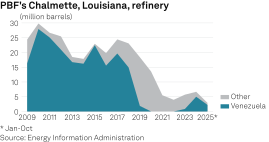
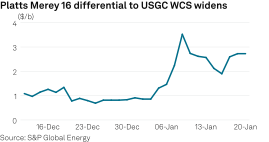
However, Chalmette, along with other US refiners that have processed Venezuelan crudes, including ExxonMobil at its Baytown and Baton Rouge facilities, have the ability to increase throughput.
USGC prime destination for Venezuelan crude
The USGC refineries have always been a good fit for Venezuelan crude. In addition to Venezuelan Citgo's US three refineries, refineries like Chalmette and the now-shuttered LyondellBasell Houston plant were built to run Venezuelan crude, given its ample supply and favorable logistics.
Rebuilding the country's oil infrastructure would allow some refiners to increase their runs of the heavy crude back to pre-sanction levels as the US takes charge of directing crude exports away from China.
Over the past four weeks, Venezuela exported just about 14 million barrels of crude, according to S&P Global Commodities at Sea.
Of all crude exported from Venezuela between Dec. 28, 2025 and Jan. 20, 2026, about half went to the US refiners almost totally on the US Gulf Coast.
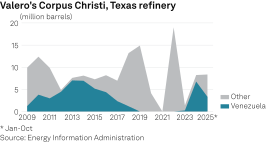
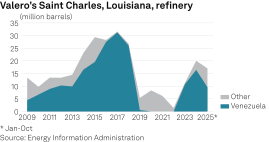
During this four week period, Corpus Christi, home of Valero's Christi refinery, received 1.2 million barrels of Boscan while Valero's St. Charles refinery, received 500,000 barrels of Hamaca, and Freeport, Texas saw 1 million barrels of unspecified crude grade.
Chevron's Pascagoula, Mississippi, refinery received just under 900,000 barrels of an unspecified crude grade in this time frame, while a cargo of over 600,000 barrels Merey 16 was seen going Chevron's Richmond, California, which serves the San Francisco Bay-area.
As the only US holder of approved Venezuelan production, Chevron produces about 250,000 b/d of crude in the country. Chevron produces oil from several Venezuelan holdings, including the Orinoco belt in Eastern Venezuela as well as the Boscan field in Western Venezuela. Its US exports go primarily to its 356,440 b/d Pascagoula, Mississippi, refinery.
In 2024, the Pascagoula refinery imported about 18.8 million barrels of Venezuelan crude, or about 40% of its total heavy crude imports, according to EIA data.
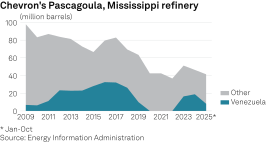
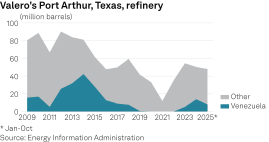
While China was the largest importer of Venezuela's crude in 2024, Valero was the largest US importer. And the second-largest US refiner is looking to expand to run more Venezuelan crudes, according to CEO Lane Riggs' remarks during the Jan. 9 meeting with US President Trump.
In 2024, Valero imported just over 37 million barrels or just over 100,000 b/d, according to EIA data. Most of Valero's Venezuelan crude goes to the 215,000 b/d Saint Charles, Louisiana, refinery – which in 2024 took just over 16 million barrels or about 45,000 b/d. In Texas, Valero's 380,000 b/d Port Arthur and 290,000 b/d Corpus Christi plants imported just over 20 million barrels or just under 57,000 b/d of Venezuelan crude in 2024.
Riggs gave no additional information during the meeting as to how he would expand refining for Venezuelan crude, and if those plans included increases in actual refining capacity or just increased Venezuelan refinery runs. A company spokesperson was not immediately available to comment.
Phillips 66 also processes Venezuelan crude at its two US Gulf Coast refineries and is happy to increase runs, according to CEO Mark Lashier, speaking at a Jan. 6 Barclay's conference.
"Specifically for Venezuela crudes at those facilities, it's somewhere in the order of a couple of hundred thousand barrels per day that we could process if the crudes are available and the economics are there to support it," he said, which would be an increase over recent Venezuelan throughputs.
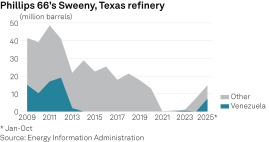
The Sweeny, Texas, plant in 2024 processed 8.8 million barrels of heavy Venezuelan crude, or just under 25,000 b/d, up from the 2.454 million barrels in 2023. Sweeny recently completed a crude flexibility project, allowing it about 40,000 b/d of capacity to switch between sweet and heavy crudes based on economics.
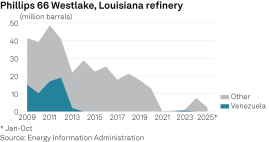
At its Lake Charles, Louisiana, plant, Phillips 66 imported about 7.7 million barrels of heavy crudes in 2024, though none from Venezuela.
Phillips 66 imports a lot of heavy sour crude into the Midwest – one of its best-performing regions – bringing in about 500,000 b/d of Western Canada Select and the company sees that increased flows of Venezuelan crude will impact the whole heavy crude dynamic.
"So across the system, where we're running about [500,000 b/d] of heavy crudes, you'd expect to see that benefit flow up through the consumption we have in the Mid-Continent where we're currently a heavy buyer of Western Canadian crude," he said.
However, China, denied heavy Venezuelan crude barrels, is likely to increase shipments of WCS and other heavy flows from Canada's TMX pipeline.
Phillips 66 has another upside with increased diluent requirement needed to blend with the viscous, heavy Venezuelan crude in order to transport it.
"We've got opportunities to export C5s back into Venezuela if that opportunity exists," Lashier said, referring to light naphtha is used as a diluent.
Lashier sees, in the longer term, the potential for growth.
"Venezuela was producing 3 million b/d of heavy crude. We've got refineries designed for the long term to process that crude. But it's going to take a lot of investments by the upstream folks over years, if not decades, to realize the full potential," he said.

Editor: