Crude Oil
January 21, 2026
Oil market balanced in December but supply glut still likely: IEA

HIGHLIGHTS
Production down 900,000 b/d from September high
Supply glut to peak at 4.5 million b/d in Q2 2026
2026 demand growth revised higher for third month
Falling output saw the global oil market briefly return to equilibrium in December 2025, but bloated inventories and new supply injections continue to steer the world toward a major supply glut in the coming months, the International Energy Agency reported Jan. 21.
The Paris-based IEA, which advises its membership of OECD countries on climate policy, has consistently warned of a major global supply imbalance in 2026 as surging production from the Americas is expected to increasingly outstrip expected demand.
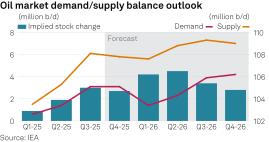
In its first monthly oil market report of 2026, the agency projected some 2.5 million b/d in global supply growth for the year ahead, lifting its previous forecast by 100,000 b/d. Its outlook puts full-year production at an average of 108.7 million b/d, with gains driven almost exclusively by the Americas quintet of the United States, Canada, Brazil, Guyana and Argentina,
In contrast, demand is on track to average 930,000 b/d annual growth in 2026, rising from an estimated 850,000 b/d in 2025, the IEA said. Its new report upgrades expected consumption for a third consecutive month and adds 70,000 b/d to its last 2026 growth forecast.
The new forecast falls short of the 1 million b/d of oil demand growth forecast for 2026 from analysts at S&P Global Energy CERA, which estimate that last year's consumption grew by 700,000 b/d.
Nevertheless, the IEA outlook issues a consistent warning of a heavily lopsided market in the year ahead, despite supply and demand roughly matching in December.
After global production slid for a third consecutive month, the agency cut its Q4 2025 surplus from 3.1 million b/d to 2.7 million b/d. Nevertheless, steady gains are expected to tip the market into a peak supply overhang of 4.5 million b/d in Q2, according to the new forecast.
Production drop
Falling oil production in December "continued to chip away" at a global surplus that had accumulated over the past year, as output fell by 900,000 b/d from September's record high, the agency said, but is unlikely to alter structural capacity gains.
Global oil production fell by 350,000 b/d on the month to 107.4 million b/d, the IEA said, driven by Middle Eastern declines and a 200,000 b/d slump in Kazakh supplies due to ongoing disruptions at its damaged CPC terminal.
Sanctions pressure on Venezuela and Iran both pushed output lower, while future export trajectories remain a point of uncertainty amid recent geopolitical upheavals.
The US blockade of sanctioned Venezuelan oil tankers pushed exports from 880,000 b/d to roughly 300,000 b/d in early January, the IEA said. It left its Venezuelan production outlook otherwise unchanged, adding that it "is still too early to assess" the longer-term impact of subsequent upheaval through US military intervention in the country.
The monthly declines were more than enough to offset rising Russian output, which rebounded by a massive 550,000 b/d from November levels to hit a 33-month high, despite ongoing Ukrainian attacks that have increasingly targeted its upstream infrastructure.
Demand recovery
The IEA expects steady gains in global oil demand amid a "normalization of economic conditions" after the shock of US tariffs in 2025, with gains led by jet fuel and petrochemicals.
Oil consumption held up better than initially projected after President Donald Trump announced sweeping tariffs on most US trade partners in April, which saw the IEA immediately cut its 2025 growth forecast from over 1 million b/d to 730,000 b/d.
However, growth ended up in line with the 1 million b/d outlook, according to the latest IEA estimates, which see consumption increasing by similar levels in 2026 despite a subdued start to the year.
China will remain the lead growth driver with an additional 180,000 b/d of demand in 2026, and propped up December consumption with an apparent return in stockpiling activity. Indian consumption is set to grow by a similar volume to China in 2026, recovering from a 120,000 b/d increase but markedly below its 230,000 b/d of growth in 2024.
Stock surplus
Seasonal refinery maintenance is expected to produce a 1.7 million b/d drop in global crude runs from December to March, potentially exacerbating a "hefty surplus" in crude stocks that have accumulated in the past year.
Crude oil accounted for 96% of the 2.5 million b/d increase in observed global oil inventories in November, while preliminary December data shows further stockbuilds led by products.
In a departure from recent trends, however, oil showed signs of clearing from tankers to inland storage, with inventory gains led by a 64 million barrel increase in onshore stocks. In comparison, oil on water gained by 11 million barrels, of which the majority was sanctioned Iranian, Russian and Venezuelan crude in floating storage.

Editor: