Crude Oil
January 09, 2026
Oil executives make diverging pledges to Trump on Venezuelan investment
By Kate Winston and Eamonn Brennan
HIGHLIGHTS
Chevron able to boost oil production by 50%
Repsol ready to triple oil production
Venezuelan oil in process of being exported
US and international oil executives offered differing pledges on investing in Venezuela's oil industry during a Jan. 9 White House meeting with President Donald Trump, with some promising rapid increases in production and presence, after the US' Jan. 3 seizure of Venezuelan President Nicolás Maduro.
The Trump administration will decide which companies will be allowed to develop Venezuelan oil resources .
"We're going to be making the decision as to which oil companies are going to go in, that we're going to allow to go in, going to cut a deal with the companies," Trump said. "We'll probably do that today or very shortly thereafter."
Energy Secretary Chris Wright and Interior Secretary Doug Burgum will work on the deals, Trump said.
Oil companies will have total safety and security, Trump said, as he pledged security guarantees to the companies without offering details or pledging to put US troops in the country to secure projects. He also stated that it was US policy to prevent Russia and China from developing projects in the country, but those countries could still purchase crude exports.
"It's a whole different Venezuela," he said.
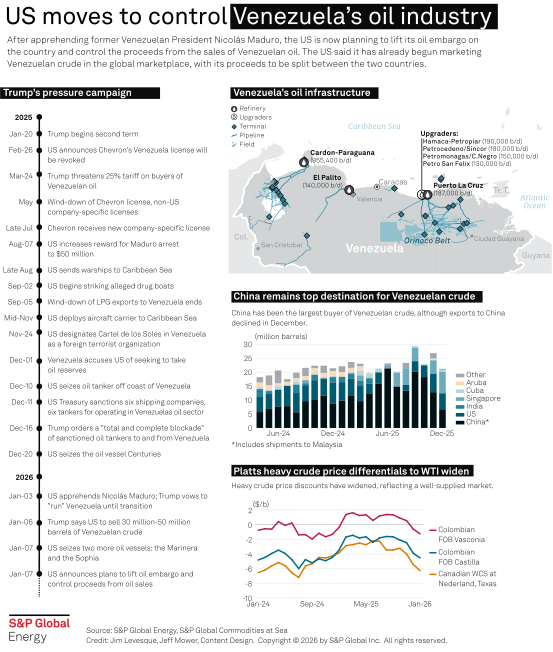
Russian and Chinese companies are currently in joint ventures with Venezuela's state oil company PDVSA. For instance, China's CNPC has a 40% stake in the Sinovensa, while Russia has a 40% stake in Petromonagas.
Differing projections
Mark Nelson, vice chairman of Chevron, said that in the past five to seven years, his company has increased production in Venezuela from about 40,000 b/d to 240,000 b/d. There is a path to increase production in the near term simply by bringing facilities and equipment up to standard, he said.
"I think we have a path forward here very shortly, to be able to increase our liftings from those joint ventures, 100% essentially effective immediately," Nelson said. "We are also able to increase our production within our own discipline, investment schemes, by about 50% just in the next 18 to 24 months, and that's just leveraging what's on the ground."
Repsol CEO Josu Jon Imaz said the Spanish company was "ready to invest more in Venezuela and triple production there in the next two or three years" and noted the country was responsible for much of the natural gas production used to power the South American country's grid.
Repsol currently produces 45,000 b/d of oil in Venezuela, Imaz said.
Repsol has a 40% stake in the Petroquiriquire Occidente joint venture with PDVSA.
Jeffrey D. Hildebrand, founder and chairman of Hilcorp, said his company was "fully committed and ready to go rebuilding the infrastructure in Venezuela."
"You'll be going," Trump said. "That's good."
Valero CEO R. Lane Riggs told Trump the refiner was willing to expand its US refinery capacity to accommodate increased imports from Venezuela.
US Gulf Coast refiners are geared up for running heavy crude, whether from Venezuela, Canada or Mexico.
Valero imports Venezuelan crude for its refineries in Corpus Christi and Port Arthur, Texas, and Norco, Louisiana, according to the US Energy Information Administration.
"If the US is able to purchase more Venezuelan crude at market prices, we expect that 300,000 b/d of additional heavy Venezuelan crude imports would be sufficient to fill [US Gulf Coast] cokers, which are currently operating below capacity," S&P Global Energy CERA analysts said in a report. "This would shift the marginal pricing point from spare coking economics to less efficient refinery conversion layers and could pull Atlantic Basin HSFO cracks down by $3-$5/b and heavy crude differentials down by $2-$3/b."
Need for legal, political changes
Darren Woods, CEO of ExxonMobil, said that his company could have a technical team on the ground to assess the current state of the industry and assets "within the next couple of weeks."
However, ExxonMobil has had its assets in Venezuela seized twice, Woods said, and told Trump the supermajor's immediate desire to invest in the country would require significant changes to the legal and political landscape.
"If we look at the legal and commercial constructs, frameworks in place today in Venezuela today, it's uninvestible," Woods said at the meeting. "Significant changes have to be made to those commercial frameworks, the legal system, there has to be durable investment protections, and there has to be a change to the hydrocarbon laws in the country."
At the meeting, Trump reiterated that "30 million" barrels of Venezuelan oil were already in the process of being exported and marketed by the US.
Trafigura CEO Richard Holtum told Trump the trader was already working with the administration "to bring that Venezuelan oil" to the US and that its first tanker should load in the next week.
Vitol executive John Addison pledged his company was "there to ensure you are going to be able to move all this oil around the world at the best price possible, so that the influence you have over the Venezuelans will ensure that you get what you want."
Trader discussions ongoing
Trump said the economies of the US and Venezuela, two major oil powers in the Western Hemisphere, would be more closely integrated.
"One of the things the United States will get out of this will be even lower energy prices," he said.
Trump argued that many companies are interested in developing oil in Venezuela.
"If you don't want to go in, just let me know, because I got 25 people that aren't here today that are willing to take your place," he told the oil company executives.
Details on future investment and development remained uncertain.
"We will see what kind of a deal we're going to make with these geniuses," he said, referring to the oil company executives.

Editor: