Crude Oil, Maritime & Shipping, Wet Freight
January 07, 2026
US plans to lift oil blockade on Venezuela with oil proceeds controlled by US: Wright
By Kate Winston and Eamonn Brennan
HIGHLIGHTS
Oil sales to benefit Venezuelan people, drive changes
US to market stored, floating, future crude production
WCS crude price discounts widen on news
The US is planning to lift its oil embargo on Venezuela and control the proceeds from the sales of Venezuelan oil, US Energy Secretary Chris Wright said Jan. 7.
The oil will be sold to US refineries and to buyers around the world, but the sales will be done by the US government and deposited into accounts controlled by the US government, Wright said at the Goldman Sachs Energy, CleanTech & Utilities Conference in Miami.
"From there, those funds can flow back into Venezuela to benefit the Venezuelan people, but we need to have that leverage and that control of those oil sales to drive the changes that simply must happen in Venezuela," Wright said.
In the short term, the US had a blockade to pinch cash flow to Venezuela and remove the heads of the regime, Wright said.
"And now we have a different arrangement, where, instead of the oil being blockaded as it is right now, we're going to let the oil flow," Wright said.
The leverage from oil is key to getting change in Venezuela, Wright said. "If we control the flow of oil, the sales of oil, and the flow of the cash that comes from those sales, we have large leverage. But without large leverage, as we've seen in the last 25 years, you don't get change."
Venezuela will buy only American-made products with money from the oil sales, US President Donald Trump said late Jan. 7.
"I have just been informed that Venezuela is going to be purchasing ONLY American Made Products, with the money they receive from our new Oil Deal," Trump said on his Truth Social media platform. "These purchases will include, among other things, American Agricultural Products, and American Made Medicines, Medical Devices, and Equipment to improve Venezuela's Electric Grid and Energy Facilities."
US marketing Venezuelan oil
The US has begun marketing Venezuelan crude oil in the global marketplace, the US DOE said in a Jan. 7 fact sheet.
The proceeds from the sales will first settle in US-controlled accounts at globally recognized banks to guarantee the legitimacy and integrity of the ultimate distribution of proceeds, the DOE fact sheet said.
"These funds will be disbursed for the benefit of the American people and the Venezuelan people at the discretion of the US government," the DOE fact sheet said.
At a press briefing Jan. 7, White House Press Secretary Karoline Leavitt confirmed the US is "selectively rolling back sanctions to enable the transport and the sale of Venezuelan crude and oil products to the global markets." She did not specify which sanctions designations would be affected. The US Treasury's Office of Foreign Assets Control has not updated its list of Venezuela-related sanctions since Dec. 31.
US Defense Secretary Pete Hegseth said Jan. 7 that the blockade continues. "The blockade of sanctioned and illicit Venezuelan oil remains in FULL EFFECT – anywhere in the world," Hegseth said in a post on X.
The only oil transported in and out of Venezuela will be through legitimate and authorized channels consistent with US law and national security, the DOE fact sheet said.
Oil futures fell on the news Jan. 7, while heavy Canadian crude price discounts on the US Gulf Coast widened sharply.
Venezuela produces and exports heavy crude that competes with heavy barrels from Mexico and Canada in the US Gulf Coast.
Platts last heard Western Canadian Select at Nederland, Texas, trading at a $9.60/b discount to the WTI CMA, down $3.10/b day over day. Platts is part of S&P Global Energy.
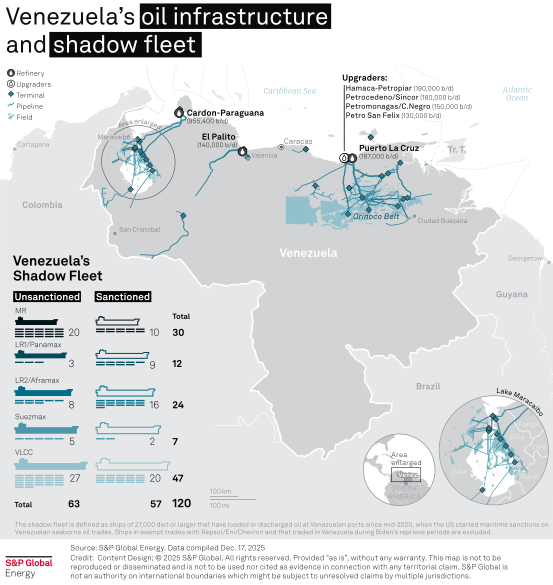
US seizes two more tankers
The US military apprehended two sanctioned oil tankers on Jan. 7. US European Command forces confirmed the seizure in the North Atlantic of the Russian-flagged Marinera, previously known as the Bella 1, an alleged shadow fleet tanker that evaded capture by US forces near Puerto Rico in December. US forces also boarded the Sophia, a "stateless, sanctioned dark fleet motor tanker," without incident in the Caribbean Sea early Jan. 7, US Southern Command wrote in a post on X.
When asked about Trump's announcement that Venezuela will turn over between 30 million and 50 million barrels of sanctioned oil to the US, Wright said that oil will come from onshore and offshore floating storage.
"We're going to market the crude coming out of Venezuela, first this backed up, stored oil, and then indefinitely, going forward, we will sell the production that comes out of Venezuela into the marketplace," Wright said.
Venezuela had roughly 34.4 million barrels of crude in storage as of Dec. 26, according to S&P Global Energy CERA, citing satellite data. Another 3.2 million barrels of crude are stored in Aruba, and 5.8 million barrels in the Bahamas, some of which could be Venezuelan oil, CERA analysts said.
Venezuela also likely has crude in floating storage. As of Jan. 6, around 12 oil tankers were anchored near Amuay Bay, four of which were laden with crude and one laden with fuel oil, according to S&P Global Commodities at Sea data.
The US will supply diluent as required to optimize production and transport of Venezuelan oil, the DOE fact sheet said. The US will also authorize the import of select oilfield equipment, parts, and services to offset production declines and drive near-term growth, the DOE fact sheet said.
Wright said he has been speaking with companies to determine the conditions they need to invest billions of dollars in fields and infrastructure in Venezuela.
When asked about the size of the opportunity in Venezuela, Wright said the upside is huge. "And then when [former President Hugo] Chavez came in power, it has been a steady, massive decline. Think of how enormous the resources must be if it's still producing 800,000 or 900,000 barrels a day after that kind of mismanagement."

Editor: