Coal, Energy Transition, LNG, Emissions, Renewables
December 17, 2025
COMMODITIES 2026: Thermal coal's European retreat to accelerate in 2026 amid renewables push
HIGHLIGHTS
Europe's thermal coal imports to decline 15%-20% in 2026
Coal-fired power generation in Western Europe to drop over 40%
Atlantic thermal coal prices likely to remain flat or decline
The European thermal coal market is set to enter 2026 with expectations of further contraction, as a combination of surging LNG inflows, persistent weakness in gas prices, and coal plant closures across Europe accelerates the region's retreat from coal.
"EU15 thermal coal imports are expected to decline by 15%-20% in 2026 compared to 2025 levels, reaching around 30 million mt, as coal-fired generation continues its structural decline across the continent," Wendy Schallom, associate director for Global Seaborne Thermal Coal Research at S&P Global Energy CERA, said.
The first half of 2025 saw an unexpected rise in coal-fired power generation, driven by persistently low wind yields in the first quarter. However, the second half saw a return to normalcy as higher renewables output, coupled with low gas prices, weighed on coal-fired power generation, resulting in weaker imports in the second half of 2025.
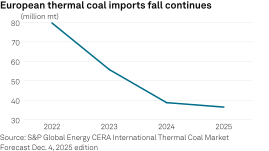
The same pattern that appeared in the second half of 2025 is likely to continue in 2026, as Rickson expects coal-fired power generation in Western Europe to decline by more than 40% year over year, averaging just 3.0 GW, with Germany accounting for around half of the total output.
The primary driver behind this anticipated weakness is the outlook for gas prices, which are expected to come under sustained pressure from rising LNG supply, particularly from the US, according to an Italy-based trader. With gas competitiveness improving against coal, market participants see limited upside for thermal coal demand throughout the year, the trader said.
Nearing the end
Europe's push for renewables has prompted many countries to accelerate the retirement of coal-fired power plants in recent years, resulting in a decline in coal imports year after year, except in a few instances where coal has found favor among European utilities due to geopolitical issues or concerns about renewable energy output.
"Italian coal generation is expected to drop by 50% as several coal plants transition into reserve status," Rickson highlighted, indicating that the fuel that once dominated the power mix in Europe is fast approaching its end.
The faltering imports in Europe and an oversupplied global thermal market in 2025 resulted in the Platts-assessed CIF ARA 6,000 kcal/kg coal average coal price falling below the $100/mt mark for the first time since 2020, marked with volatility throughout the year.
Platts CIF ARA 6,000 kcal/kg NAR coal price averaged $98.05/mt in 2025 to date, down sharply from the average of $112.10/mt in 2024, Platts data showed. The last time the Platts-assessed CIF ARA 6,000 kcal/kg NAR coal price averaged below $100/mt mark was in 2020, when it averaged $50.10/mt.
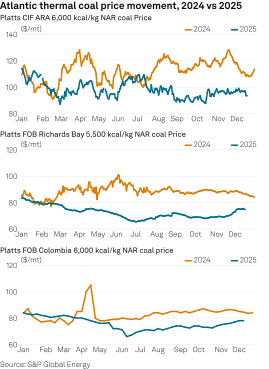
Platts-assessed FOB Colombia 6,000 kcal/kg coal price has averaged $75.70/mt so far in 2025, compared with $82.90/mt in 2024, and similarly, the FOB Richards Bay 5,500 kcal/kg NAR thermal coal price slipped to an average of $72.50/mt in 2025 from $88.40/mt in 2024. Platts does not assess FOB Richards Bay 6,000 kcal/kg NAR coal.
Heading into 2026, the price environment for Atlantic thermal coal is also expected to shift. The volatility that has defined recent years is likely to give way to a flatter, possibly declining price range for CIF ARA 6,000 kcal/kg NAR, as the significant price support from cross-basin demand fades, according to Schallom.
Atlantic suppliers in a fix
South African suppliers have successfully established their presence outside of Europe, with India emerging as their leading destination, leading to increased exports in recent years. The growth is supported by an improvement in the country's logistics sector after years of lackluster performance.
Market participants anticipate that South African thermal coal exports will likely see further improvement in export volumes, although global commodity markets are expected to remain largely unpredictable and volatile due to geopolitical disruptions and tariffs introduced by US President Donald Trump.
"Thermal coal export volumes from South Africa in 2026 will largely depend on Transnet Freight Rail performance. There has been a significant improvement in TFR's performance to Richards Bay Coal Terminal (RBCT) in 2025, and that trend is expected to continue into 2026," said Ruan Nothnagel, COO of South African mining company Menar.
Nothnagel added that as global seaborne coal demand is expected to rise in 2026, supply is likely to continue to decline. He anticipates overall demand to be relatively inelastic, particularly for South Africa due to its exclusive link with the Indian sponge iron sector. South African coal is poised for a bullish run in 2026, he said.
Meanwhile, Colombian thermal coal suppliers who resorted to production cuts earlier in 2025 to support falling prices expect a similar trend heading into 2026, as the prices of thermal coal will dictate output.
"Next year, we may expect a trend similar to this year; as always, all depends on price," a source at a Colombia-based producer said. "If prices somewhat rebound, producers will have the ability to react by increasing production/exports."
For thermal coal producers, flexibility will be the key skill required to navigate 2026 as the global commodity market continues to find a balance amid various uncertainties.

Editor: