Coal, Metals & Mining, Maritime & Shipping, Metallurgical Coal, Containers
October 20, 2026
US port fees on China-linked ships likely delayed to January, sources say

Editor:
HIGHLIGHTS
Two-month extension would push fees to January 2027
Metals, coal exporters face increased shipping costs
The Trump administration is expected to grant a two-month extension before reinstating port fees on Chinese-linked ships, a move that grants temporary relief to US metals and coal exporters, shipping and industry sources told Platts, part of S&P Global Energy.
The fees on ships built or owned by China using US ports were delayed for one year as part of the Busan Agreement, an October 2025 deal between the two countries that also delayed some tariffs.
When first announced in early 2025, the fee proposal sent a panic through the coal industry, which relies on exports as a lifeline amid declining domestic consumption and has few alternatives to China-built ships. The year delay ends on Nov. 9, but sources said the government will likely extend the suspension through Jan. 10, 2027.
"What we understand through our communication in DC and trusted government sources is that due to the recent visit from China and the extension of the Busan treaty for another two months until Jan. 10, the USTR 301 port fees are part of that consideration," Joshua Juel, president and CEO of the Chamber of Marine Commerce, a nonprofit association representing the marine shippingindustry, told Platts.
The Office of the US Trade Representative (USTR) has not issued a formal notice extending the suspension as of Oct. 19. USTR and the White House did not respond to requests for clarification.
An industry source told Platts that they understand the implementation of the port fees will be pushed to January. That date could be further extended if trade negotiations between the US and China continue in a positive direction, the source said. US President Donald Trump and Chinese Premier Xi Jinping last met in September, and they are expected to meet again in November.
The suspended port fees would impose an initial rate of $50/net ton per voyage for vessels owned or operated by a Chinese entity. Non-Chinese operators of Chinese-built vessels would be charged the higher of $18/nt or $120 per container discharged. The rates are scheduled to increase annually, beginning this year. A net ton is equivalent to a short ton.
The revised fees are less stringent than USTR's initial proposal, which would have charged up to $1.5 million per entrance of Chinese built-vessels, and received major backlash from US industry.
Platts assessed low-vol hard coking coal at $210/metric ton FOB US East Coast Oct. 16, up 21% from last year. High-vol A hard coking coal was assessed at $185/mt FOB USEC, up 23.3% year over year, while high-vol B hard coking coal was assessed at $166/mt FOB USEC, up 18.6%.
China's coal commitment could signal port-fee delay
The US and China, as part of the trade truce extension, agreed to consider reduced tariff treatment for $30 billion worth of goods under a reciprocal framework that includes Chinese imports of US coal. The recommended reductions have yet to take effect as both countries complete legal procedures.
China's potential elimination of tariffs placed on US coal could be linked to a US decision to suspend or eliminate the port fees on Chinese vessels, one coal industry source said.
China also agreed to import at least 10 million mt of coal from the US in both 2027 and 2028. That commitment could conflict with added costs associated with fees on China-linked vessels and give the administration another reason to delay them, Juel said.
"That seems to be a ray of light or some indication of where the administration intends to go with respect to exporting coal and how to treat ships of Chinese origin," Juel said.
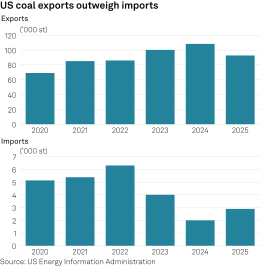
The US exported 50.5 million short tons of coal in the first half of 2026, according to the US Energy Information Administration's latest quarterly coal report. Asia accounted for 53.4% of US coal exports during the first half of the year.
The National Coal Council recommended that the Trump administration make the suspension of the port fees permanent, according to a July 2026 report on US coal exports. The maritime actions would raise costs for transportation, reduce vessel availability and undermine the competitiveness of US coal exports, the council said.
"We certainly hope there is a recognition of the unintended consequences these fees could create for US exporters, including industries that depend on access to global markets," Emily Arthun, CEO of the American Coal Council, told Platts.
With only weeks to go before the fees are set to take effect, the continued uncertainty over policy complicates capital investments and hiring decisions, Juel said.
"Reliable transportation and competitive shipping costs are important considerations for producers looking to serve overseas customers. A stable and predictable shipping environment is important as we continue developing our business," Bobby Gaylor, executive vice president at US met coal producer Clinch Resources, told Platts.
