Coal
September 10, 2025
Asian thermal coal’s longest rally in two years fizzles as Chinese prices stabilize

HIGHLIGHTS
Longest rally since Sept-October 2023
China's imports rose in July and August
Asian thermal coal prices staged their longest rally in nearly two years last month but that momentum has fizzled out as Chinese domestic prices steady amid an easing of mine safety checks, tapering summer demand and higher hydropower output.
Prices across grades rose through August in an offseason trend supported by strong Chinese buying, price advantage for domestic coal, and expectations of domestic supply constraints amid mine inspections.
The price of the most liquid grade, Kalimantan 4,200 kcal/kg GAR, increased consistently week after week from the week ending on Aug. 1 to week ending on Aug. 22, while the mid CV grade, Kalimantan 5,000 kcal/kg GAR, increased for seven straight weeks, beginning the week ended July 11 through the week ended Aug. 22, according to Platts assessments.
It is the longest rally since Asian thermal coal prices recorded eight straight weeks of gains over September and October 2023, when Chinese utilities and traders stocked up ahead of the Golden Week holidays and to meet winter restocking needs.
The rally comes after prices had steadily dropped through most of this year, having remained rangebound through much of 2024, with only minor swings in response to sporadic Chinese purchases and uneven demand across South and Southeast Asia.
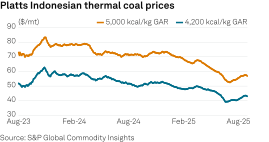
The recent rally was driven by a surge in Chinese buying. Tighter safety inspections at domestic mines pushed up local coal prices and made seaborne imports comparatively cheaper. A wave of summer heatwaves across China further lifted coal burn, tightening prompt availability in the seaborne market.
"Chinese utilities had to rely on imports more aggressively in July and early August, as domestic spot prices moved up sharply," a Singapore-based trader said. "That really gave Indonesian and Australian suppliers a pricing edge."
The latest data by China's General Administration of Customs showed that China's coal and lignite imports rose for two months in a row, 7.8% month-on-month in July to 35.61 million mt and then gaining further to 42.74 million mt in August.
The increase came as China's raw coal production in July totaled 380.99 million mt, a 3.8% decrease from the previous year and the lowest output since April 2024.
Data from S&P Global Commodities at Sea shows that Indonesia was the largest supplier of coal to China during the year so far, followed by Australia and Russia, respectively.
The upward streak broke on the week ending Aug. 22, when prices began easing again. Chinese domestic coal prices stabilized as safety checks subsided and summer demand faded, while improving hydropower generation reduced coal-fired power demand. Stocks at major Chinese ports started to accumulate, easing immediate buying pressure.
Platts assessed China-delivered 3,800 kcal/kg NAR prices at $50.70/mt on Sept. 10.
At the same time, Indonesian supply turned more robust, as several producers received additional annual output quotas, known locally as RKAB, helping ease tightness in the spot market.
"We've had extra production approvals this quarter due to revised RKAB, so exports have been flowing more steadily," an Indonesian miner said.
With China's domestic supply staying strong and its energy transition gaining momentum, the dynamics of coal imports are increasingly influenced by price competitiveness. Buyers are likely to adopt an opportunistic approach, seeking out the most cost-effective suppliers to fulfill immediate requirements and address short-term supply shortages.
"Chinese buying is usually supported before long holidays like Lunar New Year or Autumn break when domestic coal mine operation remains halted due to holidays," an Indonesia-based trader noted.
In their latest international thermal coal market forecast report, S&P Global Energy analysts said: "In China, rainfall in mining regions is expected to decrease in September compared to August; in addition, coal burn drops as temperatures cool. The widening supply-demand gap for coal is anticipated to weaken domestic coal prices and reduce the appetite for thermal imports."
