Chemicals, Aromatics, Solvents & Intermediates
December 30, 2025
COMMODITIES 2026: Tighter supply to support PX prices, PTA faces capacity overload
HIGHLIGHTS
Impacts of 'anti-involution' minimal for PTA
PX supply-demand balance healthy
Trade tensions dictate Western demand
This is part of the COMMODITIES 2026 series, where our reporters bring to you key themes that will drive commodities markets in 2026.
Asian paraxylene prices are expected to remain firm through 2026 due to tighter supplies; however, downstream purified terephthalic acid may struggle to find respite from weak margins and China's ongoing battle with excess capacity.
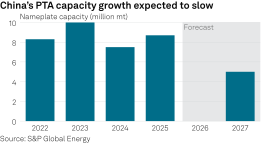
Much was expected from China's "anti-involution" announcement, a policy aimed at addressing the country's rapidly built-up and bloated PTA production capacity, with several major PTA and polyester producers leading the way in curbing excess capacity. But the move has not yet yielded concrete results, leaving market participants increasingly pessimistic about any substantial outcomes in the near term.
"The alliance is fragile; it's hard to be together," a trader in China said, referring to potential disagreements between major PTA producers to cut production.
PTA margins will continue to struggle on account of excess capacity, a China-based producer said, noting that Chinese PTA plants are "unlikely to shut for long or permanently," as they do not want to compromise market share.
Domestic Chinese PTA margins for 2025 dropped to about Yuan 180-200/metric ton ($26-$28/mt) in mid-December, compared with an average of Yuan 280/mt in 2024. Margins were at about Yuan 286/mt in 2023, according to the China-based trader.
Downstream polyester operation rates in China have remained high over the past several months despite sluggish domestic consumption and ongoing trade talks with the US, EU and Mexico, among others.
Some end-producers with stagnant orders are building inventory, Xiaodong Zhang, director of Asian aromatics analysis at S&P Global Energy CERA, said.
Polyester plant operation rates have averaged 90.11% in 2025 through mid-December, according to CERA. However, domestic demand is still not strong enough to absorb all of China's capacity build-up, Zhang said.
The trader in China said that a weak domestic economy has pushed producers to actively seek newer destinations for their goods.
Outlook for PX strong
China's PX supply is expected to tighten, as PTA capacity has grown faster than PX production over the last few years, which may support PX spot prices and strengthen margins through 2026, sources said.
Unlike previous years when PTA capacity growth outnumbered PX capacity additions, 2026 should see that trend come to a much-awaited end, but fundamentals for PX are anticipated to remain tight.
Although some PX capacities are scheduled to start up in 2026, there is little concern about a supply glut, as those additions may only begin toward the end of 2026 at the earliest, Zhang said.
India PX demand to increase
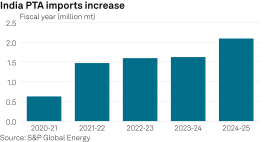
Indian PX demand looks robust, with domestic PTA capacity expected to grow in 2026.
The withdrawal of the Bureau of Indian Standards quality control order on the polyester value chain, which had created a two-tier market, along with the likely startup of GAIL's 1.2 million mt/year PTA plant by March, would give polyester yarn and PET resin makers plenty of competitively priced feedstock, market participants said.
"With GAIL's PTA supply, imports are likely to be lower," an India-based PTA producer said, suggesting the trend of increasing imports may slow or reverse.
Exporters keep eye on tariffs
Asian PX exporters will continue to monitor tariff developments in the US, as policy changes significantly impacted global trade flows in 2025.
In the US, tariffs have contributed to a notable reduction in imports for PX, with volumes for January-September around 37% lower year over year, and imports from South Korea falling nearly 50%, according to data from the US International Trade Commission.
PTA imports into the US saw even steeper declines, with South Korean volumes dropping nearly 75% over the same period. However, new tariff agreements anticipated in 2026 between the US and South Korea could help restore some of these trade flows.
Tariffs could also impact Europe in 2026, as the EU is due to decide on provisional antidumping duties in April, with definitive measures coming in October.

Editor: