Chemicals, Solvents & Intermediates, Olefins, Polymers
December 30, 2025
COMMODITIES 2026: Europe, US to continue alleviating butadiene length via exports to Asia
HIGHLIGHTS
Butadiene imports into China up 39% year over year
China market self-sufficiency not expected until 2030: analysts
Low demand in West increases exports throughout 2025
This is part of the COMMODITIES 2026 series, where our reporters bring to you key themes that will drive commodities markets in 2026.
Low downstream demand, cracker rationalization, co-cracking, tariffs and subdued recovery expectations are painting a bleak picture for the butadiene market in 2026 across various regions. Despite a recent push for self-sufficiency in China and Asia, market sources expect butadiene imports from the West to remain a fixture in the region for the foreseeable future.
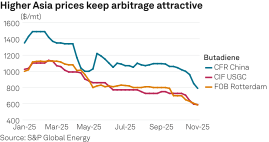
Overall, worldwide butadiene prices trended down in 2025. Platts, part of S&P Global Energy, assessed CFR China, CIF US Gulf Coast and FOB Rotterdam butadiene prices down $470-$530/metric ton from January to early December.
This trend resulted from two factors. First, macroeconomic woes have had a profound impact on the automotive and construction sectors, two of the strongest downstream consumers, resulting in a decline in butadiene consumption in Western domestic markets.
Second, cargoes have been sent overseas more aggressively, as Asian demand and a prevailing price premium made this region the most feasible for absorbing steady butadiene supplies from the US and Europe. From January to October 2025, China's butadiene imports alone stood at 428,721 mt, up 39% from a year earlier, according to customs data.
"These are easy times for buyers in China as it is the only domestic market which is doing well," a European producer said. "They can push down pricing as low as they want."
A trader source in the US added that "China is long, and that's depressing the market. That's going to be the story for the end of 2026."
The trend is expected to continue for several years. Rising production capabilities across Asia have increased its self-sufficiency in markets like polypropylene, and China recently shifted from a net importer of polybutadiene rubber to a net exporter, according to January-October customs data. However, butadiene self-sufficiency, although ever closer, is still far off.
"Asia, and especially China, will be a net importer for 2026," said Bernd Helbing, analyst director of global C4s and derivatives at S&P Global Energy CERA. Although he said Western imports were likely to be lower in 2026 compared with 2025, Helbing added that "China is only expected to achieve self-sufficiency around 2030."
Nevertheless, Asia's doors are already closing to Western imports. Asian market sources said supply from Europe would likely slow down early in 2025, as the location spread is seen narrowing. Supplies from the US to China would also be limited due to an additional 10% tax on US products. While American cargoes have shifted to other Asian destinations, such as South Korea, buying appetite is not as hearty as in China.
A battle against length for the West
According to Helbing, little domestic demand in both the US and Europe is foreseen in 2026, and a slight uptick is not expected until almost the end of the decade. The bearish outlook, coupled with diminishing returns and slightly lower opportunities from Asian exports, are pushing Western participants to harsher options to reduce the market's length.
The European industry went through a challenging rationalization year in 2025. In total, four steam crackers were permanently shut in Southern and Northwestern Europe, reducing crude C4 availability and causing some butadiene producers to mitigate procurement challenges via ad-hoc spot purchases throughout the year.
The European industry is set to still see two more cracker closures in 2026. Closures of Dow's Bolhen cracker and Total's Antwerp cracker have been announced to take place by the fourth quarter of 2027. Ineos' new cracker at Antwerp, slated for opening in 2026, will use ethane for feedstock instead of naphtha.
The overall change in European cracker feed slate and capacity will result in a decreasing share of crude C4 output from crackers, which should help reduce supply length and keep the market more balanced, market sources said.
Asia pressuring US prices
In the US, market sources said that continued reliance on Asia to eliminate length could significantly hurt the domestic market, especially if prices overseas continue dropping. A downstream rubber producer pointed out that ever-lower prices for export cargoes to Asia end up pushing settlements for domestic contracts downward. The monthly CP in the US has fallen 19.75 cents/lb over 2025, Platts data shows.
The actual price paid by butadiene contract purchases often close at discounts to the original settled price, the rubber producer said. And so, if dropping Asian prices continue pushing contract negotiations, payments could drop below production costs. Hence, co-cracking, the recycling of butadiene through crackers to break it up into other chemicals, is an increasingly attractive option among producers to control the market's supply.
"It is risky and it comes at a cost via damage to plants," a butadiene buyer source said. "But regardless of how big [co-cracking] actually is, producers are going to talk it up ... to defend price rollovers or increases. But it is not going to be a wholesale answer."
Helbing said that "based on the current spot price level in Europe and the US, it is not surprising that suppliers are using alternative routes."

Editor: