Chemicals, Olefins, Solvents & Intermediates, Polymers
December 29, 2025
COMMODITIES 2026: Global glycols trade flows shifts from China amid trade tensions
HIGHLIGHTS
US export destinations in flux as spot price hovers around parity
Chinese imports to remain high amid domestic capacity underutilization
Europe focuses on upcoming antidumping duties case
This is part of the COMMODITIES 2026 series, where our reporters bring you key themes that will drive commodities markets in 2026.
Ethylene glycol margins look set to enter 2026 under intense pressure amid a supply glut that leaves sellers with dwindling export options, as trade tensions between the US and China -- as well as calls for protectionism from producers in Europe -- have done little to rebalance market fundamentals.
With spot prices in most regions hovering around multi-year lows and capacity utilization rates also historically low, some participants suggest rationalization is in order.
US-China trade tensions put US exports in flux
The first half of 2026 poses the US ethylene glycol market with the question of where to reallocate supply formerly consumed in China.
Since consumers in China halted imports of US EG amid deteriorating trade relations, US-based sellers must redirect an estimated 1 million metric tons per year of monoethylene glycol; prior to the trade dispute, China, the world's largest consumer, imported about that much MEG annually.
Typical export alternatives for US-based sellers -- such as Turkey, Egypt and Western Europe -- are considerably smaller markets and are unable to absorb the demand that previously came from China.
MEG spot prices fell to an 18-month low of 18 cents/lb FOB US Gulf Coast in April after remaining rangebound at 21.55-22 cents/lb in the first quarter, according to Platts assessments from S&P Global Energy.
However, spot prices rebounded in the second half of May following a force majeure at Lotte Lake Charles, climbing back to 21 cents/lb on June 27.
MEG spot prices fell 4 cents, or 21%, from July 3 to Dec. 12, with December spot prices reaching a five-year low, according to Platts data.
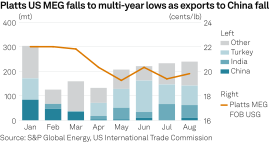
India consumes about 40,000 mt/month of MEG, which is about 44% of Chinese consumption, according to two traders. Although the Indian government lifted import restrictions on global EG, US-based sellers are skeptical that any one country could fully replace China.
Non-integrated producers in the US are under particular pressure to idle, one of the traders said, with supply growing longer and prices nearing a floor.
With export volumes falling, US-based producers, meanwhile, have had to reduce production to manage inventory levels.
Nan Ya, a subsidiary of Formosa Plastics, has shut down EG production at its 360,000 mt/year EG1 plant in Point Comfort, Texas, a source familiar with company operations said, adding that the plant "would not restart in December."
At least two other producers on the USGC are operating at reduced rates, according to multiple participants, although only one unit is fully idled.
China can expand domestic output amid low imports
MEG plants in China remain underutilized, with operating rates averaging 55%-65% in 2025. Rates are likely to remain at similar levels in 2026 amid a myriad of factors, including upstream crude oil and ethylene costs, coal prices, environmental concerns and downstream polyester and PET demand, market sources said.
The cost advantages of MEG production in the Middle East and North America have provided a more economical way for China to meet its MEG demand.
China's imports of MEG totaled 6.3 million mt from January to October, up 16% on the year, according to Chinese customs data. Many of these imports from Saudi Arabia, Canada and Taiwan increased significantly on the year.
But, with continued expansion of downstream polyester capacity in China, curtailed US volumes due to trade tensions could prove problematic, Sally Fu, director of China olefins research at S&P Global Energy CERA, said.
Several market participants expect China will continue to fulfil its consumption requirements through imports, looking to the Middle East, Taiwan, South Korea and Malaysia in lieu of US volumes. However, China will have to compete Europe for those volumes.
Europe moves to protect market position
Europe is primarily focused on the November 2026 expiry of antidumping duties applied to US and Saudi Arabia MEG, implemented in November 2021. Reviews of the duties typically need to occur at least three months prior and are usually started around six months beforehand, meaning a review would likely take place between May and August.
The broad market expectation is that the duties will be renewed. However, there is less certainty regarding what revised duties could look like.
There is a scope that duties applied to all industrial goods from the US might be scrapped; if that is the case, Europe-based producers anticipate this will make European material even less competitive.
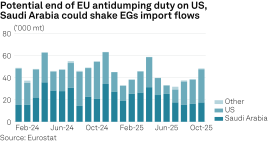
As with other regions, the primary concern heading into 2026 in Europe is oversupply, and how much of that glut Europe-based producers can supply, with so many low-cost producing regions looking to find a home for their EG.
Where the outlook in Europe differs to China, though, is demand coming from downstream markets, namely polyethylene terephthalate, where sources expect limited opportunity for recovery in 2026.

Editor: