Chemicals, Polymers
December 23, 2025
COMMODITIES 2026: Global 2026 PVC on the edge of production cuts and trade flow twists
HIGHLIGHTS
Barriers and uncertainties regarding duties impact competitiveness
Changes in the Indian market altering the landscape in other regions
This is part of the COMMODITIES 2026 series, where our reporters bring to you key themes that will drive commodities markets in 2026.
After a year marked by falling prices of polyvinyl chloride resin and no concrete signs of robust growth in regional construction industries, the market does not expect a turnaround in demand for 2026, but expectations for production cuts have been gaining strength.
The increase in PVC trade flow in 2025, with projections for a new record in global exports, was not enough to ease expectations regarding supply, and the key to this lies in prices, as explained by Harry Thomas, Director, Global Head Inorganics & Vinyls at S&P Global Energy.
"With prices setting 20-year annual average lows for PVC exports in 2025, many producers are shipping at a financial loss this year. They are attempting to find ways to increase values or possibly lower some participation until greater values arrive," Thomas said.
The Dec. 15 announcement that Westlake has decided to cease operations at one of its PVC plants has strengthened expectations of rising prices due to lower supply in early 2026. "I think the important point to note here is the action taken by Westlake. It indicates that current costs and margins are unsustainable unless producers are willing to take aggressive action, even though immediate pain is high," a distributor said.
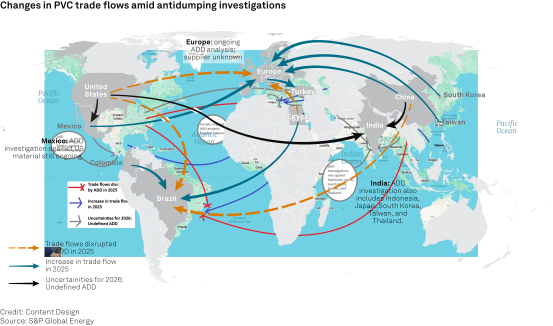
While the market awaits production cuts to relieve the oversupply pressure on prices, global market participants are also monitoring one of the key factors that could determine the price direction in 2026: India. After the rescission of the much-anticipated Bureau of Indian Standards quality control norms, the deadline for an antidumping investigation against several countries expired without any official announcement from the government
The drop in resin prices in India was one of the largest among all regions. Platts, part of S&P Global Energy, India PVC price assessments fell by over 30% from December 2024 to December 2025.
A participant in the Chinese market said that, with the Indian market secured, Chinese producers "no longer need to sell at extremely low prices into other regions, a tactic used previously when facing ADD and BIS threats." In 2026, a significant influx of Chinese cargo is expected to continue heading to India.
The scenario creates sustained competition and price pressure for other suppliers operating in the country such as Taiwan and South Korea. In light of China's aggressive offers in India, other suppliers have begun to direct their offers to Europe and Brazil.
In Europe, some pockets of cautious optimism have emerged following progress in peace negotiations between Ukraine and Russia, as a formal peace agreement would lift PVC demand through reconstruction-driven consumption. Another bullish factor would be the German government's pledge to invest EUR 300 billion in federal infrastructure over the next 12 years.
In Brazil, amid macroeconomic indicators pointing to unemployment at historic lows and increased income for the population, the launch of real estate projects was reportedly growing despite an increase in interest rates. Even so, demand for PVC in the country has been uncertain in recent months, especially after the increase in the ADD against material from the US and the maintenance of duties against China.
As a result, Colombia, Argentina, and Egypt, which benefit from import tariff exemptions for Brazil, have become the country's largest suppliers of PVC.
Forecasts about India impact on the US
If competitive offers from China are forcing other Asian suppliers to find new markets, it is uncertain whether the same will happen with the US. Part of the market believes that US producers should seek alternatives to avoid head-on competition with China in India, but it's not a consensus.
Among sources in India, while there has been some discussion regarding the potential for increased PVC imports from the Middle East and the US, opinions remain divided. It appears that China-origin material will continue to dominate the market, especially in the first half of 2026, sources said.
But others see potential upcoming upside for the US, as the absence of BIS and ADD in India increases the chances of allocating additional volumes.
In addition to the increase in ADD in Brazil, the EU's implementation of definitive ADD duties ranging from 58% to 77% on the US in January has made imports uncompetitive. The Mexican government had also decided to initiate an ADD investigation into imports of suspension PVC from the US.
These are not the only uncertainties regarding duties that loom over the market in 2026. Despite the uncertainties, the volume of PVC traded in 2026 is expected to remain high, Harry Thomas forecasts.
"In terms of exports and implications of tariffs in 2026, we are not expecting a significant change in country flows. We do expect a larger annual export PVC volume, primarily driven by India's growth and PVC imports into India from China, Taiwan, Japan, South Korea, and the USA," Thomas said.
Forecasts for supply cuts gain strength
While the new scenario for trade flows remains unknown, in Asia, market players anticipate production cuts to address increasing supply as China continues to expand its capacity amid weak demand.
"If the export growth rate in China continues at 10% to 20%, the accumulation of inventory will still be difficult to improve. I lean toward the possibility of production cuts, as marginal factories are indeed starting to incur losses," a Chinese trader said.
In the US, the sentiment is similar. Following the interruption of the sustained price decline due to production reductions resulting from maintenance shutdowns, traders anticipate that lower supply will persist. However, no producer has openly expressed plans to adjust operating rates.
"If US producers keep the production rate near 80%, the supply and demand may be balanced to snug from US to Latin America. If the production rate goes back up, US PVC will need to compete with Chinese PVC in Africa, the Middle East, and India," a US trader said.
According to Harry Thomas, "the US is headed to a new record PVC export total in 2025; however, China appears likely to take the #1 exporting country spot for the first time in 2025."

Editor: