Chemicals, Aromatics, Solvents & Intermediates, Polymers
December 18, 2025
Europe’s phenolic chain experiencing wave of rationalizations
By Nate Zhang and Luke Warren
HIGHLIGHTS
Production costs present structural challenges for Europe
Weak demand and oversupply permeate the value chain
The European phenolics chain is experiencing unprecedented pressure, driving a wave of rationalizations as producers struggle to remain competitive against global peers.
Phenol production costs in Europe are approximately 41% higher than in Southeast Asia and 45% higher than in the Middle East, according to S&P Global Energy CERA data. This cost differential is largely attributed to higher energy costs following the reduction of Russian pipeline gas imports in 2022, as well as elevated feedstock costs.
European producers rely predominantly on naphtha steam crackers, producing propylene as a secondary product and making prices susceptible to low cracker run rates during periods of weak demand. In addition, Europe's limited propane dehydrogenation capacity further increases feedstock costs relative to other regions.
Carbon compliance costs in Europe add to the overall cost burden for European producers, while generally older and less energy-efficient phenol units contribute to higher operating costs.
Since March 2024, European phenol spot prices have declined by 49%, while acetone prices have fallen by 61.5%. Traditionally, the co-product relationship between phenol and acetone helped balance market fundamentals. However, weak demand for both phenol and acetone -- due to softness in BPA and phenolic resins and subdued demand in solvents and MMA -- has resulted in both markets being oversupplied. Lower phenol production rates have not led to acetone shortages and margins for producers have narrowed as both products fail to drive positive margins.
Supply-demand imbalance
Since 2019, European phenol demand has fallen by approximately 30%, according to CERA data, via downstream capacity rationalization.
In 2025 alone, the market lost significant volumes of phenol and acetone consumption. This includes the closure of Westlake's 150,000 mt bisphenol-A (BPA) plant in Pernis, in the Netherlands, at the end of Q3 2025, and the closure of Trinseo's 100,000 mt/year methyl methacrylate (MMA) facility in Rho, Italy.
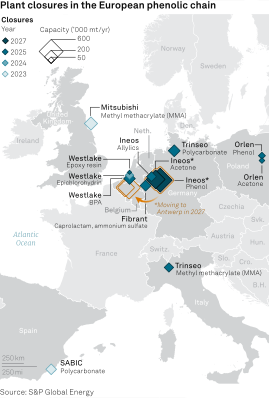
On the other hand, nameplate phenol capacity remains mostly intact, having declined only 3.1% since 2022, owing to the closure of Orlen's phenol unit in Poland, while 60-70% operating rates have failed to combat the persistent length in both the phenol and acetone markets.
Although Ineos has announced the closure of its 660,000 my/year Gladbeck facility by the end of 2027, the company simultaneously announced plans to restart production at its 680,000 my/year Antwerp site. The opening of Moeve's planned IPA plant in Spain, last confirmed to be delayed to Q1 2026, and any concurrent changes in phenol operating rates also remain uncertain factors in Europe's supply-demand balances for 2026.
Meanwhile, global phenol capacity continues to grow, driven by integrated projects into downstream bisphenol-A and further downstream polycarbonate and epoxy resin production. Global BPA nameplate capacity is set to rise from 11.5 million mt in 2024 to nearly 13.3 million mt by 2029, with most additions in China, where capacity will increase from 6.1 million mt to 8 million mt, according to CERA data.
As of December, feedstock spot BPA prices exceed polycarbonate prices due to extremely competitive Chinese imports, some of which are stored in European warehouses for prompt delivery. Chinese PC imports increased almost 44% to September 2025 compared with 2024, while Platts-assessed PC extrusion prices have fallen approximately 38% since August 2024.
Market participants have expressed disappointment in the effectiveness of antidumping duties on epoxy resins from several Asian countries, as spot prices have dropped below pre-ADD initiation levels. Notably, Westlake, one of the three producers that filed the complaint together with Olin and Spolchemie, exited the market in 2025.
As 2026 approaches, the phenolic chain of chemicals, along with its upstream and adjacent markets, will continue to navigate capacity rationalizations and evolving trade flows, further challenging the industry's resilience.

Editor: