Refined Products, Agriculture, Energy Transition, Jet Fuel, Biofuel, Renewables
December 17, 2025
COMMODITIES 2026: Asia SAF navigates supply surge, low regional adoption
By Mia Pei and Kelvin Chow
HIGHLIGHTS
Asia's SAF production capacity to reach 1.6 million mt/year by 2026
Mandated demand lags at 380,500 mt/year
Asia to remain structurally long SAF through 2030
This is part of the COMMODITIES 2026 series, in which our reporters bring to you key themes that will drive commodities markets in 2026.
Asia is on track to become one of the world's largest producing regions of sustainable aviation fuel; however, much of its output is still expected to be directed to Europe over the remainder of the decade, as government mandates remain limited and mostly voluntary, according to industry players.
By 2026, Asia's SAF production capacity is expected to reach about 1.6 million metric tons per year, while the region's mandated demand is projected at just 380,500 mt/year, according to S&P Global Sustainable1' estimates.
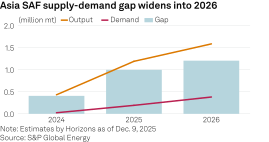
This imbalance is set to leave Asia structurally long SAF through at least 2030, even as policymakers roll out early-stage mandates.
"(In Asia) SAF supply growth is outpacing demand growth, with demand not developing as expected," said Mario Mifsud, Vice President of Renewable Fuels Sales & Trading of EMEA & APAC at Neste.
Mifsud highlighted the absence of policies mandating demand or incentives for SAF adoption in the region, even though Asia-Pacific region is expected to account for 40% of global air traffic and passenger demand by 2035. "Until regional SAF mandates begin to come into effect from 2026-27 onwards, any SAF use will be purely voluntary."
Policy frameworks in Asia's SAF market remain patchwork. Singapore has linked a SAF levy to a 1% SAF use target in 2026, South Korea plans a 1% blending mandate from 2027, and Japan aims for 10% SAF use by 2030, while Indonesia, Thailand, and India have roadmaps without binding obligations. Malaysia is working on a proposal to introduce a 1% blending mandate starting in 2027.
Key market China, which leads Asia's aviation sector in terms of passengers and fleet size, has not yet committed to a nationwide SAF blending mandate beyond a modest consumption target of 50,000 mt of SAF by 2025.
Related content: Decarbonizing aviation: The scale-up challenge
"Policymakers have a critical role to play in driving SAF adoption," a Shell spokesperson told Platts, part of S&P Global Energy, noting "acceleration of SAF policy momentum in the region".
In comparison, binding mandates under the EU's RefuelEU Aviation regulation require a 2% SAF blend from 2025, rising to 6% by 2030.
"A lot of Asia's SAF is still going to the EU, because that is where the mandates are firm and bankable," said Lamberto Gaggiotti, Head of Green Energy Business at Apical.
Supply surges
While demand remains nascent in Asia, the region's production capacity is expected to continue growing in 2026. SAF output in the region is estimated to rise 33% year over year, according to Sustainable1, keeping suppliers focused on export opportunities.
The new Aster-Aether SAF plant in Singapore, targeted for operation in 2028, will primarily serve the Asia-Pacific aviation market, Rachel Kwan, Aster's General Manager for Low Carbon Solutions and Circular Economy, said.
"We are also looking forward to scaling up in the future," said Kwan, noting Aster is "actively" exploring opportunities as market demand and regulatory frameworks evolve.
A key supplier to watch is China, said Sustainable1 analyst Chua Wei Jun. Beijing has released a fresh batch of SAF export quotas, boosting the annual total to 1.2 million mt, which could account for almost half of the estimated global demand at 2.47 million mt in 2026.
Gaggiotti noted that China's SAF capacity could even rise toward 2 million mt in 2026 with new plants coming online.
China's role in export trade sharpened after the EU imposed antidumping and anti-subsidy duties on Chinese biodiesel and renewable diesel in February. "Many Chinese producers switched those same facilities into SAF production, because SAF is not covered by the investigation," Gaggiotti said.
"China's new export quota has introduced additional dynamics into the supply landscape," EcoCeres' CEO Matti Lievonen said. While EcoCeres sees "clear and growing momentum for SAF adoption across Asia", it continues assessing market developments "carefully" to balance supply across Asia and Europe, he added.
Demand lags
With limited mandated demand, early SAF adoption in Asia is driven by corporate decarbonization commitments, said Christopher Ong, Senior Vice President and Managing Director of DHL Express Singapore.
DHL has committed to a 30% SAF share by 2030 across its air freight operations and plans to procure approximately 300,000 mt/year of SAF globally. Ong estimated global SAF availability at around 1 million-1.5 million mt in 2025, with DHL "to take a significant proportion of that."
He said the freight sector is more likely to drive the SAF market than passenger airlines.
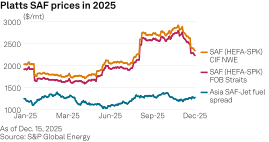
SAF prices have rallied since the beginning of 2025 as European end-users sought compliance with the EU's 2% blend mandate, boosting CIF Northwest Europe values.
Platts assessed SAF CIF NWE price up about 15% year-to-date at $2,342/mt on Dec. 15, after touching a high of $2,921/mt in November, with traders citing a "short squeeze" as buyers scrambled to secure barrels for ReFuelEU mandate compliance.
In Asia, SAF FOB Straits assessments started in 2025 at $1,946/mt, climbed to highs of $2,796/mt in November before easing to $2,234/mt on Dec. 15.
An Asian-based broker expects SAF prices to stabilize at $2,300-$2,400/mt in the first quarter of 2026 as EU demand cools and China supply rises.

Editor: