Crude Oil, Maritime & Shipping, Wet Freight
December 10, 2025
China Merchants Energy Shipping sees robust VLCC market through 2026-28
HIGHLIGHTS
Strength driven by limited tanker supply, healthy demand
Refining capacity tightness, Chinese inflows aid long-haul demand
China Merchants Energy Shipping expects the global supertanker market to remain strong through 2026 and potentially into 2027-28, supported by a constrained supply of modern compliant tankers and a healthy demand outlook, Secretary of the Board of Directors Kong Kang said during an investor call Dec. 8.
The Shanghai-listed company, one of Asia's largest VLCC operators, expressed a bullish outlook, anticipating that structural supply-demand tightness will support the VLCC market for several years.
CMES said it expects the VLCC freight midpoint in 2026 to exceed that of 2025, while the outlook for 2027 remains uncertain but is unlikely to worsen, given the continued growth in long-haul flows and global refinery capacity constraints.
VLCC freight on the Persian Gulf-China route reached an all-time high of w143 on Nov. 25, according to Platts assessments from S&P Global Energy. During the first three quarters of 2025, freight rates remained rangebound, with the Persian Gulf-China average at w59.6 in the first quarter, w60 in the second quarter and w64.6 in the third quarter, Platts data showed.
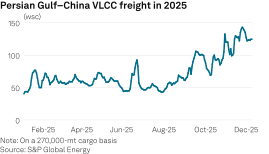
Factors, including increased demand for non-sanctioned vessels as some Chinese and Indian oil refineries reduce their Russian crude imports, have boosted rates in the fourth quarter, with the quarterly average at w108.6 as of Dec. 9, according to Platts.
Crude oil volumes being transported via sea hit an eight-year high of 1.96 billion barrels as of Nov. 16, data from S&P Global Commodities at Sea show.
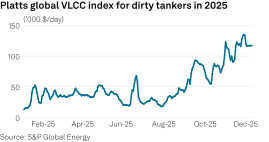
Meanwhile, the Platts global VLCC index for non-scrubber, non-eco ships has remained firm above $50,000/d since September. The index's year-to-date average was $51,431/d as of Dec. 9, more than 60% higher than the first assessment in March 2024.
CMES said tighter global refining capacity and limited Chinese product export quotas are additional long-term factors supporting long-haul tanker demand.
"Tight global refining capacity has pushed crack spreads back to historic highs, supporting downstream profitability and tanker demand," Kong said.
CMES cited maritime consultancy Clarksons' data indicating that 41 new VLCC orders were placed in the past three months, with top-tier Chinese yard slots effectively sold out until 2028 and global mainstream shipbuilding capacity limited to roughly 40-50 VLCCs/year.
This is particularly relevant as older vessels face increasing compliance constraints. By 2029, some 319 VLCCs will reach 20 years of age, and those already over 18 years old are struggling to secure compliant cargoes due to safety, insurance and chartering restrictions, according to Kong.
Kong said demand growth -- rather than supply tightness alone -- is the primary driver of the current upcycle in the VLCC market. He said winter 2025 rates remain elevated mainly because "tanker demand exceeded market expectations," and that new supply will likely fall short of compliant-market demand until the second half of 2028 based on the order book.
Outlook
VLCC spot rates have held firm from August to November as long-haul loadings from Brazil, Guyana, West Africa and the US Gulf Coast "exceeded expectations," while Middle Eastern supply recovered into the fourth quarter, according to Kong.
Western restrictions on "sensitive barrels," including Russian grades, are gradually reshaping trade patterns and supporting ton-mile demand for compliant owners, he said.
CMES noted that 160-165 December-loading VLCC cargoes had been fixed by the end of the trading week on Dec. 5, with abundant activity in both the Middle East and Atlantic markets.
Time-charter inquiries have also risen, with multiyear VLCC hire assessments reaching a three-year high of over $60,000/d recently, according to Kong. Inquiries for one- to three-year time charters are rising, but owners are reluctant to commit, showing strong confidence in the outlook for the next three years, he said.
Chinese crude imports
China's crude imports have been a key driver influencing VLCC demand, with inflows up about 3.1% year over year over January-October, according to CMES.
Kong said the market should focus not only on absolute volumes but also on the "structure, origin and trend" of imports, including shifts among Middle Eastern, Atlantic and Russian barrels.
He said shifts in the procurement strategy for commercial inventories and strategic stockpiles will continue to shape China's purchasing decisions and shipping demand.
CMES, part of state conglomerate China Merchants Group, has continued to engage in compliance-related trades despite Beijing's official rejections of Western sanctions on Russia, Iran and Venezuela.
The company said Western insurance restrictions and recent disruptions to Black Sea infrastructure have widened discounts for Russian grades and reshaped trade patterns. Premiums for ships carrying Russian-related cargoes have surged to about 1% of the ship-plus-cargo value, equivalent to roughly $3 million for a VLCC, according to Kong.
ESPO shipments to China fell to 690,000 b/d in November, the lowest in 18 months, as state-owned refiners paused procurement amid heightened risk, Kong said. Meanwhile, Indian refiners have increased their sourcing from West Africa, Brazil and the Middle East, driving additional ton-mile demand, he said.

Editor: