Chemicals, Olefins, Polymers
November 06, 2025
Limited competitiveness, weak demand, rationalization: circular polymer markets grapple with bearish conditions

HIGHLIGHTS
Illiquid pricing cements substantial premiums over fossil products
Structural demand development continues to lag, sentiment pessimistic amidst rationalization
Scaling, legislative targets and shifting virgin trends provide opportunities for H2 of decade
As 2025 draws to a close, European chemical and polymer market players developing circular solutions find themselves reckoning with uncertainty surrounding the future of their industry, following a year in which pronounced weakness in market conditions has persisted.
"A deep competitiveness crisis is suffocating the industry," trade association Plastics Recyclers Europe said in a Sept. 4 statement. "This is not only a threat to the competitiveness of Europe's industry, but also its ability to meet circular economy and climate goals."
Subsequently, stakeholders across the continent's chemical industry find themselves at a crossroads regarding sustainability, weighing consistent enquiries from consumers and broader pushes in public discourse towards a transition to the circular economy against difficult affordability conditions and structural pressure in fundamentals, which continue to weigh on the industry.
Weak pricing competitiveness continues
Sentiment within the circular polymer and chemical industries has shifted heavily from the outlook voiced at the start of the decade. In these early years, as the industry saw increasing demand and wide proliferation of projects focused on waste plastic recycling, stakeholders in mechanically recycled industries commonly asserted that the sector was disconnecting from trends in its fossil fuel-based counterpart, anticipating the foundation of stronger demand and more competitive pricing for the former materials as a result.
This expectation has not held. Demand destruction in the post-pandemic marketplace for virgin polymers provoked strong bearish pricing trends across both spot and contract pricing, while a continued lack of capacity for recycled polymer products has limited the potential for similar trends on the recycled side.
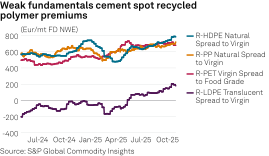
Recycled high-density polyethylene natural pellet spot prices have averaged Eur1,691/mt DDP Northwest Europe across 2025 to date, a negligible change from 2024 averages of Eur1,716/mt, according to Platts data. By contrast, virgin HDPE injection spot prices have averaged Eur1,033/mt FD NWE, down 8% from 2024.
While demand for polymer material remains weak across the board, consumers consistently favor the discounted virgin material, prioritizing affordability to boost margins amid anemic demand from downstream markets and end-user industries.
Similar trends are seen across other alternative chemical value streams. Platts has consistently been quoted spot pricing levels at a minimum of double the price of fossil-based product for bio-olefin and aromatic chemicals, a trend set by pricing divergence in upstream feedstock markets where bio-naphtha premiums have averaged Eur753.84/mt FOB NWE to fossil-derived naphtha.
Chemically recycled material is also consistently quoted at a minimum of double the price of virgin product.
"For chemical recycling ... basically everything suffers from way too high raw material specifications, which cost you easily $500/mt, and treatment costs of a further $400-$500/mt, and further yield costs," Eric Appelman, chief revenue officer at Canada-headquartered advanced recycling firm Aduro Clean Technologies, told Platts in an Oct. 30 interview. "This is why many programs and projects in this sector are being delayed."
Such pricing premiums are a critical hurdle weighing large-scale adoption of alternatives to virgin materials, with demand currently generally limited to major brand owners who can more readily offset premium-priced material in their operations.
"If there was a price parity between the alternative solutions against fossil, we would be in a totally different scale and ballpark with the solutions," Maiju Helin, director of the Polymers and Chemicals Unit at Neste, a Finnish oil and renewables refiner and producer of renewable and circular feedstock for polymer and chemicals, told Platts in an Oct. 21 interview. "It would be hard for me to see that there will be a price parity between fossil and alternative solutions in the next years."
Knock-on effect on immediate market conditions
This difficulty drawn from a lack of pricing competitiveness has exacerbated weakness in underlying demand for sustainable materials, with the need for chemical and polymer material already weak due to ailing construction and automotive industry conditions across Europe, key sectors in polymer consumption.
With the scale of supply limited across mechanically recycled, chemically recycled and bio-based markets, sector conditions have continued to wane across 2025, when combined with a broader trough in conditions across chemical and polymer value chains and pressure from supply expansion of fossil-based materials from regions such as Asia, prompting widespread pessimism and uncertainty in outlook for stakeholders focused on non-fossil alternatives.
This weakness in market fundamentals and severe pressure on margins from the high cost of materials have materialized structurally on the industry's landscape across 2025, with a variety of production facilities canceled and projects delayed in response to the downturn. Almost 1 million metric tons of existing European recycling capacity is expected to have been lost between 2023 and the end of 2025, according to PRE.
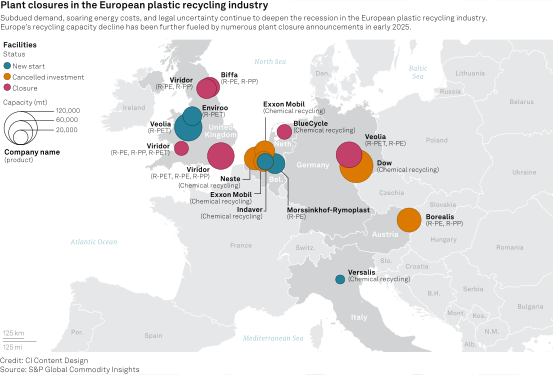
These rationalizations have outpaced announcements of new capacity or facilities across the continent, further fueling pessimistic sentiment from market participants.
Such troughs and capacity cuts in circular markets reflect broader weakness in fundamentals for plastics and chemical markets, with similar closure announcements seen in fossil derived markets as the industry grapples with structural oversupply and anemic demand.
By 2027, 7,315,000 mt of olefin capacity with be rationalized in Europe, with chemical majors such as Dow, Shell, BP, Sabic, LyondellBasell and Versalis announcing closures and operational reviews of various European assets.
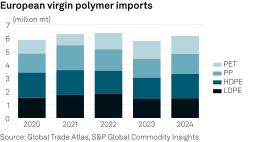
A lack of competitiveness against Asian, Middle Eastern and North American markets is a primary driving factor fueling the closures in the fossil-based market, a dynamic which has added further pressures to circular product value chains. Aggressive capacity expansion in these other regions has cemented Europe as an attractive export destination with consumers keen to prioritize low-cost product, denting demand for EU-origin recyclate.
Outlook and effectiveness of legislation
Given the difficulty in market conditions, the short-term market outlook for 2026 is broadly pessimistic. Any substantial demand recovery from key downstream construction sectors are noted to be predicated on a conclusion to Russia's war in Ukraine, while any erosion in pricing premiums is not expected imminently amid structurally short supply for sustainable materials.
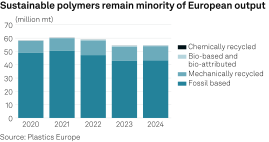
Mechanically recycled, chemically recycled and bioplastics only account for 20.7% of the 54.6 million metric tons of plastics capacity in Europe, according to data from Plastics Europe.
Subsequently, industry stakeholders have persistently called for further legislative and regulatory support to help facilitate competitiveness for the markets, with current measures prompting limited success so far. Despite legislation such as the Single-Use Plastic Directive and the Packaging and Packaging Waste Regulation coming into force this year, market sources indicate that these measures lack the necessary penalties or financial incentives to substantially drive demand.
SUPD mandates that beverage bottles include a minimum of 25% recycled content by 2025, while PPWR aims to expand the targets set by SUPD to cover other plastic packaging applications. However, both segments have seen a substantial decline in demand across 2025. Further concern has been raised due to the lack of attention paid to the nuances and different challenges faced by alternative streams of renewable and recycled product streams within current legislative frameworks.
"The hurdle is implementation -- first we need to be quite fast in initiating legislation but also allowing a technology neutral approach ... the current rules put complementarity between chemical recycling and mechanical recycling at risk because factually it's making them compete for the same raw material and clean plastic waste" Heilin said.
Similar concerns have been voiced in the bioplastics sphere. "Current EU policy frameworks remain fragmented and inconsistent, often falling short of creating an enabling environment," industry association European Bioplastics told Platts in a September interview. "While there is growing high-level political recognition of the bioeconomy's potential, such as through the European Green Deal, the upcoming European Biotech Act in 2025, and the proposed Circular Economy Act, key structural barriers persist."
Despite the uncertainty across both legislative, supply and demand facets of the market, participants do continue to express optimism on the longer term, with consumer interest in the materials consistent even without more consolidated demand at present. Complementarity between different value chains in the sector, combined with broader public discourse surrounding improved sustainable practices and transition to the circular economy.
"Something has to be done on creating a market," Appelman said, noting that a critical component is that "the recycling industry needs to really work on a comprehensive set of technologies that can operate at low cost."
Expressing similar sentiment, Heilin also emphasized the strength of a collaborative approach to the market.
"All these three [mechanical recycling, chemical recycling and bioplastics] have their own strengths and they should play with their own strengths in their own field," she said. "Whether that's for emission reduction, circularity or alternative raw materials, all can be seen as positives which signal potential to scale up and grow."

Editor: