Refined Products, Chemicals, Naphtha, Olefins
October 09, 2025
Russian naphtha finds home in Taiwan as South Korean buyers pull away
By Max Lin, Gawoon Vahn, and Zoey Ng
HIGHLIGHTS
Formosa Petrochemical emerges as top buyer of Russian naphtha
Taiwan's naphtha imports from Russia stir criticism amid Ukraine stance
South Korea shuns Russian naphtha, diversifying feedstock sources
Russia has found a new top buyer for its naphtha: Taiwan's Formosa Petrochemical Corp. But the ethylene producer's move, driven by a shift to discounted feedstock, has stirred criticism due to Taiwan's diplomatic stance toward Ukraine.
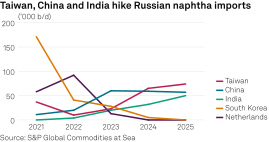
While South Korea and the Amsterdam-Rotterdam-Antwerp region were the top destinations for Russian naphtha in 2021 -- the year before Russia invaded Ukraine -- Taiwan, China and India have emerged as the largest buyers in recent years, according to S&P Global Commodities at Sea.
Formosa Petrochemical, Asia's top naphtha buyer with three crackers that can produce 2.93 million metric tons/year of ethylene, is coming under the spotlight as the Taiwanese government has publicly supported Ukraine and sided with the US and EU, while China and India have long signaled their willingness to purchase Russian oil despite Western pressure.
Earlier this month, a group of nonprofit organizations led by Finland-based Centre for Research on Energy and Clean Air named Formosa Petrochemical as "the single largest known buyer of Russian naphtha in the world" since the Ukraine war broke out.
Taiwan imported 6.8 million mt of naphtha worth $4.9 billion from Russia between February 2022 and June 2025, equal to 20% of the country's total exports, according to the nonprofits, which warned in their research report: "Continued purchases could compromise Taiwan's image as a reliable partner and undermine diplomatic relations with the US, EU, and other strategic allies."
After the report's release, Taiwan's economy ministry said state-owned CPC -- the only other Taiwanese naphtha buyer -- has halted Russian oil purchases, but that the private sector is still importing naphtha as there is no official ban. Taiwan has stopped buying Russian crude.
"We will comply with relevant EU and G7 regulations," Minister of Economic Affairs Kung Ming-hsin told Taiwanese lawmakers Oct. 8. "The private sector has committed to not buying Russian naphtha if the EU doesn't allow it to buy."
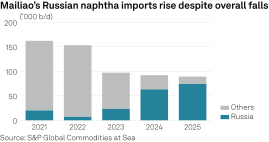
Russia has exported 397,000 b/d of naphtha so far this year, of which 74,000 b/d was destined for Taiwan, the largest buyer, CAS data shows. All of the barrels have gone to Mailiao, where Formosa Petrochemical's plants are based, and whose imports of Russian naphtha only amounted to 20,000 b/d in 2021.
Different way
In contrast, South Korea -- which has also sided with the West and imposed sanctions on Russia following the Ukraine war -- has moved away from Russian naphtha in recent years.
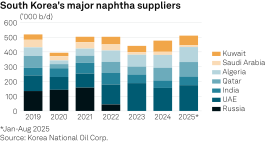
Russia was South Korea's top naphtha supplier in 2021 as Asia's fourth-biggest oil consumer took 157,918 b/d of the light distillate product from the northern neighbor. However, South Korea completely stopped purchasing Russian naphtha in July 2022, data from state-run Korea National Oil Corp. showed.
Feedstock managers at major South Korean petrochemical makers told Platts over Oct. 3-8 that they have completely shunned purchasing Russian naphtha for the past few years, comfortably replacing Russian supplies with other alternative grades. However, they noted that the diversification of the feedstock trading has had some impact on their cost economics.
According to Platts assessments, the monthly average discount of Russian naphtha was as wide as $34.524/mt in November 2024, before narrowing to $2.67/mt last month amid falling Russian suppliers.
In late 2024 , South Korea's Yeocheon NCC awarded its January-December 2025 term naphtha contract at a premium of $1.50-$2/mt to the monthly average of Mean of Platts Japan naphtha assessments, on a C&F Yeosu basis, market sources said. Formosa Petrochemical fixed its annual term tender for light naphtha with a minimum 70% paraffin content at a discount of $30-$35/mt to the monthly average of MOPJ naphtha assessments, C&F Mailiao.
Among the petrochemical companies vying for a competitive edge in the Asian petrochemicals export markets, the key to success lies in effectively controlling and analyzing profit margins, feedstock and logistics managers at three South Korean refiners and petrochemical firms recently said.
Olefin production margins have remained persistently weak for several years, staying below the typical breakeven spread of $250/mt for integrated producers and $300-$350/mt for non-integrated producers.
Platts-assessed C&F Northeast Asia ethylene spread to Japan naphtha has averaged $227.69/mt in the year to date as of Oct. 8, slightly above the 2024 average of $204.77/mt and 2023 average of $203.22/mt, according to S&P Energy data. Margins have plummeted since reaching their peak at an average of $399.01/mt in 2020.
To achieve optimal margins, the foundational step is to identify who can initiate operations with the most economical feedstock, the petrochemical feedstock management sources said.
"If there are competitors taking advantage of cheaper Russian naphtha, they will grab the edge in the margins game... but anything Russian is too much of a business risk and it's not worth it," a feedstock strategist at a South Korean petrochemical maker based in Daesan said.
More purchases
Russian naphtha has made up 60% of Formosa Petrochemical's total imports in 2024 and 85% so far this year, but the increase is related to global market conditions rather than a deliberate shift in procurement strategy, the Taipei-listed company said Oct. 1.
"All of our tendering is procured through public tendering without restriction on country of origin," Formosa Petrochemical said in a statement. "In recent years, due to global market conditions, most bidding suppliers have delivered Russian naphtha."
President Lin Keh-Yen told Platts that if the EU or the Taiwanese government explicitly bans Russian naphtha, Formosa Petrochemical will stop its purchases. Lin added that the company is also considering not buying Russian naphtha to limit business risks but has not made any decisions. Like other Taiwanese firms, Formosa Petrochemical -- which also has a 540,000-b/d oil refinery -- has ceased Russian crude imports.
The EU and G7 have imposed two price caps on Russian exports of petroleum products. The nonprofits have accused Formosa Petrochemical of potential violation as naphtha could be seen as light oil for undergoing a specific process under Combined Nomenclature code 27101211, which has a cap of $45/b. But Formosa Petrochemical said its purchases were under CN27101290, and the company has complied with the higher cap of $100/b as required.

Editor: