Chemicals, Olefins, Polymers
September 30, 2025
APLA 2025: Oversupply, tariffs reshape olefin chain trade between Asia, Americas
HIGHLIGHTS
Market expects changes in the US-Brazil-Asia ethylene chain trade
China PP producers aim to strengthen Latin American foothold
This feature is part of a series setting the stage for the APLA conference in Mexico by exploring the scenarios for supply and demand of chemicals and polymers in Latin America for the rest of 2025. The previous story is here.
The olefins value chain is experiencing fluctuating market dynamics. Oversupply, rising tariffs and geopolitical tensions have set the stage for a shift in trade flows between Asia, Latin America and the US.
Olefins
During 2024 and Q1 2025, the US ethylene spot market faced several planned and unplanned plant outages, as cracker maintenance was due for older plants. This had the effect of boosting spot buying and pushing prices higher, closing the arbitrage to other regions.
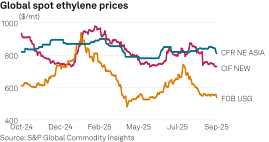
US tariffs also created an environment of uncertainty that halted international trade flows, particularly into Asia.
As a result, between Q2 2024 and Q1 2025, US ethylene export levels decreased significantly, by 61%, according to US International Trade Commission data. China and Indonesia, the two main US ethylene destinations overseas since 2023, saw a significant reduction in US import volumes during the first half of 2025.
Even after geopolitical tensions between the US and China eased later in the year, the Asian players did not regain their position as main export markets, with European countries accounting for over 80% of the exported volume in Q2 2025.
China recently surpassed the US in installed ethylene production capacity, partly composed of ethane crackers, facilitating a trade flow with the US to supply the feedstock.
The US market has new facilities to serve upcoming export markets. Navigator Holdings and Enterprise Product Partners built an ethylene and ethane export terminal at Morgan's Point, Texas, which has a capacity of 1.55 million metric tons per year following a December 2024 expansion.
Other US olefins could develop tighter ties to Asia, with propane export demand expected to rise following the expansion of Energy Transfer's LPG Nederland terminal and Sinopec's Zhenhai Refining & Chemical Co. Ltd.'s 600,000 mt/y expansions at its PDH plant in Ningbo, China.
PP volumes into LatAm
Asian polyolefin suppliers are making a push for market share in key countries, with regional producers left to combat increasingly aggressive pricing amid a sluggish economic backdrop.
An Asian producer indicated they are attempting to penetrate Latin American markets, particularly polypropylene, where they feel more competitive.
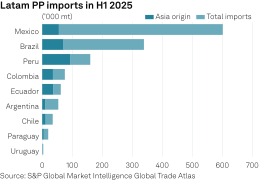
PP imports from China and South Korea have gained substantial market share in Latin American countries, with China-origin cargo commanding the most competitive export prices.
Despite increased competition, some buyers prefer domestic PP, even at higher prices, owing to faster deliveries and reduced volatility brought by foreign exchange rates and freight, according to market sources.
The same producer said they are considering opening warehouses in Brazil, Mexico, and Peru to enhance logistics and delivery times and potentially capture market share from regional competitors.
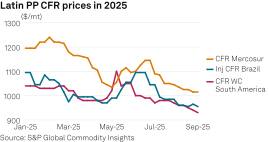
Market feedback indicates that CFR WCSA prices for Asia-origin homopolymer PP range from $910-$980/mt, while prices for PP from South America and the US range from $1,000-$1,080/mt.
Platts, part of S&P Global Energy, assessed homopolymer-grade PP at $930/mt CFR West Coast South America Sept. 24, levels last seen since June 2020, according to Platts data.
Platts assessments for CFR Mercosur and CFR Brazil showed similar downtrends.
"Everything related to consumption of families is very slow," said a Brazil-based trader. "Even when the product is very cheap, demand is not moving because clients have a lot of stock."
Asian PP dominates the import market for WCSA countries, in part due to generally lower and quicker freight. In contrast, other Latin American markets exhibit stronger intraregional trade.
PE trade flows
The situation is different for Asia-origin polyethylene, which is losing competitiveness and shrinking in market share in Latin America compared to US PE, which dominates the import market across most Latin American countries.
However, recently imposed anti-dumping duties on US PE imports have led Brazilian buyers to explore alternatives, some of which are Asia-origin.
A second Asian producer noted that due to the ADDs on US PE, there had been an uptick in quotation inquiries from Brazilian buyers, but ultimately, consumers remained hesitant to buy.
Closing deals has proven "challenging," according to the first Asia-based producer, since the desired prices were too low and market dynamics were still weak.
"Our FOB China price is similar to the desired CFR Brazil prices," the source said.
Platts assessed HDPE blowmolding at $855/mt CFR Brazil on Sept. 24, a level last seen in June 2020, according to Platts data.
The ADDs are opening new arbitrage opportunities between Asia and the US. In the US, participants have discussed exporting surplus to Asia since August, as PE prices have continued dropping, and demand in Latin America has failed to provide relief to the US' oversupply.

Editor: