Chemicals, Polymers
September 23, 2025
Consumer income pressure erodes appetite for recycled goods, resin in US

By Tareen Kazi
HIGHLIGHTS
Consumer demand for recycled goods tied to income sensitivity
Higher prices for recycled content limit sustainability ambitions
Weak economic conditions test corporate recycling commitments
US consumers have shown an increasing appetite for goods made with recycled content, ranging from sustainable packaging incorporating post-consumer resin like recycled HDPE to bottles made with recycled PET.
However, it is primarily defined by income sensitivity. While interest in eco-friendly consumer goods remains, the green premium tied to recycled resins often outweighs sustainability ambitions in weaker economic conditions, sources said.
A McKinsey & Company survey this year found that 44% of US consumers ranked environmental impact as "extremely" or "very important" in packaging choices, returning to 2020 levels. And 62% of respondents said recycled content and recyclability were the top attributes.
Those preferences, however, face limits when higher prices collide with shrinking household budgets.
"I think the majority supports goods made with recycled contents," a source from a material recovery facility said. "But if you ask, 'Are they willing to pay 25% more for a bottle made with recycled plastic?' that answer will change."
Labor-intensive processes
Consumer goods incorporating recycled content often carry a green premium, a price increase that reflects the labor-intensive processes involved in obtaining recycled materials. These processes include the sorting, washing and processing post-consumer materials like PET.
Also, the scarcity of certain materials, like high-density polyethylene natural bales, adds to the green premium. Due to its versatility and ease of coloring, this material is a popular sustainable substitute for virgin polymers in personal care product packaging.
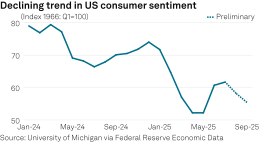
The recycled market largely depends on consumer purchasing behavior. Consequently, demand for recycled goods is limited by weak macroeconomic factors, primarily driven by consumer sentiment and income levels.
"Consumers drive the appetite for recycled material in their product, but consumer sentiment has been steadily ticking down throughout the year," a second materials recovery facility source said. "Now people are pinching every penny."
Consumer sentiment has declined since 2024, according to data from the Federal Reserve Bank of St. Louis. Inflation, tariffs and geopolitical uncertainty continue to weigh on household spending, amplifying the squeeze on demand for recycled goods and, in turn, recycled resin.
Weak consumer demand has begun to ripple up the value chain, with fast-moving consumer goods companies recalibrating ambitious sustainability targets. Unilever, for instance, adjusted its virgin plastic reduction target to 30% by 2026, down from a previous goal of 50% by 2025. However, the company did maintain its recycled-content target of 25% by 2025, with current progress at 22%.
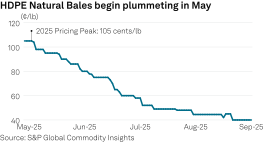
Post-consumer markets like recycled HDPE natural remain particularly sensitive to brand decisions. After more than a year of a bullish rally, rHDPE natural bale prices fell from their May 2025 highs as brand demand weakened, according to Platts data.
"There is no demand from brands to use PCR," a pellet buyer who works with these brands said. "Even if virgin comes up in price, PCR is still at a significant premium. There's the cost of running trials, new blends, etc."
Income discrepancy plays a large part as well. A 2025 study, Income Inequality in the Uptake of Environmentally Friendly Products, by Martina Maglicic and Vítor V. Vasconcelos, found that this adoption is closely tied to income levels and is unevenly distributed. Higher-income individuals prioritize social desirability and environmental consciousness, whereas lower-income groups focus more on financial limitations.
Demand for recycled resins remains tethered to consumer willingness to pay, exposing the market to weak macroeconomic conditions. While sustainability remains on consumers' radar, affordability ultimately dictates the consumer's purchasing decision. The positive income elasticity of demand for recycled goods will continue to influence demand for the recycled resin market, while testing how resilient corporate commitments can be when wallets tighten.
Platts assessed post-consumer HDPE natural bales at 40 cents/lb EXW Chicago and post-consumer PET curbside bales at 3 cents/lb ex-works Chicago Sept. 22.

Editor: