Refined Products, Chemicals, Naphtha, Olefins, Polymers
September 02, 2025
South Korea to shut nearly 3-4 naphtha crackers to meet govt's restructuring guidance
HIGHLIGHTS
South Korea’s PDH plants likely to be shut
Detailed plan remains fluid
South Korean steam cracker operators will likely shut 3-4 naphtha-fed units to reduce capacity by 2.7 million-3.7 million mt/year as guided by the government, according to market and industry sources.
"Three or four steam crackers will be shut down to meet the guideline," said Paul Joo, director of olefins and derivatives at S&P Global Energy.
South Korea needs to reduce its naphtha-fed steam cracker capacity by 2.7 million-3.7 million mt/year, the country's Ministry of Trade Industry and Energy said Aug. 20, to focus on producing high-value specialty products amid declining olefins margins.
Joo said it is up to each petrochemical company to develop their restructuring plans.
"PDH plant operations have been below 100% in South Korea amid negative margins. I think some PDH plants will be shut down under the restructuring plan," a market source said.
The ministry has asked petrochemical companies to submit their detailed plans by the end of the year, Platts reported previously.
Market sources said it would take time, as further negotiations would be necessary with plant workers.
South Korea's ethylene capacity is at 13 million mt/year. Based on this, the capacity reduction is estimated at 20%-28%, Platts data showed.
"It will take some time until South Korea shuts down steam crackers. Lots of negotiations and discussions are necessary for chemical companies to come up with their restructuring plan," said an industry source.
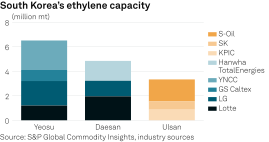
South Korea has three key petrochemical complexes -- Ulsan, Daesan and Yeosu.
The restructuring plan is already underway in Daesan. Lotte Chemical and HD Hyundai Group plan to integrate their naphtha cracking facilities in the Daesan petrochemical complex, Platts reported previously. This is a strategic move to navigate the challenging landscape of the South Korean petrochemical sector amid poor margins. In Daesan, Hanwha TotalEnergies also operates a steam cracker.
But plans in Yeosu and Ulsan are still fluid. In Ulsan, two steam crackers, owned by SK and KPIC, are currently operating. S-Oil plans to start up its new steam cracker there in 2026. The cracker can produce 1.8 million mt/year of ethylene and 770,000 mt/year of propylene.
In Ulsan, some industry sources said PDH plants will also likely be mothballed. South Korea's Taekwang's PDH plant will remain shut until the end of 2025 due to negative margins. The PDH plant has been shut since December 2024 and produced 300,000 mt/year earlier. A company source said the plant will likely remain shut for now.
Hyosung Corp. shut its 200,000 mt/year No. 1 PDH plant in May 2024. Its 350,000 mt/year No. 2 PDH plant has been running at 90%, a company source said Aug. 27.
SK Advanced has a PDH plant in Ulsan with a propylene capacity of 600,000 mt/year. The PDH plant was restarted in early August after the turnaround, Platts reported previously.
In Yeosu, Yeochun NCC shut its No. 3 naphtha-fed steam cracker on Aug. 8 amid negative margins, Platts reported previously. It is unclear when the cracker will be restarted. The cracker can produce 500,000 mt/year of ethylene and 240,000 mt/year of propylene.
On Aug. 14, YNCC approved Aug. 14 a capital injection and a comprehensive financial support package for YNCC, which would ensure smoother operations as part of a long-term improvement plan, according to a letter to YNCC customers.
Three other chemical companies – Lotte, LG Chem and GS Caltex – operate their steam crackers in Yeosu.
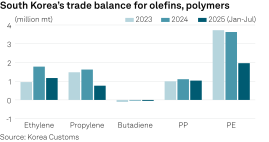
South Korean trade flow
Joo expects South Korea to remain an exporter of ethylene and propylene after capacity reduction.
South Korea's ethylene exports from January to July stood at 1.176 million, compared to imports of 7,532 mt, according to the latest customs data. The country's propylene imports were 960,421 mt over the same period, while imports were 199,935 mt.
Meanwhile, South Korea has become a net importer of butadiene since 2023. From January to July, its butadiene exports stood at 160,032 mt, while imports were at 209,168 mt, according to Korea Statistics.
In polymers, South Korea exported 1.05 million mt of polypropylene from January to July, down 6.5% year over year. It imported 19,305 mt of PP, mainly of the grades that South Korean producers do not make, up 11.07% from a year ago.
In polyethylene, South Korea exported 1.86 million mt/year from January to July, while imports stood at 146,712 mt, the customs data showed.
Joo said South Korea exports around 60% of its total polymer production and this trend will likely remain after the capacity reduction. He expects nearly 50% of South Korean production to be exported after the cracker restructuring.
On Sept. 1, Platts assessed the CFR Northeast Asia ethylene price stable from Aug. 29 at $840/mt.
