Chemicals, Polymers
August 29, 2025
PE market stability 'best-case scenario' for Americas in September: participants
HIGHLIGHTS
HDPE blowmolding pricing drops $15-$40/mt on month
Most foresee a hard September amid unchanged fundamentals
Some hope remains for seasonal economic reactivation in Q3
Across the Americas, polyethylene market participants are mainly hoping for the decline in prices to slow down in September, with stability the "best-case scenario" for the market, sources said.
The Americas PE market was mired by bearish sentiment in August that saw year-to-date and all-time low prices in some markets. However, weak demand and oversupply has been heightened by trade and political factors.
"Production rates in the US are high," a Colombia-based trader said. "I don't see how to correct upwards. Moreover, customers are selling little, so their inventories are stretching further. In the best-case scenario, the decline stops."
Price declines were a consistent feature of the PE markets across the Americas in August. Platts, part of S&P Global Energy, assessed US blowmolding high-density PE at $816/mt FAS Houston on Aug. 27, down $22/mt, or about 3%, from July 30.
Over the same period, prices for the same grade fell $35/mt basis CFR Brazil and dropped $15/mt delivered Argentina. Blowmolding HDPE prices in West Coast South America fell $20/mt CFR in the same period, while Mercosur prices fell $40/mt CFR, respectively.
In Mexico, HDPE blowmolding prices fell $30/mt from July 30, Platts data showed.
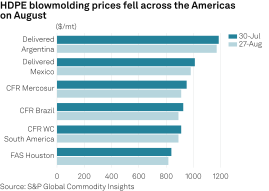
All other grades across the Americas PE markets followed the same trend over August, with prices for low-density PE film grade and several linear LDPE grades in the US reaching year-to-date lows. All three assessed Argentine HDPE prices fell to the lowest prices on record in August, Platts data showed.
Participants throughout North and South America fear the same trend will continue during September.
A US-based distributor said replacement costs must drop between 1-3 cents/lb during September, as workable margins have been very difficult to achieve.
Some producers have been announcing price increases for September, a Paraguay-based distributor said, adding, however, that "not a single client believes that."
Several sources also said it was unlikely that supply and demand conditions would strengthen. In Mexico, a producer continued to point to high availability on both the seller and buyer sides. In Peru, a trader said there was no way to overcome the current oversupply.
"The problem is the lack of widespread consumption," the Peru-based trader said.
However, some sources did expect fundamentals would change slightly in September, either in favor of higher prices or further depressing prices.
A US-based trader said there was "not a lot of space to move lower," while a Mexico-based source hoped demand would increase as spending in general starts to normalize at the end of the summer holiday period.
Sentiment uncertain on trade, capacity and politics
Some events were throwing additional uncertainty into the market, with the announcement of new preliminary antidumping duties in Brazil causing the most concern among participants.
Even though most Latin America- and US-based sources had already expected the duty since US President Trump leveraged 50% tariffs on several Brazilian imports starting Aug. 1, most still were unsure what effects to expect.
"Everyone's still trying to understand how things will work from now on with the anti-dumping duty," a Brazil-based source said. "US imports will not cease; instead prices will be leveled up."
In Mexico, major local PE producer Braskem-Idesa recently resumed production, increasing product availability and further increasing worries as to how the stream of supply might push prices lower in the coming weeks.
Meanwhile, state-run Pemex announced plans to substantially increase its PE capacity in Mexico in the next few years, although some sources doubted whether the short-term goals could be met.
Further south, Argentina-based sources were closely watching regional and federal election processes amid a delicate economic situation that has reduced end-consumer purchasing power and increased costs across productive chains due to an increasingly expensive US dollar.
Although several sources have said President Milei's policies are promising for economic development, his party would need to win the upcoming October federal legislative elections with a comfortable margin to enact several pending legislations. Buenos Aires' regional election, scheduled for the first weekend of September, could give a glimpse of his party's chances for achieving the necessary votes in October.
