Chemicals, Polymers
July 29, 2025
High cost of recycled plastic pellets in Asia, US limits recycling adoption

By Hui Heng
HIGHLIGHTS
Recycled plastic prices exceed virgin costs, hindering adoption
Brands soften sustainability goals amid rising recycled prices
Recycling faces challenges like quality issues, supply inefficiencies
Recycled plastic pellets in Asia and the US have been significantly more expensive than their virgin counterparts, limiting adoption amid several recycling challenges, including supply constraints due to collection inefficiencies and processing limitations, sources said July 29.
Platts, part of S&P Global Energy, assessed the monthly average of recycled polyethylene terephthalate clear flakes' price difference to virgin PET pellets at $74-$100/mt in Asia, while the spread of recycled PET natural pellets to virgin was $22.45-$128.36/mt in the US in July.
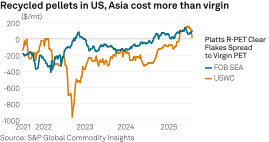
Prices for recycled plastics fluctuate based on demand for virgin plastics and regulatory changes. A slump in crude oil prices since April has decreased the cost of virgin plastics, making recycled options less attractive.
Consequently, buyers began reevaluating the premiums they were willing to pay and the levels of recycled content they would like to include in their products.
Several key consumers have softened their sustainability pledges. Coca-Cola confirmed it had pushed its 2030 goals to 2035 and lowered its recycled content target, according to a press release. Pepsi followed suit, updating its packaging target to 40% recycled content by 2035, less ambitious than its previous commitment of 50% by 2030, according to its website.
Plastic packaging consumption has plateaued, with recent data showing no significant rise, recyclers said. Brand owners had increased the recycled content in their packaging by up to 16% in 2024, resulting in reductions of about 3 million-4 million mt of virgin plastics annually, according to Energy analysts.
However, the broader impact of the increase in brand owner recycling on global recycled demand has been limited. Major brands represented only about 5% of global plastic consumption, and those using approximately 12 million mt of packaging constituted roughly 10% of the global plastic packaging market, Energy analysts said.
One major brand reiterated that its commitment centered on reducing prime resin usage 50% by 2030, not necessarily by replacing it with recycled content, but by employing strategies such as product lightweighting. The brand added that they were exploring paper-based alternatives to meet regulatory and sustainability requirements.
The lower prime price was only one factor under consideration, with many end-converters citing the absence of recycling mandates in Asia and the Americas and the ease of using prime resin as key reasons for their preference toward virgin, buyers said.
Hurdles to overcome
The recycling sector has been burdened by persistent supply constraints, particularly in collection inefficiencies, processing limitations and inconsistent material quality.
PET is the most recycled polymer in the world. Over two-thirds of R-PET goes into fiber applications, which have less stringent quality requirements than packaging resins. They require less cleaning and are usually less costly than virgin materials, but cleaning and processing costs to make R-PET suitable for use in beverage containers could occasionally make it more expensive than virgin resin.
A key challenge is ensuring quality consistency. Brand owners noted difficulties in switching suppliers as their qualifications require stringent checks on quality and reliability, including the recycler's financial stability, sources said.
However, most recyclers are small businesses and waste quality is often hard to control, sources said, adding that public misinformation leads to confusion about what can be recycled, resulting in improper disposal and contamination.
The lack of standardization also hinders recyclability and many regions, especially in developing countries, lack facilities for efficient collection, sorting and processing.
Overcapacity in the prime polymers space has a long-term impact on recycled polymers. Thin demand and upcoming capacity additions have hindered prime polymers' operations, presenting substantial challenges for recycled polymers, sources said.
Producers said it takes years to build a large-scale asset. However, while there are many new sustainability-related products, large-scale capacity expansions are lacking, sources said.
Bioplastics
Some traders are looking into bio-based polymers as an alternative to mechanically recycled polymers, which are difficult to collect in good quantities, clean and sort sufficiently to be recycled.
India's capacity for polylactic acid production is anticipated to reach approximately 80,000 mt/year in 2026 and overall demand is expected to reach 16,000 mt/year, according to Energy analysts. The US and Canada are expected to reach about 150,000 mt/year in capacity in 2026, Platts data showed.
Total demand for biopolymers in North America is projected to reach approximately 288,000 mt/year by 2026, with significant contributions from both polylactic acid and starch-based polymers, according to Platts data.
Recycled plastic resin prices would follow prime resin prices, which remain in a stable to weak pattern, driven by sluggish demand, high inventories and thin demand, sources said. Without a strong recovery in downstream demand or deeper production cuts, most resin prices are expected to remain soft heading into 2026.
Globally, mechanical recycling penetration rates, calculated as recycled polymer production divided by total polymer consumption, remained low between 5% and 15%, according to Platts data. The recycling ratio is likely to see a compounded annual growth rate of about 5% by the end of 2025, Energy analysts said.
The long-term outlook beyond 2026 for global recycled polymers is still positive for most recyclers Platts had spoken to. The recycled demand figures are small compared with the scale of the global plastics market -- estimated at over 300 million mt/year in demand. This highlights the potential growth of the recycled sector vis-à-vis global plastics demand, sources said.
Strategic investment, supportive policy frameworks and technological innovation are critical, and more efforts are needed to close the supply-demand gap and advance the circular plastic economy, recyclers added.

Editor: