Chemicals, Polymers
July 29, 2025
CHEMICALS H2 2025: PVC makers rethink trade flows amid excess capacity, regulatory changes
HIGHLIGHTS
Excess China capacity to keep prices subdued
India BIS mandate postponed to December
Qatar Vinyl plant expected to start in September
Global vinyl markets are facing ongoing challenges in the second half of 2025 as demand has not kept up with increasing production capacity, especially in Asia.
The weak fundamentals are being exacerbated by US tariffs affecting the re-export of PVC finished goods.
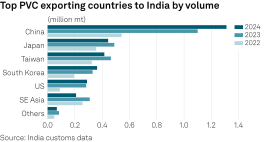
The market's attention has turned to India, where the BIS mandate has been postponed to December, and long-awaited antidumping duty investigations are nearing their final findings. These developments could alter trade flow patterns in the region, making it more difficult, if not impossible, for Chinese cargoes to penetrate the Indian market.
Asian oversupply may lead to output cuts
Producers are expected to reduce run rates to manage increasing supply as China continues to add capacity in a stunted demand environment. Volatile freight costs further complicate exports.
Ethylene-based PVC capacity expansions in Jiangsu, Fujian, Tianjin, and Qingdao are expected to have added approximately 1.7 million mt/year of new output by the end of 2025.
On the demand side, India's PVC uptake is expected to improve after the postponed BIS mandate, now due by Dec. 24. Indian market players remain mixed on the potential outcome of the BIS implementation at the end of the year. While they expect that many more participants will be reviewed to be awarded a certificate of BIS, they say that the potential change in trade flows to meet the mandate will cause a steep rise in price on a CFR India basis and those higher prices could put a lid on demand.
Post-monsoon infrastructure and festive season restocking may also boost Indian volumes in September, but it was too early to tell if demand would see a bump at the tail end of Q3.
However, driven by the country's growing economy, the demand push could provide support to the PVC market. But, there was also a consensus that until there is clarity on the long-awaited anti-dumping investigation, prices may remain soft due to the availability of competitively priced Chinese-origin cargoes. At the moment, the antidumping investigation has been extended to Sept. 25, but in the week of July 25, the market was abuzz with anticipation that the findings would be announced by the end of August.
Platts, part of S&P Global Energy, assessed the CFR India price at $715/mt on July 23 after it had been at recent lows of $695/mt for most of May.
Demand may also not match H1 2025 levels, as India's buyers were heard to be front-loading Chinese cargoes earlier in the year, January to April, in anticipation of export curbs.
New Qatar capacity to start in September
Qatar Vinyl is due to start PVC production at its new 350,000 mt/year plant Mesaieed in September. Sources anticipate Europe could be a key export market for the site, as capacity outweighs domestic demand.
While some material will be sold to India, it does not seem to be a major market, as sources expect Europe and Africa to bring in better margins. A majority of the domestic India market, however, believed that the impact will be minimal on price levels in the short term.
Europe has potential for further rationalization
There could be further production shutdowns in the European market in H2 2025 amid ongoing weak domestic demand, competitively priced imports, and high production costs compared to other regions. Smaller capacity and less integrated sites look to be the most vulnerable to closure as producers seek to improve margins.
"Consolidation to improve cost base is the name of the game," a producer said.
While demand is expected to be flat to softer, there could be some positive signs from Germany amid the new government's Eur500 billion pledge for infrastructure and the climate transition. Additionally, a peace settlement between Ukraine and Russia would bolster PVC buying interest through rebuilding efforts.
Traders will continue to move material from Asia into Europe, given the open arbitrage. Italy and Spain, in particular, are expected to remain key markets for Asian origin material.
US PVC competes with China in Latin America
The outlook for US PVC is stable to pessimistic, influenced by lower-priced Chinese competition, Brazil's import tariffs, and a struggling domestic housing sector.
Similar export prices have put the US and China in competition in the world's import markets.
Platts assessed the US FAS Houston price at $630/mt on July 24, down 22% year over year and the lowest in five years. On the same day, Platts assessed the FOB China price at $625/mt.
Brazil's importers benefited from the competition between US and China exports, but increased import duties have changed the dynamic.
Brazil increased the antidumping duty on US PVC from 8.2% to 43% at the end of May and then increased import taxes on Chinese product, which reduced volumes from both countries to Brazil.
As a result, more imports from Egypt and Colombia became competitive. From January to April 2025, the US accounted for 30% of Brazil's PVC imports, and Colombia, 45%. In May and June, the US market share fell to 24%, while Colombia's share rose to 46.5%, according to data from the Ministry of Development, Industry, Trade and Services. From Egypt, Brazil's imports rose to 40,381 mt over January-April 2025, to remain the third largest supplier behind Colombia and the US, and was up 14,783 mt over the same period in 2024.

Editor: