Chemicals, Aromatics, Solvents & Intermediates, Olefins
July 25, 2025
CHEMICALS H2 2025: Global acrylic monomer, MMA markets struggle to rebound
HIGHLIGHTS
Demand likely to remain weak globally for rest of 2025
Buyers cautious amid economic, trade uncertainties
New capacities deepen supply-side pressure
The global methyl methacrylate and acrylates markets are set to remain under pressure in the second half of 2025, as persistent weak demand, rising capacities and cautious purchasing behavior continue to pressure margins and limit recovery potential.
Weak demand weighs on European MMA, acrylates
European MMA players said conditions were unlikely to change during the second half of the year amid ongoing weak demand and oversupply.
Some suppliers had hoped prices might stabilize in August, supported by rising raw material and freight costs for China-based producers, which could slow import flows. However, offers from Saudi Arabia and South Korea have remained competitive.
Regardless, demand remained the main price driver, with limited hope for any recovery beyond a potential end-of-summer restocking.
"Rather than asking whether demand will increase, we are having discussions about whether demand will remain stable as opposed to decrease," a producer said.
Any further slump in demand would create additional pressure on European offers and could force producers to cut rates or divert more product into polymethyl methacrylate production.
Europe-based players were also closely monitoring Roehm's new MMA plant in Texas, where increasing production rates could reduce European exports into the US and ease Chinese imports into Europe.
However, amid weak US demand, sources have suggested US-based sellers could look to increase exports to Europe.
European DDP NWE 3-30 days forward prices fell to Eur1,410/mt on July 21, hitting the lowest level since Platts, part of S&P Global Energy, started assessing the market on April 2, 2024. So far in 2025, the price has seen a consistent downtrend.
Downstream European PMMA players expected competitive imports to continue, as China- and South Korea-based producers vie for greater market share, particularly in the extrusion market. Ongoing weak downstream automotive and construction sectors -- stemming from geopolitical challenges -- were expected to breed more "aggressive" PMMA pricing strategies, a trader said.
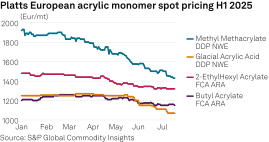
Sources also expected the European acrylic monomer market -- particularly for butyl acrylate, 2-ethylhexyl acrylate and glacial acrylic acid -- to maintain a bearish outlook.
Demand was expected to remain subdued for the remainder of the year, largely driven by lower forecasts across key downstream buyers.
Second-half 2025 contract negotiations continued, with buyers aiming to either bring down contract prices closer to current spot levels or reduce minimum volume commitments, aiming to leverage persistently low spot prices and steady imports from Asia.
While this could boost some spot demand, activity was still starting from a low level.
Chinese offers for both BA and 2-EHA were actively heard in the market, and with the arbitrage open, import arrivals were expected in September.
Roehm reshapes US MMA
The US MMA market was watching the impact of Roehm's rising market share after the startup of its 250,000 mt/year Texas plant, as participants await demand recovery in construction and automotive coatings -- both of which are tied to interest rates and tariff policies.
Domestic demand is "better than other regions," a second trader said, although elevated prices have curbed exports.
A third trader said domestic coatings demand was not much better, having fallen, and the trader expected this trend to persist for the rest of 2025.
US demand has faltered due to macroeconomic weakness, employment uncertainty and tariffs, a fifth source said, adding that high interest rates "won't help as far as getting a loan."
"The general consensus is: consumers aren't spending," the fifth source added.
Front and forward demand were heard at parity, according to a sixth source, who pointed to lengthening supply and a lack of forward demand since Roehm's new plant began producing consistently.
The plant "changes everything," a fourth trader said, adding that Roehm's cost edge via ethylene feedstock and "must be aggressive" to retain market share.
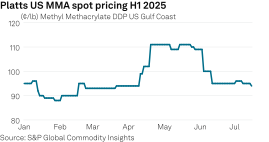
Spot DDP USG MMA prices have fallen from year-to-date highs of 111 cents/lb DDP USG on May 14 to 93 cents/lb DDP USG on July 21, according to Platts assessments.
Asian MMA, PMMA demand modest
Asian MMA and PMMA markets were not expected to see a demand revival in the second half of 2025 after weak consumption and low prices in the first half of the year, sources said.
Indian demand remains subdued, particularly from the paints sector, which suffered early in 2025 after buying high-priced cargoes at $1,600-$1,800/mt FOB China. With July prices dropping to the $1,200s/mt range, India-based buyers have largely stepped back, adopting a wait-and-see stance.
Southeast Asia-based buyers were also monitoring weak paint demand since Diwali 2024, although some traders were hoping for a pickup ahead of Diwali 2025.
Meanwhile, China- and Middle East-based producers continued to offer ample supply. China's new capacity could meet regional and export demand, but with persistent oversupply, some China-based producers may cut operating rates.
There were unconfirmed reports of a government push to idle older capacity and concerns around smaller producers, sources said.
In China, MMA demand came from PMMA casting sheets, coatings, resins and PVC additives, however, with construction still sluggish, these markets remain oversupplied.

Indian BA under pressure
India's butyl acrylate market was set to remain under margin pressure in the second half of 2025 amid additional domestic capacity, market sources said.
Indian Oil Corp. is expected to start production in July, adding 150,000 mt/year to Bharat Petroleum's existing 130,000 mt/year. With demand near 330,000 mt/year, imports of around 50,000 mt may still be needed if both run at full rates.
However, BPCL has been operating at around 70%, and IOCL is likely to start at 50%-60%, leaving room for continued imports in the second half of the year.
"Demand hasn't picked up since early 2025 and is expected to stay moderate over the second half of the year," a second producer said, citing weak consumer spending.
Most butyl acrylate goes into paints and adhesives for construction. While government policies support infrastructure, sources said prices were unlikely to rise without stronger consumer demand.
Instead, added capacity may ease costs and boost exports, which had slowed after import restrictions in late 2023.

Editor: