Chemicals, Crude Oil, Refined Products, Aromatics
May 30, 2025
US carbon black market shares mixed price expectations amid upstream volatility

HIGHLIGHTS
High upstream low-sulfur oil price volatility clouds carbon black outlook
Carbon black price decrease unlikely to mirror upstream proportion
Market volatility heard significantly hindering demand for spot material
Participants in the US carbon black market expressed mixed views on near-to-medium-term price movements amid the stabilization of upstream low-sulfur oil prices, following a period of high volatility due to fluctuating US tariffs.
US carbon black prices are typically adjusted based on fluctuations in upstream low-sulfur oil. Increased volatility in oil markets has clouded price movement expectations among carbon black market participants.
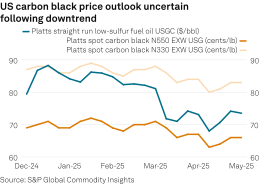
Platts, part of S&P Global Energy, assessed the US N330 carbon black spot price at 83 cents/lb ex-works US Gulf Coast May 30, down 5 cents/lb from March 28. Spot US N550 carbon black was last assessed at 66 cents/lb ex-works USGC, down 4 cents/lb from March 28.
Upstream volatility
US President Donald Trump's round of tariffs announced on April 2 led to a historic decline in oil prices.
Platts' assessment for low sulfur US Gulf Coast oil, a proxy for carbon black oil, dropped 16% over April 2-10.
Since then, the Platts assessment for low-sulfur oil has remained rangebound, with an uptick following the US-China 90-day tariff pause, effective May 14. Still, current levels are approximately 10% below levels prior to April 2.
"When oil prices decrease significantly, buyers pressure their carbon black suppliers to lower prices accordingly, which is not feasible," a distributor said.
Downstream price effects are uncertain
While there's general agreement that falling oil prices will likely lower spot carbon black prices, some market participants said that recent drops should not significantly affect prices.
A US producer expressed optimism for a stable market, highlighting strong downstream demand.
Carbon black serves as a reinforcing agent in various applications, with two-thirds of its demand from the tire industry.
"March demand picked up 5%-6%, in April it may have increased another 6%, so demand has been increasing slightly," the producer said in May. "Over the next two months, we see more or less the same level of demand, and a drop in July due to factory wind-down for the holidays."
A second distributor shared a different perspective, saying, "I anticipate a decline in carbon black prices for June, followed by stability or a slight upward trend in July."
The producer said that while prices are expected to decline with upstream oil, most agreements, including spot deals, are contracted for the year, limiting fluctuations to 2%-3%. Meanwhile, N550 carbon black June spot offers were heard 5% lower than May levels.
The second distributor added that spot prices are currently much lower than contract prices.
"The market is too volatile," the distributor remarked. "This uncertainty has significantly hindered demand for spot material."
Demand feedback also varies
Despite shared optimism about US tariffs on possible longer-term scenarios for the country's tire industry, market participants throughout the carbon black value chain say indirect effects are weighing on short-term demand.
While downplaying direct impacts, US-based participants noted a deteriorating business environment due to the tariffs.
In their first-quarter earnings calls, some US producers expressed optimism regarding tariff impacts, while others warned of weaker downstream markets, with customers taking a more cautious approach to inventory levels.

Editor: