Refined Products, Fuel Oil, Jet Fuel
February 16, 2026
Singapore strengthens its lead as Asia’s multifuel marine and aviation hub

By Mia Pei
HIGHLIGHTS
Oil demand driven by hub role
Total refined products demand to peak in 2028
Carbon tax influences refinery investment
Marine fuel sales at Singapore hit an all-time high of 56.77 million metric tons in 2025 amid record port activity, according to official data, keeping the city state firmly entrenched as the world's leading bunkering port, but the government has an eye on future maritime and aviation fuels.
Alternative marine fuel sales at the port are gaining traction, reaching 1.95 million mt in 2025, up from 1.35 million mt in 2024, as demand for bio-blended bunkers and LNG continued to grow.
The Maritime and Port Authority of Singapore (MPA) has responded by opening new LNG bunker supply license applications from Jan. 14, and, together with Enterprise Singapore, plans to upgrade LNG bunkering standards and introduce Singapore's first technical reference for ammonia bunkering in Q2 2026. These moves are designed to enable future trials and large-scale operations for next-generation fuels.
MPA said Singapore "further strengthened its position as a leading international maritime center in 2025" and is taking "coordinated steps in readying Singapore as a multi-fuel bunkering hub." The government reiterated its commitment to maritime decarbonization, even as the US opposed the International Maritime Organization's Net-Zero Framework, delaying a vote by a year. In October 2025, a Keppel-led consortium was appointed to carry out front-end engineering and design studies for ammonia power generation and bunkering, while three methanol bunkering licenses were awarded in November.
In aviation, Singapore has moved beyond voluntary uptake by introducing a SAF levy. The Civil Aviation Authority of Singapore has established SAFCo, a non-profit to centrally procure SAF with a fixed-cost levy to meet 1% uplift target from 2026. The government also set longer-term ambitions to raise the SAF share to 3%–5% by 2030, subject to global developments and SAF availability. SAF demand is estimated at 90,000 mt under the 1% uplift, potentially rising to 156,000 mt in 2036 under 5% SAF uplift for departing flights, according to S&P Global Sustainable1.
Trading hub
Singapore is not an oil producer, but its role as a trading, storage, and blending hub makes it one of the most influential energy centers globally. In 2025, ship arrivals totaled 3.22 billion gross tons and container throughput reached 44.66 million TEU, up 3.5% and 8.6% year over year, respectively, MPA data showed. The robust activity supported record marine fuel sales, underpinned by resilient global trade and strong fuel offtake.
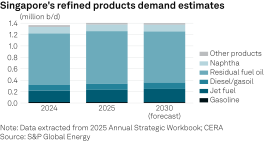
Unlike major inland oil-consuming countries, Singapore's oil demand is driven by its role as a hub for marine bunkers, aviation uplift, and petrochemical feedstock. S&P Global Energy CERA estimates Singapore's total oil products consumption stands at 1.4 million barrels per day, with international bunkers accounting for 1.2 million b/d. This is up from 1.37 million b/d of total consumption in 2024, of which 1.15 million b/d were for international bunkers.
Residual fuel oil remains the largest demand segment at 919,331 b/d in 2025, rising from 896,449 b/d in 2024. Jet fuel consumption is estimated at 214,136 b/d in 2025, up from 198,460 b/d the previous year.
CERA forecasts Singapore's refined products demand to peak in 2028 and notably shrink as it progresses toward a cleaner economy. Total oil products consumption is estimated at 1.4 million b/d in 2030, of which 895,403 b/d would be fuel oil.
Nonetheless, jet fuel consumption is set to rise in the region's aviation hub. Consumption is estimated at 231,279 b/d in 2030.
"Singapore's domestic demand will dwindle, but it will remain as the region's trading hub for refined products," said CERA analyst Cheng Han Thong.
Refining center
Singapore's refining capacity has remained at 1.27 million b/d since 2022, as the largest refining center in Southeast Asia, operated by three major players: Aster, ExxonMobil and Singapore Refining Co (SRC).
As an export-oriented economy, the refinery output responds to market forces promptly, with jet fuel and kerosene as the largest components in refinery output, followed by gasoline and diesel. More than 80% of its combined gasoil and gasoline production is exported to regional markets such as Indonesia and Vietnam.
Refinery utilization is estimated at 55% in 2025, according to CERA, below pre-pandemic levels, given weaker-than-expected regional demand growth. Crude and condensate runs are estimated at 693,302 b/d in 2025, dropping to 658,229 b/d in 2030.
Cheng said that Singapore's refined products output will likely remain stable until 2035, as no major capacity expansions are expected. She noted Singapore's carbon tax system could influence refinery investment.
Prime Minister Lawrence Wong said in Feb. 12 budget speech that the carbon tax may be set at the lower end of the S$50–S$80/mt range by 2030 if global climate action slows.
Amid Chevron's potential divestment from SRC, reflecting a broader trend of refinery consolidation in Asia, Singapore's Economic Development Board told Platts it remains open to new entrants in the refining sector.

Editor: