Chemicals, Aromatics, Solvents & Intermediates
January 19, 2026
China's weak benzene fundamentals weigh on TDP margins, despite PX strength
HIGHLIGHTS
Producers favor purchasing MX over boosting TDP run rates
Benzene markets struggle with elevated inventory levels
Asian toluene markets rely on TDP margins with closed arbitrage
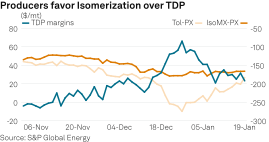
In China, diverging market fundamentals for downstream products of toluene disproportionation units, including paraxylene, isomer-mixed xylenes and benzene, are creating uncertainty around TDP/selective TDP unit margins. Despite a $42.67/metric ton rise in PX prices since early December 2025, producers remain hesitant to operate TDP units at full capacity, with one North China producer reportedly reducing operating rates in recent weeks.
In response to inquiries about the sale of feedstock toluene cargoes by a TDP operator in China, despite currently favorable PX margins, several market participants pointed to weak benzene prices as the primary reason. The producer commented that "the profit margins for benzene might be unfavorable," while a trader with a similar perspective noted, "profits are better [when] selling toluene, as benzene prices are low."
Soft fundamentals in the benzene market have narrowed the spread between benzene and toluene, compared with the toluene-PX spread, standing at minus $31.67/mt and minus $183/mt, respectively, as of Jan. 19.
Another trader suggested that, given the current weakness in benzene prices, "it would be better to simply buy MX and process it into PX, as the margins are higher."
At present, the price differential between isomer-MX-paraxylene and toluene-PX is nearly identical, with the Asia isomer-MX-paraxylene spread at minus $166/mt, while the toluene-PX spread is at minus $183/mt on Jan. 19. The TDP unit primarily produces benzene and isomer-MX, which then undergo additional processing to obtain PX, incurring additional cost.
According to calculations from Platts, part of S&P Global Energy, TDP product spreads, calculated as the weighted average of products isomer-MX and benzene minus toluene, stand at plus $23.22/mt as of Jan. 19. Market sources report that a typical spread of $100-$120/mt is required to breakeven.
Benzene
Amid high inventory at East China ports, Asian benzene fundamentals remain weak as demand struggles to absorb it. As buyers and sellers tussle on term contract discussions, progress continues at a slow pace, as some market participants report unfinished discussions as of Jan. 19.
"I expect the benzene-naphtha spread to remain weak for the rest of 2026," a trader based in Southeast Asia said.
Despite China experiencing record imports in 2025, market participants expect fundamentals to weaken substantially in 2026, as the Asia-US arbitrage is expected to remain closed while China ramps up its own production capabilities.
One source expects China to bring online 1.3-1.5 million mt/year of benzene capacity in 2026, roughly a quarter of its 2025 imports.
Meanwhile, the second largest buyer of Asian benzene, the US, which historically accounts for one-third of production, is expected to buy limited amounts of benzene as the arbitrage remains closed, while US import tariffs make benzene imports even more difficult.
Platts assessed the Asian benzene marker $22.34/mt higher on the session at $727.67/mt FOB Korea on Jan. 19.
Isomer-MX
Market participants expect strong downstream PX demand to support higher isomer-MX prices, underpinned by elevated PX production rates. A Northeast Asia-based trader noted that Chinese producers have been buying isomer-MX as feedstock to boost PX output.
The trader noted that this trend is expected to persist into February and March, driven by favorable isomer-MX-paraxylene spreads, even as Chinese domestic isomer-MX experiences a supply overhang.
Platts assessed the isomer-MX FOB Korea marker at $713/mt, up 50 cents/mt from the previous close on Jan. 19.
Paraxylene
Spot PX prices have been on a downtrend through most of the week to Jan. 16, though they have occasionally found support on the back of an upswing in crude oil prices.
The slowdown in spot prices could be attributed to an earlier-than-expected stalling of downstream polyester production in China, traders said. With weak demand due to the lull season and dwindling profits, polyester producers are beginning shutdowns ahead of the Lunar New Year, much earlier than anticipated. In the week to Jan. 16, polyester operating rates in China fell to around 88%, down from around 90% the previous week, a Chinese broker said.
Platts assessed the PX CFR Taiwan/China marker at $879/mt, stable from the previous close on Jan. 19.
Toluene
Feedstock toluene is largely dependent on TDP margins for price support, as arbitrage to the Singapore Straits, a market that primarily consumes toluene as a gasoline blend stock, remained closed.
Supported by sustained strength in downstream toluene prices, several producers in China indicated that South Korea's selective TDP units are likely the principal source of purchasing interest for Chinese-origin toluene in the dollar-denominated market, which explains why FOB Korea is currently trading at a premium relative to FOB China.
Platts assessed the toluene FOB Korea marker at $696/mt, up $18/mt from its previous close on Jan. 19.

Editor: