Agriculture, Oilseeds
December 23, 2025
COMMODITIES 2026: US, Brazil soybean trade seen hinging on China’s imports
HIGHLIGHTS
US soybean exports face uncertainty amid China trade tensions
Brazil's soybean crop surges, boosting exports to China
China's import duty favors Brazilian soybeans over US supplies
This is part of the COMMODITIES 2026 series, where our reporters bring to you key themes that will drive commodities markets in 2026.
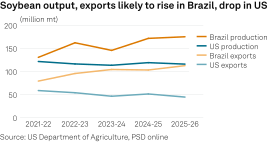
In 2026, US soybean market participants are expected to see a fall in both production and exports as uncertainty remains over the China-US trade. On the contrary, a bigger soybean crop in Brazil could push China toward securing more Brazilian supplies.
China is the largest importer of soybeans.
According to market participants, ongoing uncertainties are likely to hinder overall exports from the US. This could also deter farmers from planting soybeans, causing them to switch to corn instead, they added.
In marketing year 2025-26 (September-August), the soybean harvest in the US is expected at 115.75 million mt, 2.8% lower year over year, according to the US Department of Agriculture's World Agricultural Supply and Demand Estimates report published Dec. 9.
"I believe corn acreage will increase and bean decrease," a trader in the FOB Gulf market said. "Because of the uncertainty of demand from China and growing competition out of Brazil."
With many farmers affected by uncertainty due to trade conflicts and high prices, the US administration announced a $12 billion aid package Dec. 8.
"We estimate the $12 billion aid package will result in $31 per acre for soybeans," another trader in the FOB Gulf market said. "That helps partially, and it doesn't solve the entire problem."
In MY 2025-26, US soybean exports are likely to decline as China avoided purchasing US-origin soybeans from June through late October.
The USDA pegged US soybean exports at 44.5 million mt in MY 2025-26, 13.1% lower year over year.
China resumed purchasing US soybeans Oct. 30 following a meeting between US President Donald Trump and Chinese President Xi Jinping in South Korea. After the meeting, Trump claimed that China would purchase 12 million mt by December 2025 – a deadline later pushed to February 2026.
However, most trade participants expect US soybean exports to China around 8 million-9 million mt in MY 2025-26.
S&P Global Energy CERA analysts forecast that China will purchase 12 million mt soybeans from the US during MY 2025-26. In MY 2024-25, China bought over 22.6 million mt soybeans from the US, according to the USDA.
Brazil likely to benefit
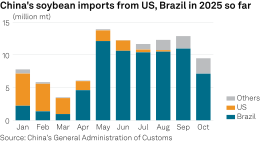
Most market participants believe that Brazil will continue to benefit from continuing uncertainties in 2026. In 2025, Brazil increased its export volumes to China.
According to the latest data from the Chinese General Administration of Customs, China purchased 74% of its total soybean imports during January-October from Brazil, totaling 70.8 million mt, 4.5% higher than in the same period of 2024.
For MY 2025-26 (January-December), Brazil's soybean exports are forecast at 112 million mt, up 4.7% on year, Brazil's food supply and statistics agency Conab said Dec. 11. CERA analysts forecast Brazil's soybean exports at 112 million mt in MY 2025-26, up 3.2% year over year.
Conab projected Brazil's soybean harvest at a record 177.1 million mt in MY 2025-26, 3.3% higher year over year. According to CERA, Brazil's MY 2025-26 soybean output is seen at 179.5 million mt, up 2.6% year over year.
"We are observing an increase in planted area, with yields in line with the average trend. Nonetheless, the accumulated precipitation levels need to be monitored closely, as it appears to be erratic in some states," according to Silvia Navarro, senior market analyst at CERA.
China import duty
Traders in both the US and Brazil are largely focused on China's soybean imports in 2026, after a turbulent year.
China removed retaliatory tariffs on certain US imports Nov. 5, including soybeans. However, the total duty on US soybeans remains at 13%, comprising the 3% most-favored-nation import tariff and a 10% levy introduced in response to Trump's previous duties in April, while Brazilian soybeans are subject to only the 3% MFN tariff.
Most Chinese purchases of US-origin soybeans are happening through the government trading house COFCO, market participants said. Private buyers in China are still staying away from US soybeans as they attract a higher import duty compared to the Brazilian crop, traders said.
According to the USDA, as of Dec. 11, China has booked over 3.25 million mt of soybeans for MY 2025-26 since the Oct. 30 talks. In MY 2024-25, China had booked and purchased a total of 17.8 million mt soybeans up to Dec. 12, 2024.
"While the purchases have started but the overall volumes are still far less than they usually are at this time [of the year]," a trader with a US-based multinational grains trading company said.
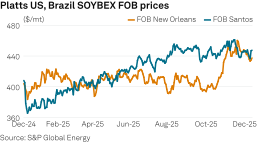
Trade participants added that prices should fall to facilitate the completion of export forecasts in the US, as the current prices are expected to benefit Brazil's supplies.
"If the exports in the US are going to become a reality, prices have to go down," the second trader in the FOB Gulf market said.

Editor: