Agriculture, Grains, Meat, Oilseeds
December 19, 2025
COMMODITIES 2026: Regulatory uncertainty, disease risks cloud Europe's feed market outlook
HIGHLIGHTS
Ample corn, soymeal supply; demand remains subdued
Wheat increasingly replaces corn in feed formulas
Disease outbreaks and EUDR drive market uncertainty
Europe's animal feed market is expected to head into 2026 with ample corn and soybean meal supplies, subdued demand, shifting feed grain preferences, regulatory uncertainty and ongoing disease outbreaks.
The EU Deforestation Regulation has been a key focus area throughout 2025 and is expected to continue influencing soymeal prices amid its delayed implementation for a second time. Meanwhile, diseases such as African swine fever threaten to reduce feed demand in key protein production regions such as Spain.
Wheat competitive in feed formulas
EU corn supply is forecast to reach 85.4 million metric tons in the 2025-26 marketing year (July-June), up 0.7% from the previous year, analysts with S&P Global Energy CERA said.
Imports are anticipated to reach 23 million mt, up nearly a quarter year over year, with Spain remaining the main importer, they added.
The EU animal feed market is expected to enter 2026 with ample corn supply at ports and in domestic markets, alongside weak demand from feed mills, market participants said.
Despite the bearish outlook for corn, CERA analysts expected more feed wheat to replace corn in feed formulas.
In Spain, although wheat prices have increased and corn prices have decreased, wheat remains competitive in feed ratios, with the price difference not significant enough for producers to prefer corn over wheat. This trend is expected to continue in the second part of the MY 2025-26, with stable price spreads, CERA analysts said.
"With the wheat-corn price convergence, demand is shifting to wheat," a Madrid-based market participant told Platts, part of S&P Global Energy, on Aug. 29.
EU soymeal to enter 2026 on a bearish note
The European soybean meal market is entering 2026 with a bearish tone, shaped by subdued demand and ample supply levels.
EUROSTAT data showed that the EU continues to rely heavily on South American origins, primarily Brazil and Argentina, while US volumes remain limited due to comparatively higher freight costs, according to market sources.
"The first half of 2026 might be bearish for soymeal," a Netherlands-based trader said, pointing to the current demand trend.
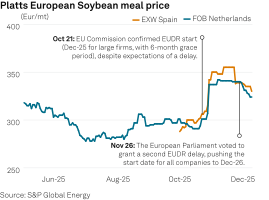
Throughout 2025, the market was influenced by the ongoing uncertainty surrounding the EUDR. Prices rose early in anticipation of the regulation taking effect, only to fall once the implementation was delayed again.
"Many buyers secured forward volumes early on, expecting EUDR to begin. With the delay, prices may ease and renewed import interest would be there, increasing stock levels and reinforcing the bearish trend," a Dutch broker said.
However, the outlook is not fully negative. Smaller buyers have yet to cover for Q1. "So the market won't be entirely bearish," the Dutch trader added.
EUDR uncertainty fuels market volatility
Market participants broadly welcomed the latest EUDR delay. "It's good news that it has been pushed back by another year," the Netherlands-based trader said. However, many also expressed concern that similar price swings and uncertainty could persist in the next year.
The European soymeal market experienced price fluctuations in late 2025, linked to shifting expectations surrounding EUDR. On Oct. 29, when Platts assessed the market following the EU Commission's statement that EUDR would still proceed from December, FOB Netherlands increased by Eur30/mt at Eur336/mt, while EXW Barcelona rose by Eur27/mt to Eur342/mt. However, in November, as the European Parliament voted to delay EUDR for all companies to December 2026, prices reversed, with FOB Netherlands falling by Eur16/mt and EXW Spain dropping by Eur17/mt.
The month-long price volatility of 14% prompted many buyers and sellers to step back from trading, according to sources. With the regulation now postponed again, "there is relief, but also anxiety about what next year might bring," another Dutch trader said, highlighting the persistent uncertainty shaping the 2026 outlook.
Disease outbreaks drive uncertainty for feed
Disease has impacted the European feed market throughout 2025 and is expected to continue doing so in 2026.
ASF has affected many countries in Europe, most recently Spain -- the EU's main pork exporter -- which has been dealing with an outbreak since Nov. 28.
Market participants in the country's animal feed sector are bracing for lower feed demand in the short- to medium term. Although it is still too early to assess the full impact, feed mills told Platts they have been "holding off" on making feed ingredient purchases for 2026 for the time being.
"ASF is potentially shaving 2026 feed demand," a feed mill buyer said on Dec. 1, adding, "If export demand for pork meat vanishes, demand for feed will shrink."
However, the overall outlook remained positive, as the Spanish market is well prepared to manage the issue, having faced ASF in the late 1970s and early 1980s. Major importers of EU pork are adapting to regionalization measures, which helps mitigate the impact of disease outbreaks on trade.
Europe's poultry market is expected to continue facing challenges related to avian flu, which is also expected to further impact feed demand in 2026.

Editor: