Agriculture, Grains
December 19, 2025
COMMODITIES 2026: Asia to import more corn on ample global supply
By Sayona anna John and Edward Low
HIGHLIGHTS
China’s corn imports to rebound from 2025 lows
China, Vietnam to lead growth in corn feed demand
Corn demand to face increasing competition from feed wheat
This is part of the COMMODITIES 2026 series, where our reporters bring to you key themes that will drive commodities markets in 2026.
Asia's corn imports are expected to increase in 2026, led by a limited recovery in China following a steep decline in 2025, with smaller gains in Vietnam, Japan, and the Philippines amid modest feed demand growth. Ample global supply and relatively weak prices are expected to support Asian feed corn importers, while weather and geopolitical risks remain.
China, Asia's largest corn producer and consumer, is expected to continue its shift toward self-sufficiency in 2026.
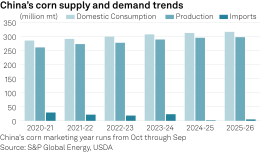
S&P Global Energy's CERA projects China's corn imports for marketing year 2025-26 (October-September) at 5 million metric tons, up from 1.8 million mt in MY 2024-25, but still well below the 23.5 million mt imported in MY 2023-24.
Domestic production is forecast to inch up 0.7% to a record 297 million mt, comfortably meeting growing demand. Feed use is projected to increase 1.7% to 234 million mt, while total consumption is expected to grow 1.3% to 316 million mt.
The recovery follows a sharp fall in imports in 2025. From January to October, China imported just 1.29 million mt, down 90% year over year, according to data from the General Administration of Customs released Nov. 20. Brazil remained the top supplier with 42% of shipments, although volumes fell 91% year over year. Imports from Ukraine and the US also plunged 95% and 99% respectively, while shipments from Russia surged 186% during this period.
"We don't expect the US to export corn to China in 2026," Anamaria Gaudencio Martins, Principal Analyst for American crops at CERA, said, adding that China's total corn imports should remain low and are likely to be sourced from Ukraine and Brazil.
Reduced US-China trade reshapes corn flows across Asia.
Surplus US volumes are redirected to other Asian markets, particularly South Korea, which sourced nearly 67% of its corn from the US in the first ten months of 2025, compared with a heavier reliance on South America previously, according to data from Korea Trade Statistics Promotion Institute.
South Korea was able to capitalize on highly competitive US corn in 2025 due to excess supply and export capacity in the Pacific Northwest that would have originally been dedicated to serving the Chinese market.
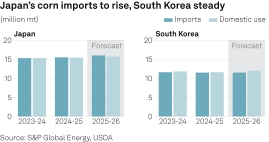
CERA projects Japan's corn imports to rise 3.2% to 16 million mt in MY 2025-26 (October-September), with total consumption set to increase 1.9% to 15.7 million mt, while South Korea's imports are forecast to remain flat at 11.5 million mt, with consumption projected to rise 3.4% to 12 million mt.
"We forecast a small increase in US corn shipments to both Japan and South Korea, as total US corn exports are expected to be significantly higher," Martins said.
Feed corn import demand across Asia is expected to remain subdued in 2026 following an overall decline in 2025.
According to the US Department of Agriculture, Vietnam's corn imports are projected to increase 5.8% to 12.7 million mt in MY 2025-26 (May-April), with feed use expected to grow 4.9% to 15 million mt.
The Philippines' imports are expected to rise 17% to 1.85 million mt in MY 2025-26 (July-June), driven by growing feed demand. However, Indonesia's corn imports for MY 2025-26 (October–September) are forecast to fall 1.6% to 1.2 million mt, reflecting lower corn consumption from wet mills.
African Swine Fever outbreaks in Vietnam and the Philippines weighed on hog populations in 2025, though improving conditions toward the end of 2025 are expected to stabilize markets and slightly increase corn demand across Southeast Asia in 2026.
However, corn demand is also expected to face increasing competition from feed wheat starting in the first quarter of 2026 as the southern hemisphere supply enters the market, according to Vladimir Zinkovski, Senior Principal Analyst and Head of Asia-Pacific Crops at CERA.
"Australia, particularly Western Australia, has had a very strong finish to the growing season that will compete in feed channels, especially in Southeast Asia. In addition, Argentine wheat has been among the cheapest grains globally and will similarly flow into Asian feed markets, particularly among more price-sensitive and less quality-discerning buyers," Zinkovski said.
Asia's corn market in 2026 is likely to remain well supplied, but sourcing flexibility is narrowing.
South American exporters, particularly Brazil and Argentina, are increasingly prioritizing domestic demand tied to higher ethanol production and increased livestock feed consumption, limiting incremental export availability. At the same time, scope for further diversification is constrained, with Russia and Ukraine unlikely to materially expand shipments to Asia amid competing demand. As a result, procurement decisions by major Asian feed millers will remain highly sensitive to relative pricing and trade policy.
Renewed US-China trade negotiations in 2026 could reintroduce price volatility, even as underlying supply conditions stay comfortable.
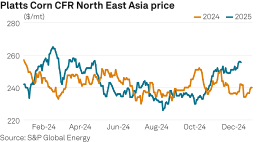
Platts, part of S&P Global Energy, assessed corn CFR Northeast Asia at $255/mt on Dec. 18, up 8.9% year over year.

Editor: