Agriculture, Energy Transition, Refined Products, Biofuel, Renewables, Jet Fuel
December 17, 2025
COMMODITIES 2026: Higher production to tame Asian ethanol prices despite demand uptick
HIGHLIGHTS
Grade B ethanol prices expected to be stable early 2026
Growing domestic output to soften India's import prices
Asia-Pacific eyes new demand centers to absorb growing supply
The Asian fuel-grade ethanol market is expected to remain relatively soft in early 2026, with prices likely to trend higher from March as market participants delay US purchases while awaiting clearer guidance on the 45Z credit.
In 2025, Asian fuel ethanol prices were largely stable, tracking US trends and lower corn prices.
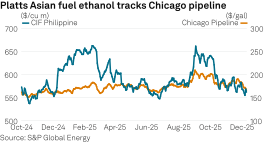
According to sources in the Philippines, buyers intentionally held off on securing US material as they monitored updates related to the 45Z credit.
One source added that ethanol meeting PNS specification does not qualify for the 45Z or 45Q credits, which is expected to support higher premium prices from March, as producers will not benefit from associated credits.
Philippines ethanol imports were up 12% year over year as of October 2025, driven by sustained demand from the country's E10 mandate, according to a Malaysia-based industry source.
The source also mentioned that the Philippines is expected to increase import volumes from major suppliers such as Brazil and the US to sustain E10 requirements, while also supporting voluntary E20 sales in selected areas.
Meanwhile, Vietnam is set to mandate E10 blending in all unleaded gasoline starting June 2026, though consumer preference for higher-octane RON95 may influence the actual uptake of higher blends, according to S&P Global Energy analytics.
Grade B ethanol market demand to hold steady
Asian industrial-grade ethanol prices remained largely steady in 2025 compared with the previous year, according to S&P Global Energy data.
Grade B ethanol prices are expected to hold steady in early 2026 amid comfortable inventories and forward-covered demand, market sources said, though prices could soften later in the year if Brazilian sugarcane output improves, according to a South Korea-based trader.
"The market has adopted a wait-and-see approach and is hoping that prices will drop," a Singapore-based market source added.
On demand, most Asian buyers are covered through Q1 2026, with some securing supply into Q2, keeping near-term trading activity steady, market sources said. Activity could pick up from March–April as Brazil's new sugarcane harvest begins. "The Grade B ethanol market is likely to remain stable next year, with stocks till Q2 and many buyers already well covered," a Japanese buyer said.
Growing Indian production to soften import prices
Indian ethanol imports in 2025 increased by approximately 7% year over year as of September 2025, despite a higher average price compared to the same period in 2024.
"India's ethanol capacity is around 2,000 crore litres against which ethanol demand is around 1,100 crore litres," said Ravi Gupta, Chairman of the Sugar Bioenergy group and Executive Director at Shree Renuka Sugars Limited. "In case we do not increase the ethanol demand by blending ethanol with petrol, and a policy of ethanol blending in diesel, there shall be a risk of capacity underutilisation." (2,000 crore litres equals to 20 billion liters).
Market demand from the industry drove the uptick as higher-priced domestic production largely focused on meeting the E20 blending target. Indian market participants explained that import prices remained lower than domestic prices, despite being slightly higher than those of last year, making imports attractive.
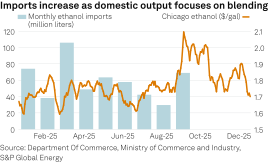
Indian market sources anticipate a softening of import prices next year, citing a possible drop in demand from India over the lower feedstock prices and a domestic surplus, which may attract some buyers to seek domestic supplies.
According to the DG Indian Sugar & Bio-energy Manufacturers Association (ISMA), Deepak Ballani, while the government's recent tender for E20 required approximately 10.5 billion liters, the industry submitted expressions of interest totaling nearly 17.76 billion liters.
He warned that without a roadmap beyond E20 or diversification into exports and other fuels, distillery utilization could fall below 50% on a sustained basis.
A US-based trader said, "Domestic prices are hard to come lower to the US offer prices". An India-based buyer said, "I believe it's a matter of time, as the ethanol and maize production ramps up, the domestic price will also become competitive".
Buyers reported that they maintain a healthy stock and are in no hurry to make fresh buying until the prices soften further and more clarity is provided on 45Z credit terms.
Furthermore, the industry is advocating for incentives to spur the adoption of Flex-Fuel Vehicles (FFVs) and carbon credit. "All it involves is incentivising flexi fuel cars, such as by reducing the GST rate, which has been done for electric vehicles. We should adopt a mechanism of mandate of reduction of carbon, which makes carbon credits tradable, adding the viability of ethanol-based initiatives," Gupta added
This year, Brazilian shipments accounted for around 6.26%, but next year they are expected to rise when the new crop material hits the market, which can further ease the prices.
New frontiers
Beyond road transport, Asia-Pacific region is eyeing new demand centers in maritime and aviation to absorb the growing supply.
"The 20 million mt/year opportunity emerges progressively towards the early 2030s, in line with the delivery of more than 1,200 alcohol dual-fuel vessels expected across global fleets," said Clarence Woo, Managing Director of the Global Centre for Green Fuels (GCGF).
Woo noted that while technology and feedstock supply currently exceeding 100-110 Mt/year for ethanol are in place, policy clarity remains the missing link.
"Industry is ready to move, but it needs predictable signals... Early fiscal incentives and clear timelines for future obligations, including carbon levies, are essential," Woo said.
In the aviation sector, multiple Asian countries like Japan, South Korea, India, Malaysia, India, Singapore, Vietnam, the Philippines and Australia are advancing SAF plans with particular focus on ethanol related pathways due to heavy biomass-related potential.
"SAF from Alcohol-to-Jet (AtJ) represents a major opportunity for the Indian sugar industry... particularly given the low carbon intensity of Indian 1G bioethanol compared to global peers," the ISMA spokesperson said.
Platts is part of S&P Global Energy.
