Agriculture, Oilseeds, Grains
December 15, 2025
COMMODITIES 2026: Russian wheat output expected to fall as farmers pivot to oilseeds
By Lalita Avd and Vivian Iroanya
HIGHLIGHTS
Black Sea export competition intensifies amid price pressure
Ukraine seeks to maximize exports amid storage constraints
EU wheat production expected to fall in MY 2026-27
This is part of the COMMODITIES 2026 series, in which our reporters bring to you key themes that will drive commodities markets in 2026.
Russia's wheat production is forecast to decline slightly in the 2026-27 marketing year (July–June) as farmers shift toward more profitable oilseed crops, potentially tightening global grain supplies and reshaping Black Sea export flows despite continued strong shipment volumes from the region.
Winter grain sowing in Russia for the 2026 harvest has been completed on the planned area. Officials report that weather conditions have generally been favorable, keeping crop development in line with expectations and supporting early forecasts for a good harvest.
S&P Global Energy CERA projects Russian wheat output at 84.1 million metric tons (mt) in MY 2026–27, down from 88.2 mil mt in MY 2025–26. SovEcon forecasts a slightly lower 83.8 million mt, reflecting a reduction in wheat area from 26.9 million hectares this season to 26.3 million hectares next year. The Institute of Agricultural Market Studies (IKAR) estimates the upcoming harvest at 86 million–91 million mt, noting that winter wheat area remains close to last year's level and crop conditions are reportedly better so far. IKAR adds that these figures are still preliminary and may be revised.
Market experts say the lower wheat production estimates reflect two main factors: a sharp decline in spring wheat acreage while winter wheat area holds steady, and reduced spending on equipment and fertilizers. With tighter budgets, farmers are expected to prioritize higher-margin oilseed crops, influencing planting decisions and overall wheat output.
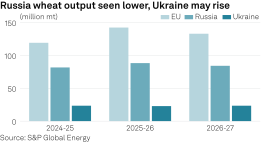
Meanwhile, Ukraine's MY 2026-27 wheat production outlook looks positive, thanks to favorable weather conditions that have positively impacted early crop development and created good initial conditions for dormancy compared to previous seasons.
Prices to remain under pressure
Black Sea wheat prices remain under pressure from ample port-side supplies following a strong harvest and heightened competition from improving Southern Hemisphere crop prospects in Argentina and Australia. Increased competition is compelling Russian exporters to reduce prices to stay competitive internationally, a trend expected to continue into early 2026.
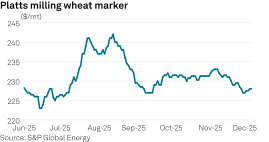
The Russian wheat export market has experienced a notable downtrend since mid-November, primarily affecting wheat with a 12.5% protein content. Prices fell to a two-and-a-half-month low in early December, hitting $227/mt Dec. 1.
Platts, part of S&P Global Energy, assessed milling wheat marker at $229.89/mt Dec. 11, unchanged day over day.
Russian wheat exports are expected to remain strong, with analysts forecasting continued robust shipments. According to CERA analysts,Russia's wheat export projections are currently at 43 million mt, but a continued strong export pace from Russia and a possible quota increase to nearly 20 million mt on Feb. 15 could lead to a revision of the forecast.
Russian exporters are also monitoring the strength of the ruble -- currently around Rb76.8/$1 on Dec. 10, putting pressure on farmers to lower their prices. The weekly export tax has not significantly impacted export prices, staying predominantly at low levels since July, even at zero rubles for several weeks.
For Ukraine, wheat exports are expected to rise in the second half of MY 2025-26 as the country seeks to maximize them, given its limited storage capacity and the high risk of airstrike damage, according to CERA analysts in the report.
Ukrainian exporters said costly internal logistics—driven by war-related disruptions—remain a key factor behind high export prices in November and December. They cited shortages of vehicles and drivers, damage to trucks, and frequent electricity outages. "Rail costs increased by 20%-25% over the past month, while trucks by around 10%," one local trader said.
Demand outlook mixed
On the demand side, key buyers are expected to remain cautious, potentially delaying purchases as they await more favorable prices from the approaching southern hemisphere harvests.
"Large wheat buyers like Egypt may soon pause purchases as they wait for the Southern Hemisphere crop to reach the market," a Black Sea-based trade source said.
According to media reports, Egypt has secured enough wheat to cover its domestic needs through February.
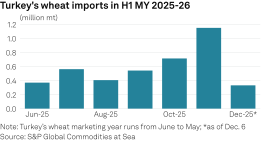
Wheat imports from Turkeyare expected to increase after a severe drought hit domestic production. According to market sources, imports are forecast to accelerate in the second half of the season as Turkish wheat stocks begin to dwindle.
The US Department of Agriculture-Foreign Agricultural Services in Turkey revised its wheat import projection to 7.3 million mt in MY 2025-26, more than double from last year's 3.3 million mt due to severe drought conditions, slashing domestic production.
EU wheat output set to fall
CERA analysts forecast EU wheat production for MY 2026-26 at 132.9 million mt, down 9 million mt from MY 2025-26 estimates.
"We expect lower harvested areas for wheat, barley, and corn due to ample 2025-26 crops in the EU and globally, and lower farmer margins. In contrast, EU oilseed areas are likely to rise as farmers shift land from grains to higher-margin oilseeds," according to Principal Analyst Khrystyna Kornetska with CERA.
Winter wheat sowing conditions in the EU have been largely favorable in major producing regions such as France and Poland, while persistent rainfall in the Balkans has delayed fieldwork, the European Commission's JRC-MARS reported in October.
"Planting campaign is a bit delayed due to very wet weather, especially in the Balkans. This might actually reduce the acreage for 2026, and farmers will look for alternatives to put more spring crops," a Bulgaria-based trade source said. So far, crops are developing well, thanks to moderate temperatures and ample moisture, the source added.
EU wheat prices are expected to face short-term pressure from competition with Argentine and Russian supplies, particularly affecting sales to North and West Africa, according to CERA analysts. Looking ahead, the same Bulgarian trade source expects prices to rise and peak in early Q1 2026. "My personal expectation is for wheat prices to peak in early Q1 2026 and then, depending on the weather, ease toward the harvest due to ample supplies," the source said.

Editor: