Agriculture, Energy Transition, Biofuel, Renewables, Vegetable Oils
December 15, 2025
COMMODITIES 2026: European biodiesel market to be shaped by regulatory landscape, feedstock dynamics

HIGHLIGHTS
Double-counting removal supports crop-based biodiesel
UCOME to remain strong on bullish renewable diesel
Market to adapt to advanced feedstocks
The European biodiesel market is closely monitoring the implementation timeline of the Renewable Energy Directive III across key member states, particularly as Germany and the Netherlands prepare to scrap double-counting incentives for advanced biofuels starting in 2026, alongside more ambitious greenhouse gas reduction targets that could significantly alter market dynamics and feedstock preferences.
Renewed interest in first-generation
The removal of double counting -- which allows advanced and waste biofuels to be counted twice toward renewable energy targets -- could trigger renewed demand for first-generation biodiesel, sources told Platts, part of S&P Global Energy.
"Priority should go to vegetable oil-based bio[diesel] with high GHG [greenhouse gas] savings if double counting is dropped," one Netherlands-based biodiesel trader said.
A Black Sea-based feedstock trader echoed this sentiment, saying "the focus is shifting toward single-counting feedstocks and therefore, first-generation biodiesel," adding that significant price support for rapeseed methyl ester is anticipated through Q1 and next year.
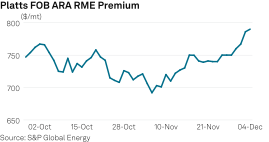
"The effect of removing double counting would really correct things in terms of demand," a Germany-based biodiesel producer said, pointing to the potential for demand on fuels that are not currently double counted, but that have high GHG savings.
Germany's latest draft removes wording outlining the crop cap at 4.4% rather than reducing it to 3% by 2030 as previously planned. The draft also removed language that would have excluded soybean oil-based products from meeting GHG reduction targets.
"Soybean oil is back, which broadens the list of the feedstock, and it will be more cost-efficient and backed with credibility, so it will definitely create a disadvantage for waste feedstocks," one Netherlands-based feedstock trader said. "Crop will play a big part, and of course, they are all capped. It's a blending game, so they need to see how they make it most efficient and economically viable."
UCOME demand to remain robust
The removal of double counting has created a bullish outlook for renewable diesel in 2026, with its substitute used cooking oil methyl ester expected to maintain strong demand, particularly as a cost-effective alternative.
"UCOME demand should be higher due to high HVO cost," a Netherlands-based biodiesel trader said.
The Netherlands' draft proposal for RED III implementation will transition the country from its current HBE system to an Emissions Reduction Units model in 2026. This framework establishes separate mandates for road, maritime, inland shipping, and refinery categories, with limited transferability between sectors.
"With fewer loopholes in regulations, as tickets for SAF blending in the UK and Netherlands are not valid anymore, there should be a healthy demand," the trader continued. "And also, higher German demand for UCOME without this double counting."
A Sweden-based feedstock trader anticipated that "HVO margins are expected to be better next year," noting that "either prices for refined products will need to come down, or feedstock prices will need to come up," with the latter scenario appearing more likely.
Advanced feedstocks gain traction
As member states pursue increasingly ambitious GHG reduction targets, biofuel industry participants are exploring advanced feedstocks, including food waste oil, tall oil and soapstock acid oil, sources told Platts.
"Advanced feedstocks are of high demand and attention; you'll see that producers are looking at advanced feedstocks and other cost-efficient feedstocks," a Netherlands-based feedstock trader said.
"I think everyone will buy as much advanced [feedstock] as they possibly can as long as the prices make sense," the Sweden-based feedstock trader agreed.
Germany's revised draft legislation extends the list of feedstocks eligible for co-processing to include Annex IX-B materials, potentially increasing competition for used cooking oil among blenders. The draft also specifies that palm oil mill effluent will remain eligible for meeting GHG reduction mandates in 2026, provided it entered the market before the 2027 compliance year.
"There will be less pressure on feedstock availability next year for sure," a Germany-based biofuels trader said, pointing to POME eligibility.
A balancing act
Market participants face the challenge of balancing GHG performance with economic considerations when selecting feedstocks.
"The other tricky thing about advanced feedstock is that the GHG savings are actual values and not the default values. So, some of the feedstock coming from China and South America have quite low savings because GHG savings will be more important," the Sweden-based feedstock trader said.
"It will be a balance, but anyone who is able to will try as much advanced material as possible. And then the balance will be UCO [used cooking oil] or animal fats."
The Sweden-based feedstock trader remained cautiously optimistic about UCO markets, saying "there will be markets where UCO makes sense due to their high GHG savings, and that would support pricing -- in Germany, up to the cap levels definitely. I think UCO will have a decent year."
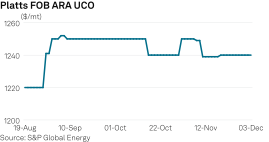
From January to October, the EU emerged as a leading destination for UCO, importing 1 million metric ton from China, according to S&P Global Energy data.
China exported 308,141 mt of UCO in October, up 28.6% month over month, with the Netherlands receiving 87,751 mt, accounting for 28% of the total, data released Nov. 20 by China's General Administration of Customs showed.

Editor: