Agriculture, Energy Transition, Refined Products, Biofuel, Renewables, Vegetable Oils, Jet Fuel
December 10, 2025
COMMODITIES 2026: Regulatory uncertainty impedes palm oil mill effluent trade
By Aditya Kondalamahanty and Ck Quick
HIGHLIGHTS
Indonesia restricts exports; buyers turn to Malaysia
EU imports slump amid policy uncertainty
Biodiesel mandates to support POME oil prices in 2026
This is part of the COMMODITIES 2026 series, where our reporters bring you key themes that will drive commodities markets in 2026.
Global supply chains for palm oil mill effluent oil face uncertainty in 2026 due to regulatory shifts in the EU and Indonesia's export restrictions, as well as increasing demand for waste feedstocks in biofuel production.
Over the past years, declared POME oil volumes in EU biofuels have exceeded global production potential, prompting several EU member states to raise concerns about mislabeling and substitution with virgin palm oil, and leading to increased scrutiny over the use of POME oil as an eligible feedstock for meeting greenhouse gas reduction mandates.
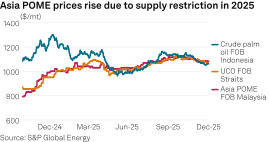
However, POME oil prices have remained supported throughout 2025 due to rising demand for biofuels in the EU, particularly second-generation biofuels, such as hydrotreated vegetable oil and sustainable aviation fuel.
Prices have also been aided by Indonesia's export restrictions on POME oil and used cooking oil, as the country attempts to retain sufficient feedstock to meet its 40% biodiesel blending mandate in 2025 and increase to 50% in 2026.
Additionally, rising demand for UCO in the domestic market in China -- the world's largest exporter of UCO -- for SAF production has resulted in a scarcity of biofuel feedstocks, which is expected to support POME oil prices in the coming year, according to a biofuels analyst at an India-based commodity risk firm.
POME oil had become the highest-priced feedstock exported from Asia by the end of 2024, driven by a surge in purchases from the EU, according to Platts data from S&P Global Energy.
The Malaysian spot price of POME oil has risen 4.8% since the start of 2025 to $1,048/mt as of Dec. 8 on an FOB basis, Platts data showed.
Platts discontinued the Platts POME oil FOB Indonesia price in May, following Jakarta's export restrictions in January.
Indonesia and Malaysia, which account for 85% of the world's palm oil supplies, are the major producers of POME.
EU policy
Driven by the Renewable Energy Directive incentives, the EU's POME oil imports grew fivefold between 2020 and 2023, according to official EU data. The inflows surged to about 600,000 mt in 2024, up 20% year over year, according to S&P Global Energy CERA. The EU was the largest buyer of Asian POME oil in 2023 and 2024.
However, over the January-September 2025 period, the EU's POME oil imports fell 33% from the same period a year earlier to 300,000 mt, a CERA report from November showed.
POME oil prices declined in the fourth quarter of 2025 as uncertainty surrounding EU policies dampened demand. Both Germany and the Netherlands have considered reclassifying POME oil from double-counting to single-counting toward GHG quotas under renewable energy regulations, while Germany also contemplated removing POME oil from the approved feedstock list.
"I remain optimistic about POME oil in the context of EU policy, as it is included in the Annex IX-A feedstock list and has the highest production volume among the listed feedstocks," a Singapore-based trader said. "Furthermore, it requires a minimum mandate to fulfill, in contrast to the maximum mandate implemented in Annex IX-B."
Under the EU's RED legislation, Annex IX-A lists advanced biofuel feedstocks, primarily consisting of wastes and residues, while Annex IX-B covers waste oils and animal fats. Both categories qualify for double-counting; however, Annex IX-A feedstocks are subject to a minimum mandate, whereas the utilization of Annex IX-B feedstocks is limited by a cap.
"2025 is almost done. The EU should prepare for 2026. The German policy confirmation can guide the direction for December [for EU buyers]," an industry source said.
Indonesian curbs
Indonesia's export curbs have led some buyers to turn to Malaysia, which has started implementing a 5% value-added tax on POME oil transactions beginning Sept. 1. Exporters could reclaim the tax after shipments, but aggregators and local traders absorbed the cost.
In October, the Malaysian Palm Oil Board urged the government to impose a tax on exports of palm oil by-products, including POME oil and UCO, to strengthen the domestic downstream industry.
Malaysian traders are also contending with higher logistics costs following government enforcement against overloading in the transportation sector. "The logistics costs have increased by at least 20%," a Malaysia-based trader said.
According to a Kuala Lumpur-based analyst, the price of crude palm oil is expected to rise as Indonesia increases its biodiesel mandate to B50 in 2026, which could have a knock-on effect on POME oil prices. The analyst said POME oil is more affordable in Indonesia's domestic markets, prompting biodiesel producers to use it as feedstock to achieve higher margins.
Indonesia's shipments of POME oil and high-acid palm oil residue products reached 3.45 million mt over January-October 2024, exceeding government estimates, official data showed in July 2025.
The Indonesian government has not publicly announced POME oil trade volumes for 2025.

Editor: