Agriculture, Energy Transition, Refined Products, Biofuel, Renewables, Jet Fuel
December 09, 2025
Global SAF supply to slow in 2026 on high costs, policy issues: IATA
By Samyak Pandey and Mia Pei
HIGHLIGHTS
Global SAF output to reach 1.9 mil mt in 2025, 2.4 mil mt in 2026
Poorly designed mandates stall SAF industry momentum
Airlines face $3.6 billion SAF cost burden in 2025 due to high premiums
Global production of sustainable aviation fuel is expected to reach 1.9 million metric tons in 2025. Still, growth is forecast to slow sharply to 2.4 million mt in 2026 as high costs and policy design issues weigh on investment, the International Air Transport Association said on Dec. 9.
The 2025 estimate -- double last year's 1 million mt -- represents just 0.6% of global jet fuel consumption, rising to 0.8% in 2026, IATA said. However, despite higher volumes, airlines will face a $3.6 billion SAF-related cost burden in 2025 due to extreme premiums, as SAF trades at two to five times the price of fossil jet fuel in several mandated markets.
"Poorly designed mandates stalled momentum in the SAF industry," IATA Director General Willie Walsh said. "If the objective is to increase SAF production to decarbonize aviation, policymakers need to learn from failure."
Mandates fail to spur supply in the EU, UK
The association stated that ReFuelEU Aviation and the UK SAF mandate have increased compliance costs while failing to deliver significant supply growth. In Europe, IATA cited "oligopolistic supply chains" and supplier margins that have driven delivered SAF prices up to five times those of conventional jet fuel.
Airlines collectively paid a $2.9 billion premium for the 1.9 million mt of SAF available in 2025, including $1.4 billion that reflects the structural spread over fossil jet fuel.
Walsh said Europe's approach "distorts markets, slows investment and undermines scaling," adding that the EU's recent STIP announcement "lacks clear timelines" to support producers.
IATA warned that many carriers will be forced to reassess their 2030 10% SAF-use commitments given the limited supply outlook.
e-SAF mandates pose even greater cost risks
IATA also urged regulators to avoid repeating mandate-driven policy frameworks as e-SAF obligations are set to begin in the UK in 2028 and the EU in 2030. With synthetic SAF costing up to 12 times fossil jet, the association said supply shortfalls could push compliance costs to Eur29 billion by 2032.
"Repeating the same approach with e-SAF would be outrageous," said Marie Owens Thomsen, IATA's chief economist.
Airline profits steady despite cost pressures
IATA's annual financial outlook projects a net profit of $41 billion in 2026, maintaining a 3.9% margin; however, the return on invested capital will remain below the industry's 8.2% cost of capital. SAF purchases in 2026 are expected to add $4.5 billion to airline fuel bills, based on the expected availability of 2.4 million mt.
Global passenger volumes are forecast to reach 5.2 billion by 2026, with load factors expected to hit a record 83.8%.
IATA also released its latest financial outlook, projecting $41 billion in global airline net profits in 2026 -- a record high but maintaining a 3.9% net margin, unchanged from 2025. The return on invested capital is forecast at 6.8%, which is below the estimated 8.2% weighted average cost of capital, underscoring the persistent structural challenges.
The association expects 2.4 million mt of SAF to be available in 2026, adding an estimated $4.5 billion to airline fuel bills next year. Fuel is projected to account for 25.7% of operating costs in 2026, with jet prices easing slightly to $88/b amid wider crack spreads.
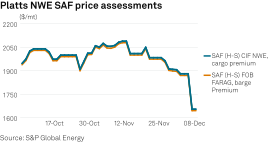
SAF prices for December loading continued to decline, driven by suppliers covering their 2025 compliance volumes.
Platts, part of S&P Global Energy, assessed the SAF (HEFA-SPK) FOB FARAG premium to Jet barges down $84/mt, or 4.3% week over week at $1,870/mt Dec. 4. The CIF NWE premium to Jet was assessed at a $10.50/mt premium to FOB FARAG barge levels.

Editor: