Agriculture, Meat
December 09, 2025
COMMODITIES 2026: Rising Brazilian output, firm demand to shape global poultry outlook
HIGHLIGHTS
Chinese import resumption to boost Brazil shipments
US chicken to gain market share from high-priced beef
Japan's chicken imports to stay strong on high retail costs
UAE consumption growth set to outpace production gains
This is part of the COMMODITIES 2026 series, where our reporters bring to you key themes that will drive commodities markets in 2026.
Global chicken markets are likely to see firm demand and improved supplies in 2026, with Brazilian production projected to rise as exports to major markets resume. In the US, chicken prices are expected to remain firm and demand to rise amid climbing beef prices, whereas in Asia, elevated retail prices and tight domestic production are likely to enhance import demand.
Brazilian output set to rise, export outlook positive
Brazil's poultry sector is expected to maintain strong production levels in 2026, supported by favorable prices and a recovery in export demand. Production is already seen rising in 2025, driven by high export prices and improved margins from competitive feed costs.
"Next year, the breeding stock is expected to increase, boosting production," an industry source based in Brazil said.
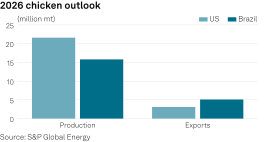
According to the Brazil attache report from the USDA Foreign Agricultural Service, chicken production is forecast to reach 15.80 million metric tons in 2026, up from an estimated 15.35 million mt in 2025, with domestic consumption rising to 10.70 million mt in 2026 from 10.35 million mt in 2025.
Per capita consumption in Brazil is projected to remain stable at 47.8 kilograms per person in 2026, according to the Brazilian Association of Animal Protein (ABPA).
Analysts anticipate that Brazil's chicken exports will continue to grow into 2026, especially after key markets like China and the EU lifted bans in Q4 2025, though exchange rate fluctuations may affect volumes.
Demand for Brazilian products in Latin America, particularly Mexico, is expected to stay strong. Pricing in 2026 will depend on the balance of global supply and demand, with elevated prices likely if demand remains robust.
US poultry outlook stable
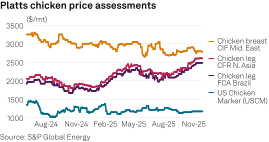
The US chicken market is expected to see more stable trade in 2026, following a volatile 2025. In May, Platts jumbo boneless skinless breast assessment peaked at $2.79/lb before dropping to $1.05/lb in October, marking significant swings since 2022.
"If you look at historical data, 2026 will follow the pattern of 2023. The previous year had crazy highs and the following year will have less volatility," said a chicken market analyst.
Several key differences from the 2022–23 period point toward firmer US chicken prices in 2026. US chicken is positioned to gain market share from beef due to its high prices and lower production levels. Beef cattle are at their lowest inventory level in seven years, while chicken hatcheries have been running near capacity with no major plant openings scheduled for 2026.
"The big difference from 2023 is the price spread between chicken and beef. In 2023, values were almost at parity, but with less cheap beef available, we expect to see an increase in chicken offerings to consumers," said a producer.
Alongside a positive demand outlook for US domestic chicken, the 2026 supply appears more favorable than in 2023. USDA cold storage volumes for chicken hit a record 931.8 million pounds in December 2022, yet current levels are below the five-year average, with the latest figure at 790.9 million pounds as of August 2025.
HPAI bird flu continues to pose a risk to chicken supplies and routing. "HPAI will bring volatility on exports, but even though it seems to be a bigger risk than last year, regional outbreaks are not as big an impact on the whole country," said a producer.
North Asia demand likely to remain strong
The North Asian chicken market is expected to maintain its upward momentum from late 2025 to early 2026, supported by steady demand and reduced export volumes of boneless legs from Brazil, according to market participants.
In Japan, high retail prices since early 2025 are expected to boost demand for imported chicken meat.
Retail prices for chicken legs remain elevated at Yen 700–800/kg ($4.5-5.15/kg), while imports are priced around Yen 400–500/kg ($2.6-$3.2/kg), a Japanese importer said.
Recent H5N1 bird flu cases in Japan may further limit the domestic supply, a source from the Japan Meat Traders Association said.
Despite strong demand, challenges arise from Brazil's declining boneless leg exports, which fell 16% year over year in November due to labor shortages and high deboning costs.
In South Korea, chicken demand is expected to rise during international sports events, with increased import volumes supported by competitive pricing compared to beef and pork, a local importer said.
China, which recently resumed poultry imports from Brazil, is expected to increase shipments of chicken wings, paws and feet. However, given the niche nature of these products, such market movement is not expected to significantly affect the region.
An S&P Global Energy CERA analyst said China's poultry meat production is projected to grow by 4.8% year over year in2026, driven by higher slaughter rates and favorable feed prices. In 2025, the feed indicator price for broilers averaged Yuan 4.22/kg ($0.6/kg), 3% lower year over year, the analyst added.
Platts assessed CFR North Asia chicken leg prices at $2,615/mt on Dec. 1, up 42% from $1,843/mt on Jan. 2.
UAE, Saudi Arabia production poised to rise
Middle East poultry markets are projected for strong demand growth through 2026, with consumption outpacing domestic production. The UAE is leading this expansion. Its production is expected to rise to 75,000 mt while consumption reaches 485,000 mt in 2026, according to USDA Foreign Agricultural Service data.
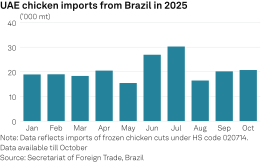
Re-exports via UAE ports, particularly for frozen cuts, are likely to continue, despite rising production, said a trader who deals in Middle East markets. Brazilian exports remain a crucial supply source, although risks such as disease outbreaks could reduce volumes.
Saudi Arabia aims for nearly 70% poultry self-sufficiency by 2025 through a Riyal 17 billion ($4.53 billion) initiative to produce 1.3 million mt of broilers annually, according to a government statement. The current consumption demand is estimated at 1.7 million mt, while production is at 1.1 million mt, according to the statement.
In Europe, producers face competition from cheaper Ukrainian imports and Brazil's return to EU markets, compounded by high production costs and ongoing H5N1 outbreaks that are expected to affect margins through 2026.
