December 08, 2025
COMMODITIES 2026: Shrimp markets to see mixed trends as Ecuador exports rise, India navigates tariffs
HIGHLIGHTS
Global shrimp production to rise in 2026
US buyers likely to diversify suppliers amid tariffs on Indian shrimp
Government stimulus to boost shrimp demand in China
EU demand outlook firm, shifting toward value-added formats
This is part of the COMMODITIES 2026 series, where our reporters bring to you key themes that will drive commodities markets in 2026.
Global shrimp markets are likely to see mixed trends in 2026, shaped by trade dynamics and regional production shifts. Ecuador is expected to maintain strong export growth, supported by resilient output and recovering demand from China, while India's shipments face pressure from US tariffs, prompting a focus on market and product diversification. In the US, import volumes may shift toward alternative suppliers if trade tensions with India persist, while European demand is likely to remain stable, with a growing preference for semi-processed and value-added products.
Ecuador exports set to rise
Ecuador's shrimp sector is set for strong growth after robust production in 2025, rebounding from relatively stable export volumes in 2024. Favorable weather conditions during the first half of the year, with warm and consistent temperatures, supported higher output and increased export potential. However, since September, cooler conditions intensified by La Nina have begun to affect output, a trend expected to continue through December and possibly into early 2026.
From January to October, Ecuador exported 1.15 million metric tons of shrimp, up 15.5% year over year, according to the National Aquaculture Chamber. China accounted for 48.18% of Ecuadorian shrimp exports, followed by the US at 19.42%, and European countries combined at 22.89%.
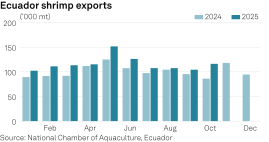
Ecuador's shrimp exports are expected to end 2025 with double-digit growth, recovering from a 0.2% decline in 2024, when total exports reached 1.21 million mt. Production is forecast to remain strong in 2026.
On the demand side, exporters are optimistic about a recovery in the Chinese market, supported by government efforts to stimulate demand. Although restocking activity has been observed, prices have remained unaffected. Conversely, European importers are reporting high inventories, which is resulting in slower trading and stabilized prices. With most buyers having completed their year-end purchases, further price increases may be limited.
In the US, buyers remain cautious amid uncertainty over tariffs. Ecuador and the US recently announced a trade framework that includes reciprocal tariff cuts and reductions in non-tariff barriers; however, the timelines for the inclusion and implementation of shrimp remain unclear. Currently, Ecuadorian products face a 15% blanket tariff in the US, with shrimp also subject to countervailing duties ranging from 3.57% to 4.41%.
"The United States commits to remove its reciprocal tariffs on certain qualifying exports from Ecuador that cannot be grown, mined, or naturally produced in the United States in sufficient quantities," the White House said on Nov. 13.
Tariff pressures cloud India's exports
India's shrimp export outlook for 2026 remains uncertain due to ongoing trade tensions with the US. Despite resilient vannamei shrimp exports rising 9% year over year to 455,244 mt over January and September 2025, market participants warn that prospects for 2026 could be challenging without a trade deal that lowers US import duties.
"We were lucky that the US tariffs came into effect while it was low season here," an exporter based in Visakhapatnam said, adding that if a trade deal is not reached before year-end, the Indian shrimp industry could face significant losses.
The US policy has had a significant impact on the Indian shrimp industry, as 40% of its total exports are directed to the US. Indian shrimp farmgate prices rebounded in September after a sharp fall in August following the US's imposition of tariffs due to supply constraints. However, the value of peeled shrimp fell drastically due to the US tariffs.
Platts peeled deveined tail-on shrimp FCA India marker averaged $6,912/mt in October, down 7% year over year. Markets such as the US and EU primarily purchase peeled and value-added shrimp from India, and prices are heavily reliant on these markets.
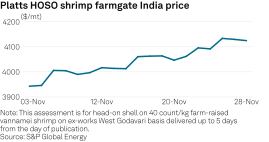
Indian exporters have observed that going into 2026, the industry can't rely on a single market, and market and product diversification is the way forward.
"The Indian seafood sector will have to look at entering new markets, besides strengthening its position in existing markets," Dr. K. N. Raghavan IRS, the secretary general of Seafood Exporters Association of India, told Platts, part of S&P Global Energy , in an interview in August.
He further added, "Currently, less than 10% of the export basket comprises value-added products. More focus on this segment will open up new markets, besides being more remunerative."
Indian exporters are expected to focus more on markets such as the EU, Russia, Southeast Asia and China in the next year.
India's shrimp production is expected to continue despite the US tariff challenges. Though there were concerns that many farmers would shift away from shrimp farming due to low market prices following the US tariff imposition, the rebound in prices kept farmers in the business, a Nellore-based trader said.
The trader said that though some farmers have switched to black tiger shrimp from vannamei shrimp, due to its price premium, they are not expecting a drop in production
According to S&P Global Energy CERA, India produced 1.18 million mt of vannamei shrimp in 2024, and the production is estimated to rise by 6% to 1.25 million mt in 2026.
US imports to shift amid tariffs
The US shrimp import market in 2026 will be shaped by ongoing tariff discussions with India. A significant reduction in duties could restore prices to levels seen in early 2025 and ensure a robust supply from India. Conversely, if tariffs remain around 60%, Indian production could collapse, impacting global shrimp trade.
The US market experienced major shifts in the second half of 2025 as high tariffs on Indian shrimp opened the door for Ecuadorian suppliers to gain market share. A hefty 50% base tariff on Indian shrimp has triggered a sharp drop in imports. "You can't sell with 50% tariffs," an Indian exporter said.
Many US importers pre-covered their needs before the tariff hikes, slowing activity in Q4, particularly for peeled and deveined shrimp, a segment traditionally supplied by India. "The only shrimp coming here from India is small peeled (raw and cooked) because other countries can't produce small shrimp at a reasonable cost," a US importer said. "We could not find a packer in any other country that could cover the volume of small shrimp we needed."
Meanwhile, importers and distributors are facing higher replacement costs and are seeking alternatives from Ecuador, Vietnam, and Indonesia. However, analysts cited by the Financial Times note that substitution is not immediate, as India dominates peeled and deveined shrimp production and has unmatched processing infrastructure.
EU demand expected to grow
The EMEA shrimp market is expected to remain broadly stable in 2026, with demand increasingly focused on semi-processed and value-added formats, particularly in Europe. Northern and Central European buyers are showing growing preference for individual quick freezing, peeled, deveined, and easy peel products, while raw head-on shrimp continues to lose relevance in retail-led markets. This shift has strengthened Ecuador's competitive position, with several suppliers expanding capacity in semi-processed formats to meet European specifications.
Ecuador is expected to maintain its dominant position as a supplier to Europe, with India holding a stable second place. No major structural changes are anticipated on the supply side; however, Asian free-trade agreements may have a marginal impact on delivered costs for some origins. "Ecuador is becoming stronger in semi-processed formats, and that is where Europe is growing. Others can compete on raw material, but not on consistency," a European importer said.
EU shrimp demand is expected to remain broadly stable, with moderate growth supported by retail programs and steady demand in the food service sector. However, the 2025 import surge is unlikely to repeat unless storage is cleared faster than expected. Traders noted that 2025 volumes were largely driven by tariff-related forward buying rather than structural consumption growth. A second source said, "What happens in 2026 depends entirely on storage. If cold rooms are full by year-end, buyers will slow down."
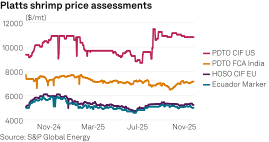
Prices are expected to stay rangebound in early 2026, with limited upside unless inventories tighten. Seasonal buying patterns remain, but price movements will be driven more by supply availability than by demand, given Europe's stable consumption.

Editor: