Agriculture, Meat
December 05, 2025
COMMODITIES 2026: China's pork imports to fall amid ample domestic supply, tariffs
HIGHLIGHTS
China, US pork output to increase; EU exports to decline
Japan pork imports to fall; South Korea imports to rise
US, EU pork exports to soften in 2026; Brazil poised for growth
This is part of the COMMODITIES 2026 series, in which our reporters bring to you key themes that will drive commodities markets in 2026.
Global pork production is expected to rise in China, the US and Brazil in 2026, while consumption growth is set to remain modest, according to analysts at CERA, part of S&P Global Energy. Pork trade flows are poised to shift as China and Japan reduce imports and Brazil expands its export footprint.
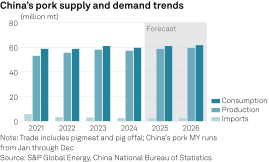
CERA projects China's pork imports, excluding offal, to fall 7.1% year over year to about 1 million metric tons (shipped weight) for the marketing year 2026 (January-December).
CERA analysts expect import volumes to remain well below the five-year average due to ample domestic supply and subdued consumer demand.
The ongoing antidumping investigation into EU pork imports, which is expected to conclude in December, combined with existing tariffs on US and Canadian pork, is expected to limit China's import volumes, according to Jessie Khor, principal protein analyst at CERA.
Pork production in China is set to edge up 1.4% to 59.39 million mt in 2026, with pork consumption expected to rise 1.2% to 61.58 million mt, according to CERA.
"Government efforts to suppress pig meat production and support prices are expected to limit domestic pork supplies in 2026," Khor said.
In June, China announced plans to cut its breeding sow herd by 1 million to stabilize persistently low pork prices after a period of oversupply.
CERA analysts expect softer wage growth in 2026 to continue limiting consumption expansion for pork.
From January to October, China imported 848,393 mt of pork, down 2.7% year over year, General Administration of Customs data showed Nov. 20.
The EU remained the dominant supplier, accounting for 53% of shipments at 454,056 mt, up 5.6% year over year.
The overall decline in imports during this period was driven by sharply lower volumes from Brazil, down 32.7%, and the US, which fell 5.9% amid existing tariffs.
China's retaliatory tariff on US pork had been 57% until Nov. 10, when it was reduced to 47% after a trade truce was reached between the two countries.
Japan's pork imports set to fall
CERA forecasts Japan's pork imports for MY 2026 (January-December) to fall 4.9% year over year to 1.29 million mt. Domestic production is projected to ease 0.6% to 1.28 million mt, while consumption is expected to slip 1.3% to 2.59 million mt.
According to Khor, high global prices are softening demand growth in Japan.
She noted that production is set to decline due to reduced slaughter and lower opening inventories, while weaker consumption is driven by demographic factors, soft income growth and high prices, making imports less competitive.
In South Korea, pork imports are projected at 744,000 mt for MY 2026 (January-December), up 5.1% from the prior year, with output expected to grow 3.8% to 1.39 million mt and consumption set to rise 4.3% to 2.13 million mt, according to CERA.
Market access changes, including China's increased tariffs on EU pork and Spain's ASF regional ban, are likely to impact available import supplies in the short run, Khor said.
She also noted that animal disease outbreaks continue to pose a downside risk to pork demand in South Korea.
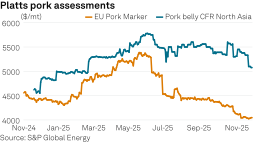
Platts, part of S&P Global Energy, assessed pork belly CFR North Asia at $5,077/mt on Dec. 4, up 5.4% year over year.
EU pork exports set to fall
The EU pork sector enters 2026 facing high production costs and intense global competition.
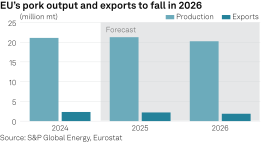
CERA projected EU pork production to fall 4.8% to 20.24 million mt in MY 2026 (January-December), with exports expected to drop 15% on the year to 1.86 million mt.
"The EU is unlikely to grow its market share of the Asian pork market in 2026, with Brazil likely to be the largest beneficiary of both a drop in EU shipments and any growth in demand," Rebecca Wright, CERA protein analyst for Europe, said.
China implemented provisional antidumping duties of up to 62.4% on EU pork imports Sept. 10, leading to a 28% year-over-year decline in EU shipments to China in the 11 weeks following the measure.
Wright said displaced EU demand is expected to be filled by Brazilian or Russian suppliers rather than US pork, as relations between Washington and Beijing remain tense.
Amid these challenges, the sector is increasingly focusing on the domestic market while diversifying its exports.
Rising beef and poultry prices are driving EU consumers toward pork, offering some relief to domestic demand.
Platts assessed the EU pork marker, FCA Barcelona, at $4,045/mt on Dec. 4, down 8.5% year over year.
Brazil pork exports to rise
According to CERA, Brazil's pork production is forecast to rise 2.6% to 5.62 million mt in MY 2026 (January-December), while exports are projected to increase 5.4% to 1.61 million mt.
Over January-October 2025, the Philippines surpassed China as Brazil's leading pork export destination, with shipments surging 58.2% year over year, while exports to China fell 31.9%, Brazil's Secretariat of Foreign Trade data showed Nov. 24.
"With export opportunities growing in the Philippines and limited in China, Brazil has shifted its focus from the Chinese market to the Philippines," Wright said.
She expects Brazil to compete strongly with EU pork across Asian markets through product availability and pricing advantages.
US pork exports to fall
US pork output is projected to edge down 0.7% to 27.53 billion pounds (12.49 million mt) in MY 2026 (January-December), according to Lacey Williams, principal proteins analyst at CERA. Exports are forecast to dip 0.9% to 6.86 billion pounds (3.11 million mt).
"The US pork herd is set to stabilize and potentially experience some tightness into Q1 2026," said Ryan Urie, director and head of global crop and proteins at CERA.
"As pork remains competitively priced, it should have some demand tailwinds from consumers shifting down from the beef complex," he added.

Editor: