Agriculture, Energy Transition, Biofuel, Renewables
November 26, 2025
UK imposes TRA-backed antidumping duties on Chinese biodiesel imports

HIGHLIGHTS
UK government sets duties at 14.79%-54.64% to counter dumping
Measures to restore fair competition in the UK market: TRA
Duties will remain in place for five years, unless reviewed
The UK government has imposed definitive antidumping duties on biodiesel imports from China, effective Nov. 25, after the Secretary of State for Business & Trade accepted the Trade Remedies Authority's recommendation, the body said Nov. 24.
The TRA concluded that biodiesel from China had been entering the UK at unfairly low prices, causing material injury to domestic producers, including Argent Energy and Olleco. Its investigation, launched in June 2024 following a complaint from the Renewable Transport Fuels Association, found that the imports were being dumped, and applying a trade remedy was in the UK's economic interest.
The new measures introduce ad valorem tariffs of 14.79% for the Zhuoyue Group and non-sampled cooperating exporters, and 54.64% for all other Chinese suppliers. The duties apply to biodiesel products, including fatty-acid mono-alkyl esters and hydrotreated vegetable oil, whether in pure solid form or blended, but exclude sustainable aviation fuel.
According to the public notice, the antidumping duty will remain in place for five years, expiring Nov. 25, 2030, unless reviewed. Importers seeking lower company-specific rates must present valid commercial invoices with the required declarations; otherwise, the residual rate of 54.64% applies.
The decision aligns the UK with other jurisdictions, such as the EU, which finalized 35.6% antidumping duties on biodiesel and renewable diesel from China in February. The TRA stated that the measures aim to restore "fair competition" in the renewable fuels market.
The new tariffs went into effect Nov. 25.
The TRA, the UK's independent body responsible for investigating trade remedy measures, makes final determinations following the publication of a Statement of Essential Facts and a stakeholder consultation period.
China's rapid scale-up in biodiesel and HVO exports has drawn scrutiny from UK and EU trade officials. Industry watchers suggested that the duties could accelerate China's pivot toward SAF, which is exempt from antidumping measures in both regions, thereby giving refiners an incentive to reallocate capacity.
While the duties may provide short-term relief for UK producers, long-term challenges persist. Weak domestic demand, high reliance on imports, and intensifying global feedstock competition are expected to remain unchanged. Additionally, if Chinese producers redirect volumes into the SAF market, the UK may find itself trading one dependency for another—less vulnerable in road fuels, but increasingly reliant on foreign supply in aviation.
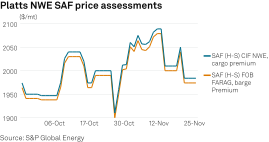
Policymakers face the challenge of ensuring that mishandled trade remedies do not deter the essential investments required to establish the UK's next-generation fuel supply base.
Antidumping duties are applied when foreign producers export goods at a price below their normal value, thereby harming domestic industries. The TRA evaluates economic impact before making recommendations to the Secretary of State.
The UK is simultaneously pursuing trade liberalization elsewhere. Tariffs on US ethanol imports were eliminated under the UK-US Economic Prosperity Deal, as tariffs on US ethanol (GBP160/cu m for undenatured ethanol and GBP85 for denatured grades) will fall to zero through a 1.4 billion-liter quota. This volume is comparable in size to the UK's fuel ethanol market.
The UK's action sits within a broader wave of protectionism in renewable fuels:
- EU: Finalized 35.6% antidumping duties on Chinese biodiesel and RD in February.
- US: Exemptions for small refiners and reviewing trade defense against Chinese and Southeast Asian waste-based biodiesel.
- China: Facing narrowing arbitrage into both Europe and the UK, likely to redirect exports to SAF or new growth markets in Asia.
European biodiesel premiums were mixed Nov. 25, with one producer citing thin market activity for FAME 0 and UCOME, as well as volatility in associated fossil fuel markets. Intercontinental Exchange gasoil front-month futures markets fell $17.75/metric ton day over day to $683.25/mt.
In the first generation, Platts, part of S&P Global Energy, assessed FAME 0 premiums at $591/mt, up $23, while RME premiums remained flat at $740/mt. In the second generation, UCOME premiums slid $3 to $778/mt Nov. 25.
Asian feedstock and biodiesel market held firm Nov. 25 with limited activity from the market.
Platts assessed UCO FOB Straits at $1,075/mt Nov. 25, also unchanged day over day.
Platts assessed UCO FOB North China at $1,099/mt Nov. 25, also unchanged day over day.
Premiums in the Amsterdam-Rotterdam-Antwerp region rose across the board Nov. 26, with traders pointing to low liquidity in used cooking oil markets and adequate rapeseed methyl ester demand.
ICE LSGO M1 continued its downward trend for the sixth straight session, falling $15.75 to $667.50/mt.
Platts used cooking oil methyl ester premiums were assessed at $789.25/mt, up $11.25.
Platts FAME 0 premiums were assessed at $593/mt, climbing $2, with no physical FAME 0 trades heard day over day. Elsewhere, Platts RME premiums were assessed at $750/mt, up $10 day over day.

Editor: