Agriculture, Energy Transition, Refined Products, Biofuel, Renewables, Jet Fuel
November 24, 2025
Australia, China poised to lead APAC Power-to-X SAF push amid uneven regional readiness

HIGHLIGHTS
Renewable powerhouses Australia, China lead APAC PtX push
Uneven regional readiness, policy gaps hinder scale-up
Integrated road map urges cross-border coordination
Australia and China hold the strongest industrial and renewable energy foundations to drive the Asia-Pacific's transition to Power-to-X aviation fuels. However, the broader region remains hamstrung by "uneven readiness" and policy fragmentation, the Roundtable on Sustainable Biomaterials said Nov. 24 in a report.
In its first integrated assessment of the region, titled "PtX and Sustainable Aviation: A Roadmap for Asia-Pacific," the RSB identified a distinct divide in the region's capacity to scale Power-to-Liquids and Power-and-Biomass-to-Liquids fuels.
While Australia and China are positioned as potential production powerhouses due to their vast renewable resources and industrial CO2 sources, other key economies face significant infrastructure and resource hurdles.
Divergent regional roles
The report categorizes the APAC market into distinct clusters, highlighting that no single country currently meets all enabling conditions for rapid deployment.
"Australia and China hold the strongest industrial and energy foundations," the RSB said, pointing to Australia's developing coastal hydrogen hubs and China's massive renewable generation capacity as critical assets for the sector.
Advanced economies such as Japan, South Korea, and Singapore were identified as leaders in governance, technology, and trading infrastructure; however, the report warned that they face explicit "geographic and infrastructure constraints" regarding raw materials.
Emerging economies such as India, Indonesia, Malaysia, and Thailand offer significant potential for biomass feedstock; however, they are currently limited by water stress, land-use pressures, and fragmented policy landscapes.
Barriers to scale
The RSB warned that the region's diversity creates both opportunities and structural risks. The road map outlined six "interlinked structural challenges" preventing PtX from scaling beyond niche projects: policy inconsistency, infrastructure gaps, financing and risk, inconsistent certification systems, and limited stakeholder capacity outside of major industrial economies.
No single country in the APAC region can independently cover all critical dimensions for PtX fuel scale-up, including renewable power, CO2 sources, feedstock supply, industrial capacity, and governance alignment.
- Renewable electricity: Australia and China lead the way with exceptional solar and wind potential, although renewable electricity demand is rising rapidly. Most APAC economies remain coal-dependent, limiting near-term renewable surplus for PtX production.
- Green hydrogen: Demand for hydrogen offtake agreements is concentrated in Japan, South Korea, and Australia, with China scaling rapidly but lagging in export frameworks. India is emerging as a significant producer of hydrogen, but it faces water stress constraints.
- Biomass residues: India, Indonesia, Malaysia, and Thailand offer vast potential for agricultural residues — such as rice straw, sugarcane bagasse, palm, and forestry residues — yet their supply chains remain fragmented, and deforestation risks necessitate strict sustainability safeguards.
- CO2 sources: Industrial CO2 is abundant in China and India, but direct air capture technology remains pre-commercial and prohibitively expensive. The road map warns that reliance on fossil-derived CO2 poses a "transition risk" and undermines the credibility of PtX.
Technology readiness levels:
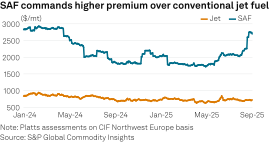
PtL and PBtL pathways remain at pilot or early-demonstration stage. Current cost estimates are $3,800-8,600/metric tons versus $600-900/mt for fossil jet fuel, a gap wider than HEFA-SAF. The road map projects cost competitiveness only after 2040, as renewable electricity prices decline.
- PtL-FT (Power-to-Liquids via Fischer-Tropsch): ASTM D7566 approved, TRL 6-7 (pilot-to-demo)
- PBtL-GFT (Power-and-Biomass-to-Liquids): ASTM approved, TRL 6-7 (pilot-to-demo)
- PtL-MtJ (Power-to-Methanol-to-Jet): Not yet approved, TRL 5-6 (demo stage)
- PBtL-MtJ (Biomass-to-Methanol-to-Jet): Not approved, TRL 5-6 (demo stage)
Strategic road map
To bridge the readiness gap, the RSB called for coordinated regional cooperation rather than isolated national strategies. The road map suggests connecting the resource-rich "opportunity clusters" —such as Australia's hydrogen hubs and India's feedstock bases — with the technology and finance centers in Singapore, Japan, and South Korea.
Key recommendations for the next decade include aligning certification systems to facilitate cross-border trade, developing shared infrastructure corridors, and integrating future aviation demand into national renewable energy planning.
"The coming decade will determine whether PtX fuels become a niche innovation or a cornerstone of aviation decarbonization in APAC," the report concluded.
Direct SAF blending mandates remain scarce across the APAC region. Only Singapore and South Korea have enacted binding SAF mandates (Singapore: 1% by 2026, rising to 3-5% by 2030; South Korea: 1% from 2027). Japan is consulting on a 10% target by 2030, while China's binding timeline remains undefined.
Sustainable Aviation Fuel prices in Europe edged lower in the week to Nov. 19, amid mixed market sentiment and spot SPK premiums quoted in a range of $1,500-$1,600/cu m.
Platts, part of S&P Global Energy, assessed the SAF (HEFA-SPK) FOB FARAG premium to jet barges down $39/mt to close the week ended Nov. 19 at $2,039.50/mt, or $1,550/cu m, based on a SAF density of 760 kg/cu m.

Editor: