Agriculture, Oilseeds
November 05, 2025
EUDR concerns slow EU soymeal trade, raise alarms in South America

HIGHLIGHTS
EU imports 85% of its soymeal from South America, where exporters face traceability challenges under EUDR.
Market activity remains muted across Europe, with December offers thin amid widespread uncertainty.
As the EU Regulation on Deforestation-free Products (EUDR) continues to create uncertainty across the EU market, it has also led to growing caution among South American exporters, especially in Brazil and Argentina.
The EU imported nearly 20 million mt of soymeal between July 2024 and June 2025, according to Eurostat data. With Brazil contributed 10.18 million mt, and Argentina contributed 7 million mt in the same marketing year. Overall, about 85% of the EU's soymeal supply comes from South America.
An Argentina-based feed consultant explained that the biggest challenge under EUDR for South America is ensuring physical segregation of compliant soybeans. "Only crushing plants with the ability to maintain separate storage and processing for deforestation-free soy will remain competitive," he said. He added that most Argentine soybeans come from low-deforestation regions, but the key issue will be proving this through geo-referenced systems.
A Brazil-based market analyst shared similar concerns, saying the country's soybean industry is on alert amid domestic uncertainty. "The main problem will be differentiating soybeans from deforested and non-deforested areas during export — that's where the bottleneck lies," he said.
In Europe, the soymeal market has gone remarkably quiet, with most feed producers taking a wait-and-see approach. "Almost all feed companies across the EU are cautious and avoiding new deals until there's clarity on how EUDR will be implemented," a Romania-based feed consultant noted.
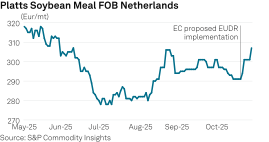
Reflecting the subdued tone, offers for December loading from Amsterdam or Rotterdam were heard at $436/mt. Platts, part of Energy, assessed soybean meal FOB Rotterdam/Amsterdam at €347/mt, marking a 17% month-on-month increase.

Editor: