Agriculture, Livestock, Meat
October 19, 2026
Beef trimming supply glut weighs on prices as China demand lifts outlook
Editor:
HIGHLIGHTS
Weekly imports drop 12.7%, up 53.1% on year
Brazil supplies 32.5% of total trimmings
Spot prices fall as 2027 demand strengthens
US beef trimming imports fell week over week, although volumes remained above year-ago levels. A near-term supply overhang weighed on spot and November 90CL values, while stronger demand from China for 2027 shipments supported a contango structure in the US import market.
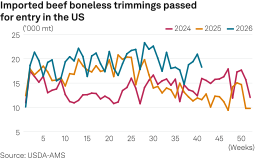
The US Department of Agriculture said in its last Imported Meat Passed for Entry in the US report that total US imports of beef trimmings for the week ended Oct. 10 were 18,267 metric tons, down 12.7% week over week, but up 53.1% from the same week in 2025.
Of the total US imports of beef trimmings during the week ending Oct. 10, 32.5% were from Brazil, 29.6% from Australia, 12% from Argentina, 10.6% from Canada, and 6.8% from New Zealand, USDA data showed.
US imports of Brazilian beef trimmings climbed 52.4% to 5,939 mt during the week; imports from Australia dropped 37.8% to 5,406 mt, and from Argentina rose 98.9% to 2,200 mt.
According to the USDA data, about 783,326 mt of beef trimmings have been imported through Oct. 10, up 19.8% from the same period in 2025, and 40.1% from the same period in 2024.
Of the total lean beef trimmings imported during the year, 30.5% was from Australia, 21.9% from Brazil, 18.6% from New Zealand, and 8.6% from Uruguay.
Regarding the free-tariff window under the affordable beef program, "the pace of entry continues well below the trajectory needed to approach the 100,000 MT monthly cap, limiting the near-term threat of a large influx of foreign lean beef into the domestic market," S&P Global Energy CERA said in its US Beef and Cattle Short-term Outlook report. "Near-term trim direction will depend on whether grind demand continues to improve sufficiently to absorb production from normalized harvest schedules and whether Tranche 2 import volumes accelerate in the back half of October."
Brazilian beef exports
Brazilian beef exports to the US totaled 44,435 mt in September, up 465% from the same month in 2025, according to consolidated data from Brazil's Foreign Trade Secretariat, or Secex
From January through September, Brazil exported 285,427 mt of fresh and frozen beef to the US, up 55.6% from the same period last year, according to Secex.
Meanwhile, a Brazil-based trader said there was an ample supply of Brazilian beef for the US market, although buying levels did not correspond to offers.
"We are seeing an ample supply of Brazilian beef for the US, but offers and buying interest aren't lining up. Prices have diverged significantly because of movements in the dollar and conditions in the Brazilian domestic market," the trader said.
During the first seven business days of October, Brazil exported 61,321 mt of fresh and frozen beef to all destinations, down 80.9% from the same period in October 2025, according to preliminary Secex data. The decline followed the completion of China's annual beef import quota, the data showed.
Australian beef exports
Australian beef exports to the US totaled 43,479 mt in September, according to Australia's Department of Agriculture, Fisheries and Forestry data. This indicates a 1.1% month-over-month decline and a 3.7% year-over-year increase.
Year-to-September, Australian beef exports to the US totaled 378,641 mt, which was 15.2% higher compared to the same period a year ago, DAFF's figures showed.
US demand for lean trimmings has remained soft over the past three weeks, weighing on prices, an Australia-based exporter and a local trader said.
China's demand for shipments scheduled for 2027 arrival has remained strong, supporting the grain-fed cattle prices, according to a second Australia-based exporter.
Some plants' warehouses were full of beef destined for the Chinese market, prompting them to reduce processing capacity to approximately three or four days per week, the exporter added.
90CL beef US prices
Platts, part of S&P Global Energy, assessed 90CL frozen beef on a CIF East Coast basis for 30- to 60-day shipment at $3.13/pound, unchanged day over day but down 4 cents from a week ago. The assessment was down 6 cents/lb from a month earlier and down 18 cents/lb from the year-ago level. Australia and New Zealand accounted for the largest share of observable CIF market data.
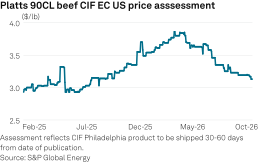
China's demand for 2027 imports has driven origin prices in Brazil and Australia higher, even though US demand has been soft.
"The market seems to be all over the show right now," a New Zealand beef trader said. "I can't really work out what the true market is."
"I have not traded anything," the same trader said. "A lot of our production to begin the season is selling into China."
There has been less activity this week, with an oversupply of imports in the spot and near market, but demand is already strong for the first quarter of 2027, according to a lean beef import US trader.
In the port-of-entry market, Platts assessed 90CL beef on an FCA East Coast basis for 16- to 60-day delivery at $3.05/lb, up 6 cents from the previous day, up 2 cents from the week but down 3 cents from the previous month. Shipments from South America were the most competitive.
Prices for shipments from South America, FCA East Coast, showed a contango market structure for 90CL. Value indications for spot delivery were as low as $2.98/lb, for 16- to 60-day delivery were as low as $3.05, and for 2027 entry were at $3.12/lb.
"The market for spot and November deliveries is under pressure, but values are higher for December and early 2027 delivery," a Central America beef exporter added. "There is a lot of uncertainty about the affordable free-tariff program for Brazil and Paraguay, which is well behind the expected, and the renewal of the free-tariff quota for Argentina."
Echoing probable higher values for December and early 2027 delivery, the Australia-based trader said that the values could be potentially influenced by China's demand.
