Agriculture, Meat
October 13, 2025
European pork exporters shift focus to domestic sales as Chinese duties take effect
By Iara Lima and Nuo geng Chen
HIGHLIGHTS
Preference for European market over frozen exports
Weaker demand from Japan, South Korea
European pork exporters are increasingly pivoting away from Asian markets as Chinese import duties and weaker demand in key Asian destinations squeeze profit margins, according to Spain-based exporters and Asian traders.
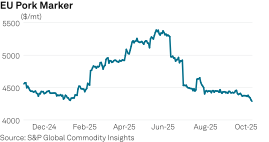
The reorientation to the domestic market, as well as seasonal trade dynamics, is pressuring European pork prices. On Oct. 10, Platts assessed the EU Pork Market at $4,302/mt, down $117/mt since the imposition of Chinese duties on Sept. 10. Additionally, on Oct. 13, Platts assessed Pork Belly CFR North Asia at $5,349/mt, down $151/mt in the same period. Platts is part of S&P Global Energy.
According to the first Spain-based exporter, the margins for these products have now decreased, leading to a complete halt in their sales of bone-in products. "Nobody is selling to China" in that category, the exporter said.
In contrast, domestic European markets offer more stable pricing despite seasonal pressures, the two exporters said.
"Offers in Europe are also low because other markets are not going well—Japan and South Korea are not doing well, and China is now out of the battle because of the duties," the second Spanish exporter said.
Japan presents particular challenges for European exporters, with the second Spain-based exporter citing "extremely depressed" pricing in that market, which makes profitable sales harder to achieve.
A trader from South Korea echoed this sentiment regarding their own market, noting that a seasonal demand slowdown in South Korea is typical as Christmas approaches.
Market eyes seasonal boost
The combination of Chinese duties and broader Asian market weakness has created a domino effect in European pricing. With fewer profitable export destinations available, European suppliers are competing more intensively for domestic sales, putting additional pressure on local pricing.
The domestic focus has become more pronounced as frozen export strategies lose appeal. Holding frozen stock entails uncertainty about what thefinal selling price will be, especially in a falling market, a Malaysian trader said.
"It is not a good idea to freeze right now," the first Spanish exporter said, adding that "all Spanish plants, if we can, we sell in the domestic market instead of frozen."
This preference is based on the domestic market operating "very differently, luckily for us," providing more predictable demand patterns and shorter sales cycles, and avoiding uncertainty around storage costs and pork price changes, the second exporter said.
European exporters are looking ahead to December, when activity in the meat sector typically rises.
The Malaysia-based trader said offers were currently low, and expected prices to rebound after clearing leftover frozen stock.
"In the first two weeks of December, prices are expected to go up compared to October and November,"the second Spanish trader said, reflecting a pattern typically observed across Europe as supermarkets make bookings and reservations during November.

Editor: