Agriculture, Meat, Grains
October 06, 2025
INTERVIEW: Australia leverages cattle feedlot growth, competitive advantage in changing global landscape
By Yuh nien Chow and Elizabeth Thang
HIGHLIGHTS
Feedlot investments aid stabilize production amid weather volatility
Australia capitalizes on trade disruptions affecting Brazilian beef
Australia aims to strengthen trade relationships with key partners
The feedlot sector is poised play a crucial role in boosting Australia's beef production, which is essential for meeting the rising global demand anticipated for 2026, Tim Ryan, Chief Executive Officer of Australian Meat Industry Council told Platts in an interview.
Ryan highlighted that the cattle slaughter rate in Australia largely depends on weather patterns and rainfall, along with other factors affecting the profitability of business managers and farmers.
This year has seen a notable increase in beef production, mainly driven by the rise of grain-fed beef, as significant investments have been made in the feedlot sector, according to Ryan.
The latest Meat and Livestock Australia's June Quarter Feedlot Survey showed a 3% increase in feedlot utilization from the previous quarter, reaching a record high of 93%.
Ryan explained that although grass-fed beef production can be volatile, the feedlot industry reduces this instability by finishing cattle on grains, which helps maintain consistent production growth.
Ryan further explained the current cattle composition in Australia, noting that the ratio of grain-fed to grass-fed cattle is 40:60. About one-third of the cattle are grain-fed, while two-thirds are grass-fed.
The June quarter saw a 5.5% quarter-over-quarter increase and an 11.4% year-over-year rise in the number of cattle on feed, reaching 1.58 million head, according to the MLA and the Australian Lot Feeders' Association.
Ryan described the outlook for Australian beef demand as positive, noting that global trade disruptions have unintentionally benefited Australia.
With the additional 50% tariffs (a 40% levy imposed in July on top of the 10% tariff from May) on Brazilian beef exports to the US, Brazil has been largely pushed aside from the US market, allowing Australian beef to take its place.
Navigating competitive landscape
Addressing the competitive landscape, Ryan said that while Brazil is working to expand its presence in the Asian market, Australia is known for its reputable brand and disease-free status. He also mentioned that the US is expected to regain its market share once it completes its herd rebuilding phase.
According to protein analysts at S&P Global Energy, stronger herd rebuilding efforts are expected in the US this fall, with cattlemen likely to reduce beef cow culling and focus on retaining replacement heifers.
Ryan acknowledged the competition from Indian Buffalo Meat (IBM) in Southeast Asia, especially in Indonesia, where Australian beef competes with IBM for offal. However, he does not see this as a major concern. In Indonesia, IBM also competes with chicken in the export trade.
While Vietnam is a major importer of IBM, competition is less fierce there, since Australian beef exports to Vietnam mainly include higher-quality cuts aimed at the retail and food service sectors.
Initiatives to expand into new markets
Talking about expanding into new markets, Ryan said that negotiations for free trade agreements (FTAs) between Australia and Europe have been ongoing for decades.
He emphasized Australia's commitment to building long-term trade relationships while preserving existing partnerships with countries such as China, South Korea, and Japan.
However, he pointed out that a major challenge in accessing the European market is its limited entry and absence of free trade provisions for beef.
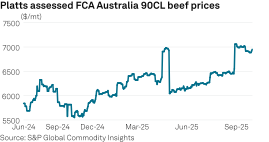
Platts assessed 90CL beef FCA Australia at $6,951/mt on Sept. 30, up 0.46% from the previous session. The average monthly price for 90CL beef FCA Australia reached $6,964.03/mt in September, the highest since April and up 6.8% from the previous month.

Editor: