Agriculture, Oilseeds
October 02, 2025
Trump-Xi trade talk hopes lift US soybean prices amid harvest pressure

HIGHLIGHTS
US soybean markets rally on Trump's trade optimism
Export pace falls 23% as storage constraints emerge
Crush margins under pressure as feed demand shifts
US soybean markets surged on Oct. 1 after President Trump indicated that soybean trade would be a focus of his October meeting with Chinese President Xi Jinping, as the industry faces its most significant demand disruption in decades with no Chinese bookings from the current crop year.
Trump's Truth Social post on Oct. 1, acknowledging that China is avoiding US soybean purchases "for negotiating reasons only," provided temporary price support, with November Chicago Board of Trade futures rising 1.8% to break a two-day losing streak.
Soybean futures rose over $10.15/bu on Oct. 1, rebounding from earlier declines after President Trump announced on Truth Social. Soybeans saw late session buying, with contracts closing 10-12 cents/bu higher.
Platts SOYBEX FOB New Orleans for November shipment was assessed at $397.93/mt Oct. 1, up $4.13 from Sept. 30.

Export pace falls 23% as storage constraints emerge
The absence of Chinese demand has significantly changed US soybean export patterns during the important fall marketing season. USDA export inspection data shows total soybean shipments decreased by 23% compared to last year, with China making no purchases after typically accounting for 50%-60% of US exports.
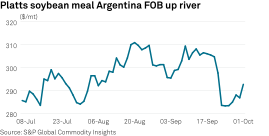
"The US will lose from 5 million to 6 million mt in sales" to Argentina's temporary export tax suspension, according to FOB Gulf market sources. China reportedly booked 20-30 Argentine soybean cargoes following Buenos Aires's Sept. 22 tax holiday, directly competing with US new-crop supplies.

Local basis levels have declined as the country's elevators cut purchase volumes, leading to wider spreads between cash and futures prices.
Basis levels indicate the worsening export outlook, as elevators lower bids amid storage capacity concerns.
Country elevators across the Midwest report increased selectivity in corn and soybean purchases as on-farm storage quickly fills up.
Competition intensifies during US harvest
Argentina's brief elimination of grain export taxes immediately increased competition for US origins.
Chinese buyers secured about 1.2 million metric tons of Argentine soybeans before Buenos Aires reimposed duties after reaching $7 billion in export commitments within 72 hours.
The timing proved particularly damaging for US market share, as it coincided with peak US harvest season when farmers usually secure export contracts.
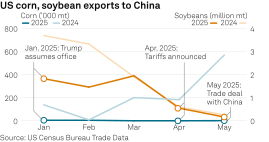
Brazilian soybeans, despite trading at a premium to US Gulf prices, continue to attract Chinese demand due to their higher protein content, which makes them suitable for immediate crushing operations.
Jack Larimer, senior soybean analyst at S&P Global Energy, forecasts Chinese demand for US soybeans to be only 10.5 million mt during the 2025-26 marketing year—less than half of the 23 million mt purchased in 2024-25.
Crush margins under pressure as feed demand shifts
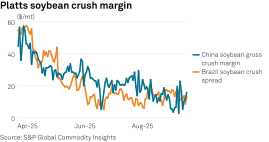
Domestic crushing operations face margin compression as export alternatives diminish.
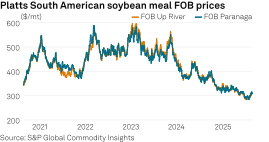
Soybean meal futures have declined along with bean prices, as processors increasingly depend on domestic livestock demand rather than export meal sales to China.
The disruption goes beyond just immediate price effects. Corn farmers noticed spillover effects as grain elevators focused on storing crops with existing export channels, causing localized basis differences across the Corn Belt.
"We're in the middle of the worst economic downturn," said a member of Nebraska Farmers Union, highlighting the broader agricultural sector stress beyond soybeans.
Forward contracting patterns signal long-term concerns
Grain merchandisers report that farmers are becoming more hesitant to commit 2026 crop acres to soybeans without clearer export demand visibility.
Forward basis bids for 2026 delivery remain historically weak, reflecting uncertainty about when Chinese trade will resume.
The marketing disruption especially affects producers who increased soybean acreage to fulfil earlier Chinese demand projections.
USDA projects 2025 soybean production at 117 million mt, requiring robust export demand to avoid significant carryover accumulation.
Policy response framework taking shape
Agriculture Secretary Brooke Rollins has said that farmer support measures are "in conversations" across government agencies, though specific details remain undisclosed.
Previous trade-disruption assistance programs distributed by USDA amounted to approximately $28 billion to farmers during 2018-2019, primarily through Market Facilitation Program payments.
Technical outlook suggests continued pressure
Market experts noted that November soybean futures remained below key resistance levels despite the rally on Oct. 1.
Without a recovery in Chinese demand, fundamentals suggest continued basis weakness through the remainder of the harvest season.
Weather forecasts indicate favorable conditions for harvest completion across major producing regions, potentially increasing storage facility pressure if export demand does not materialize.
Trade negotiation critical for 2026 plantings
The scheduled Trump-Xi meeting during the APEC forum in South Korea represents the industry's main hope for demand recovery before 2026 planting decisions.
Seed companies report that farmers are already requesting flexibility in soybean variety commitments pending trade resolution.
A statement from the Chinese Commerce Ministry showed a willingness to resume purchases if US tariffs are reduced, although specific timelines and volume commitments are still unclear.
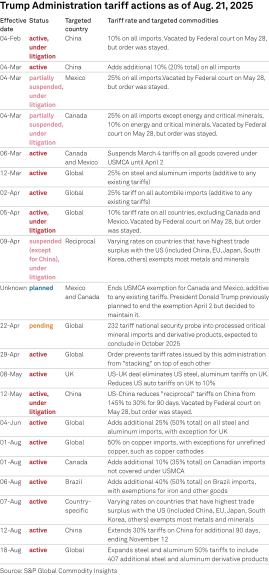
Current 34% Chinese tariffs on US soybeans effectively price American supplies out of the competitive range despite underlying basis advantages.
The agricultural industry considers the October diplomatic engagement potentially crucial for the long-term competitiveness of US soybean exports, with market participants closely monitoring both political developments and South American crop conditions as key factors influencing the 2025-26 marketing year.
Platts, part of S&P Global Energy, assessed the SOYBEX FOB Santos soybean contract for November loading at $436.90/mt on Oct. 1, $2.85/mt lower from the previous assessment.
Platts assessed China soybean gross crush margin at $15.85/mt on Oct.1 up $4.41/mt day over day.

Editor: