Agriculture, Meat, Livestock
October 02, 2025
INTERVIEW: Australia poised for record beef output despite rising competition
By Nuo geng Chen and Yuh nien Chow
HIGHLIGHTS
Growing Malaysian consumption an opportunity
Australia to see record output, exports, slaughter rates: MLA
INTERVIEW: Australia poised for record beef output despite rising competition
Australia's red meat industry is fortifying its position as a leading beef supplier to Southeast Asia while addressing competitive challenges, a senior official at trade body Meat & Livestock Australia, or MLA, told Platts.
The country is projected to see record production, exports and slaughter rates in 2025, the MLA data showed.
The slaughter rate in Australia is expected to reach 9 million head this year, said Valeska V, regional manager of the Southeast Asia market for MLA, on the sidelines of the Taste the Wonders of Australia event on Sept. 30.
A key highlight of Australian products is the commitment to traceability and transparency throughout the entire supply chain, ensuring that it can deliver clean, safe and environmentally friendly products to the global market, said Valeska.
Australia is looking to foster its partnership with Malaysia, where meat and protein consumption are rising, she said.
Malaysia imported nearly 38% more Australian beef from a year ago at 1,327 mt in August, making it the 13th-largest exporting market for Australia, according to the Department of Agriculture, Fisheries and Forestry data. The international market for Australian beef has strengthened, with shipments also going to China and the US.
The US purchased 35,343 mt of Australian beef in June, down 0.6% from a year ago, while Chinese imports rose 47% to 22,323 mt over the same period.
Rising competition in Southeast Asia
Indonesia recently approved new Brazilian slaughterhouses for imports, which, Valeska said, pose competitive challenges for Australia.
Brazil has been actively pursuing increased access to Indonesia and Southeast Asia. After Brazil was declared free of foot and mouth disease, 17 new plants were approved for export to Indonesia.
Additionally, US tariffs of 76.4% on Brazilian beef—which includes the 40% levy imposed in July on top of 26.4% on out-of-quota imports and the additional 10% tariff in May—have altered the trade landscape, prompting a shift of more Brazilian beef entering Southeast Asia.
Australian beef is highly regulated, targeting modern food service and trade sectors, Valeska said. Comparatively, Brazilian beef and Indian buffalo meat compete on price, focusing on cheaper protein options and local wet market products, she said.
"We aim to maintain and strengthen our position in the premium segment rather than competing in the segment of the commoditized market," she said.
Valeska highlighted that the industry has invested across the supply chain to ensure its proteins are traceable, sustainable and safe for consumption.
She said consumers had a knowledge gap about the origins of meat. Despite customers' strong preference for Australian beef, Valeska observed that many consumers struggle to differentiate between buffalo and beef meat.
Stable outlook
Weather conditions in the short- and medium-term are favorable for Northern Australia, she said. While parts of Southern Australia are experiencing dryness, the approach of spring suggests a potential turnaround. Overall, MLA expects weather patterns to remain stable, Valeska added.
MLA expects that supply and demand factors, in addition to weather conditions, would have a significant bearing on the outlook ahead, Valeska said.
Additionally, the carcass weight of beef has been steadily increasing, with the current weight of cattle at about 304-305 kg, up 30 kg from 10-20 years ago, Valeska said.
Australia's feedlot capacity is 1.7 million head and is more than 90% full.
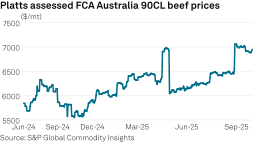
Platts assessed 90CL beef FCA Australia at $6,951/mt on Sept. 30, up 0.46% from the previous session. The average monthly price for 90CL beef FCA Australia reached $6,964.03/mt in September, the highest since April and up 6.8% from the previous month, according to S&P Global Energy data.
(The story has been corrected to clarify comments on outlook)

Editor: